ScienceNot yet confirmed elsewhere1 publisher2 min readPublished
Dracula ant workers reach peak brain size while still pupae
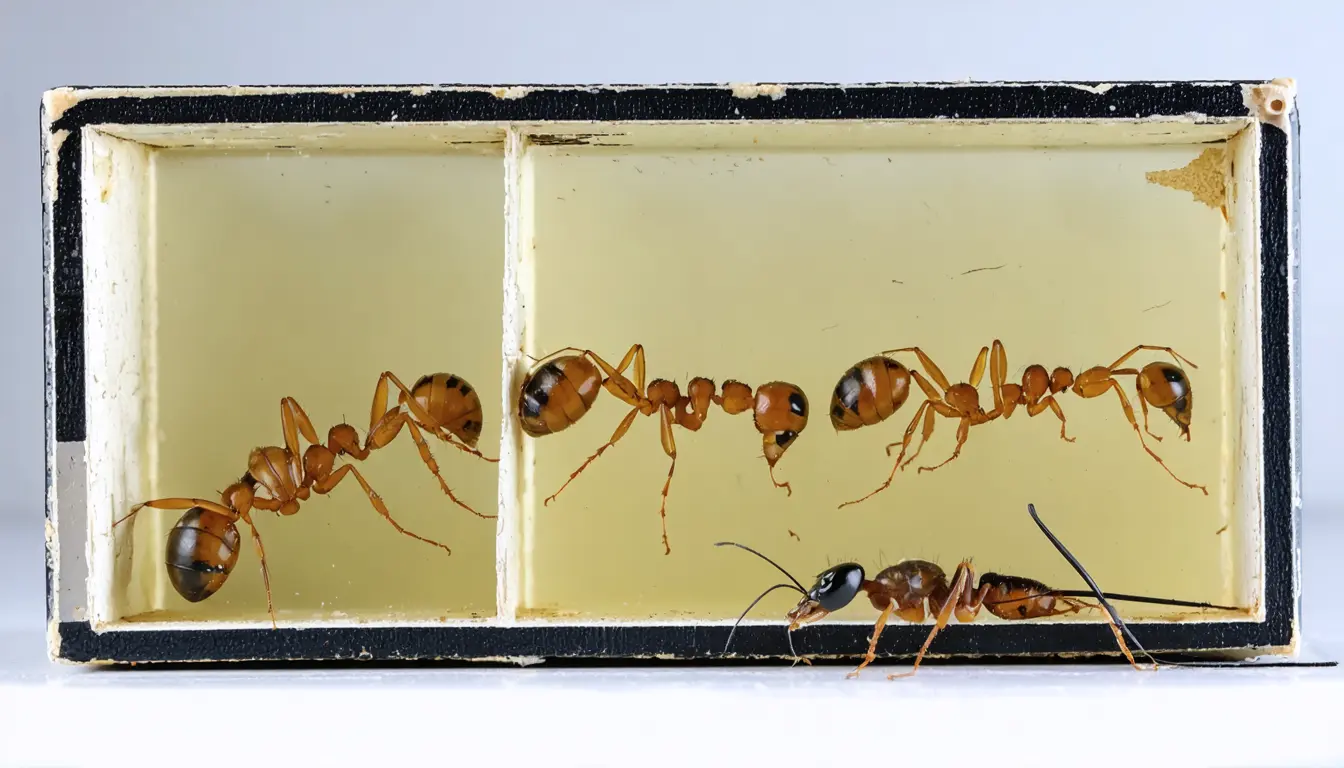
Boston University researchers found that Dracula ant workers' brains, and most of their brain regions, peak in size during the pupal stage. They tie that timing to the way workers of this species hunt from their first day as adults.
The Scientist · Science desk
What happened
- James Traniello, now a biology professor at Boston University, first reported the species' age-independent work habits in a 1978 Science paper.
- The team collected Stigmatomma pallipes in forests within several miles of Boston and stained dissected brains for synapsin, a protein found in synapses.
- Brains were sampled at four stages: white pupae, darker pupae close to emergence, young adult workers and mature workers.
- Brain size stayed relatively stable through adulthood, but the density of synaptic clusters differed between young and mature workers.
Why it matters
- constraint Comparing different ants at four stages of one species shows that brain growth ends before hunting begins; it cannot show that the pupal growth is what makes day-one hunting possible.
- decision Brain studies of other early-foraging ants will need to measure synapse density as well as region volume, because in this species the wiring kept changing after volume had levelled off.
- precedent With at least five other ant species reported to forage soon after emerging, the explanation makes a checkable prediction: their worker brains should also peak inside the pupa.
In many ant species a new adult's first job is indoors: it tends the brood before it ever forages outside [4]. Frank Azorsa, the paper's first author, told Phys.org that in social insects this progression is "a transition accompanied by changes in neuroanatomy" [18][17]. Stigmatomma pallipes workers do both jobs at once. They sting and paralyze centipedes and carry them back to the nest to feed the larvae directly [7]. "Foraging and nursing tasks are thus coupled in this ant," Azorsa said [8]. Colonies live underground and hold fewer than 20 workers [9].
The young workers are the comparison that matters most in this design. The only visible difference from older workers is slightly paler legs and gaster [19]. "Behaviorally, they are equivalent to mature workers and perform all tasks," Azorsa said [13]. If brain regions were still growing in that group, growth would overlap with the start of hunting, and the pupal stage would explain little. The measurements instead put the peak before emergence for the whole brain and most specialized regions, with size relatively stable across adulthood [2][14].
The volumes came from three-dimensional confocal images, which a laser builds up from thin slices at different depths, and were measured in AMIRA software [11]. The software also measured the density of clusters of connections between nerve cells [11]. That second measure differed between young and mature workers even though volume held steady. The researchers take this as a sign that connections keep reorganizing after adulthood begins [14].
The thing this doesn't tell you is the size of the effect. The Phys.org account does not give the number of brains imaged, the volume differences between stages, or the answer to the team's second question: whether the time a species takes to develop predicts how ready its workers are when they emerge [15]. The researchers report that S. pallipes brain development differs from that of altricial species, whose workers emerge less ready to hunt and forage [16][15].
We think the timing result is a sound description of when this ant's brain grows. It is also a plausible account of day-one hunting in a species where hunting is how the brood gets fed. S. pallipes also has social and ecological traits thought to resemble those of early ants [6]. That makes it a reasonable species to start with in asking whether a brain that peaks in the pupa is the older pattern in ants.
What to watch
- Sample sizes and stage-by-stage volume differences in the full Proceedings of the Royal Society B paper, which determine how strong the pupal-peak result is.
- The outcome of the team's cross-species comparison of development time against whether workers emerge ready to forage.
- Whether altricial ant species measured with the same staining and volume methods show brain growth continuing after workers emerge.
Clarity's read
What the record supports and how the coverage leans. The claims behind it follow.
Reality
- Evidence45
- Adoption
- Insufficient
- Hype gap+5
- Incentives
- Insufficient
- Confidence50
Claim ledger
Ranked by verification strength, evidence, and original report placement.
- [1]
Researchers at Boston University studied how brain development in Stigmatomma pallipes (Dracula ant) workers contributes to early readiness for work; findings published in Proceedings of the Royal Society B suggest brain regions reach their largest size during the pupal stage.
- [2]
The workers' brains as a whole and most of their specialized brain regions reached their maximum size during the pupal stage, before the ants emerged as adults.
- [3]
The age-independent behavior of these ants was first reported in a 1978 Science paper by James Traniello, now a professor of biology at Boston University.
- [4]
In many ant societies, young adult workers typically care for developing young inside the nest before beginning to forage outside it.
- [5]
Precocial behavior, the ability to forage soon after emerging as an adult, is reported in at least six species of ants.
- [6]
S. pallipes exhibits social and ecological traits thought to resemble those of early ants.
- [7]
According to Azorsa, S. pallipes workers sting and paralyze centipedes, which are brought to the nest to directly provision larvae.
- [8]
"Foraging and nursing tasks are thus coupled in this ant." - Frank Azorsa
- [9]
S. pallipes has small subterranean colonies of fewer than 20 workers.
- [10]
The ants were collected in forested areas within several miles of Boston, Massachusetts; dissected brains were stained for synapsin, a protein found in synapses.
- [11]
Researchers captured 3D images of the brains with confocal microscopy, which uses a laser to image thin slices at different depths, and used AMIRA software to measure the volumes of brain regions and the density of clusters of connections between nerve cells.
- [12]
Sampling included workers at four stages: pupal stage 1 (white), pupal stage 2 (light brown to brown-black, approaching eclosion), young workers and mature workers.
- [13]
"Behaviorally, they are equivalent to mature workers and perform all tasks." - Frank Azorsa, on young workers
- [14]
Brain size stayed relatively stable during adulthood, but the density of clusters of connections between nerve cells differed between young and mature workers, indicating connections continued to reorganize after adulthood began.
- [15]
The researchers also investigated whether the time different ant species take to develop was associated with workers emerging less ready to hunt and forage (altricial) or already capable (precocial).
- [16]
The brain development of S. pallipes was found to differ from that of altricial ant species.
- [17]
"a transition accompanied by changes in neuroanatomy" - Frank Azorsa, describing how social insect workers typically progress from nursing to foraging as they age
- [18]
Frank Azorsa is the first author of the paper and spoke to Phys.org.
- [19]
Young workers differ from older workers only in slightly lighter pigmentation of their legs and gaster.
- [20]
At least five ant species other than S. pallipes are reported to show precocial foraging.
Sources
1 independent publisher whose own reporting we read for this story.
- phys.orgWhy some young ants start hunting and caring for others early
1 article · October 10, 2026
Topics and entities
Follow any of these and your For You feed starts watching them — no settings page required.