Science1 publisher2 min readPublished
Zhejiang-Leeds feedback loop guides 24 chaotic qubits toward a repeating pattern
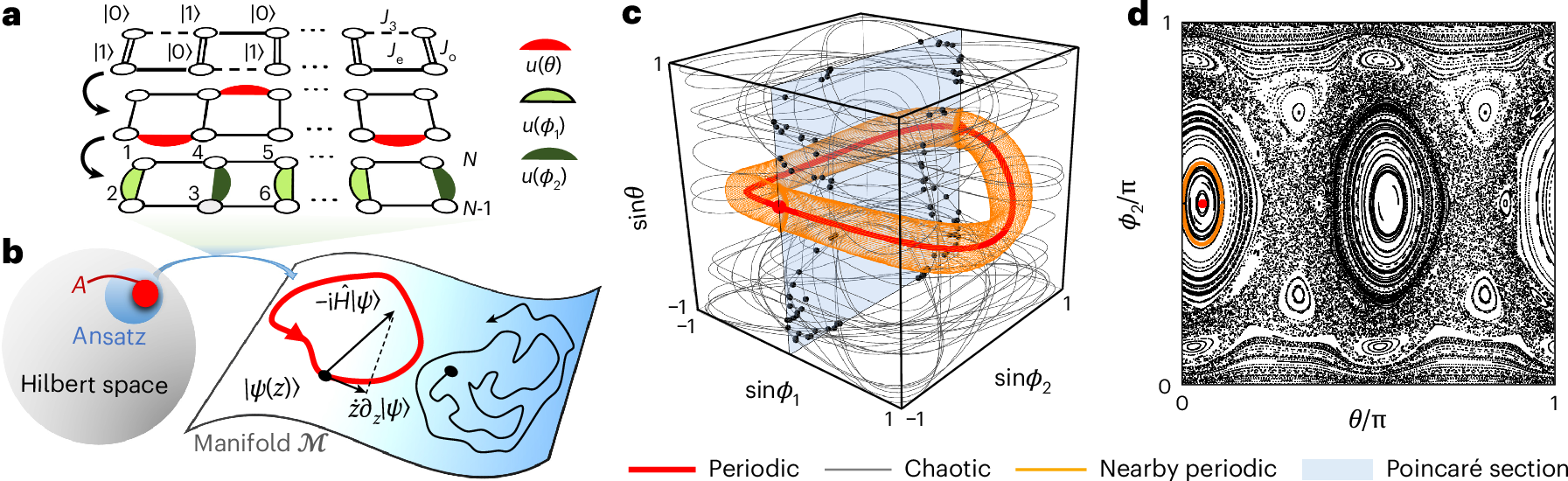
Zhejiang and Leeds physicists report in Nature Physics a feedback loop that steered 24 qubits from irregular motion into a repeating pattern. The loop finds that regular motion without being told what it looks like. That makes the quantum processor part of the search for order inside chaos.
The Scientist · Science desk
Drafted by a language model from the sources cited here and checked against its claim ledger before publication. How we use AISend a correction
What happened
- The experiment used a 24-qubit ladder selected from a superconducting processor of more than 100 qubits, working in a repeated loop with an ordinary computer.
- Each round needs only a short stretch of quantum evolution and simple measurements of individual qubits, and the method can run on current processors.
- The protocol drew on ScarFinder, an algorithm for finding the recurring motion of quantum many-body scars that was introduced in an earlier PRX Quantum paper.
- Papić said the tensor-network expertise of his postdocs Jie Ren and Andrew Hallam was crucial to developing the approach.
Compiled by The ScientistSomething wrong?How this is made
Why it matters
- constraint Because the classical step fits a relatively simple state every round, the loop can settle only on regular motion that a compact description captures. Strongly entangled recurrences would sit outside its reach.
- cost Every round adds a classical fitting step to the quantum run. The time and compute a search needs are split between the processor and the ordinary computer.
- precedent With short runs and single-qubit readouts per round, the search can be repeated on other existing superconducting chips. Other groups can then test whether islands of regular motion show up in their systems.
In some classical systems, orderly and chaotic paths occupy separate regions of an effective phase space, the map physicists build to describe how a system moves [2]. Whether quantum many-body systems share that layout has been hard to settle. Part of the difficulty is entanglement: once the components interact, their combined state cannot be fully described by treating each one on its own [3]. The Zhejiang-Leeds group went looking for "islands" of regular motion in a "sea" of quantum chaos [4].
Zlatko Papić, the paper's senior author, gave Phys.org the default expectation. "Normally, such systems rapidly lose memory of how they started," he said. "Understanding when and how they resist this fate is one of the difficult questions we have been exploring." [5]
Exceptions were already on record, some of them from this collaboration. On a 30-qubit superconducting processor, the team had found starting states that kept returning to a recognizable pattern, the behaviour known as quantum scars [13]. "In our first joint paper on quantum scars, published in Nature Physics, we demonstrated this unusual phenomenon on a superconducting quantum processor: a specially prepared system repeatedly returned close to its starting configuration," Papić said [6].
That result set up the new paper. "That work led us to ask whether these unusual motions could be part of a much richer landscape, and whether a quantum processor could take an active role in discovering it," he said [14]. Papić described one pass of the search. The team prepares the quantum system, lets it evolve briefly and collects measurements. The ordinary computer uses those measurements to find a relatively simple quantum state that closely matches the result, and that updated state is prepared on the processor before the cycle repeats [8]. Hang Dong led the implementation on the Zhejiang hardware [15].
I think the advance is the search procedure. The ladder is six qubits smaller than the system in the earlier scar demonstration [2], and it uses under a quarter of the processor it was taken from [1].
A loop that converges once, on one ladder, answers the second half of Papić's question. Mapping the "richer landscape" in the first half takes many such searches. The account of the work published so far does not report how many rounds the loop needed or how long the repeating motion held on the hardware.
What to watch
- Figures in the paper for how many feedback rounds the loop needed and how long the repeating pattern held on the hardware.
- Runs on larger sections of the 100-plus-qubit processor, to see whether the loop finds more than one island as the system grows.
- Whether the search turns up regular motion distinct from the scars already known. That would bear on Papić's 'richer landscape' question.