Science1 publisherNot yet confirmed elsewhere2 min readPublished
New wavepacket algorithm brings a simplified particle collision onto a 104-qubit IBM processor
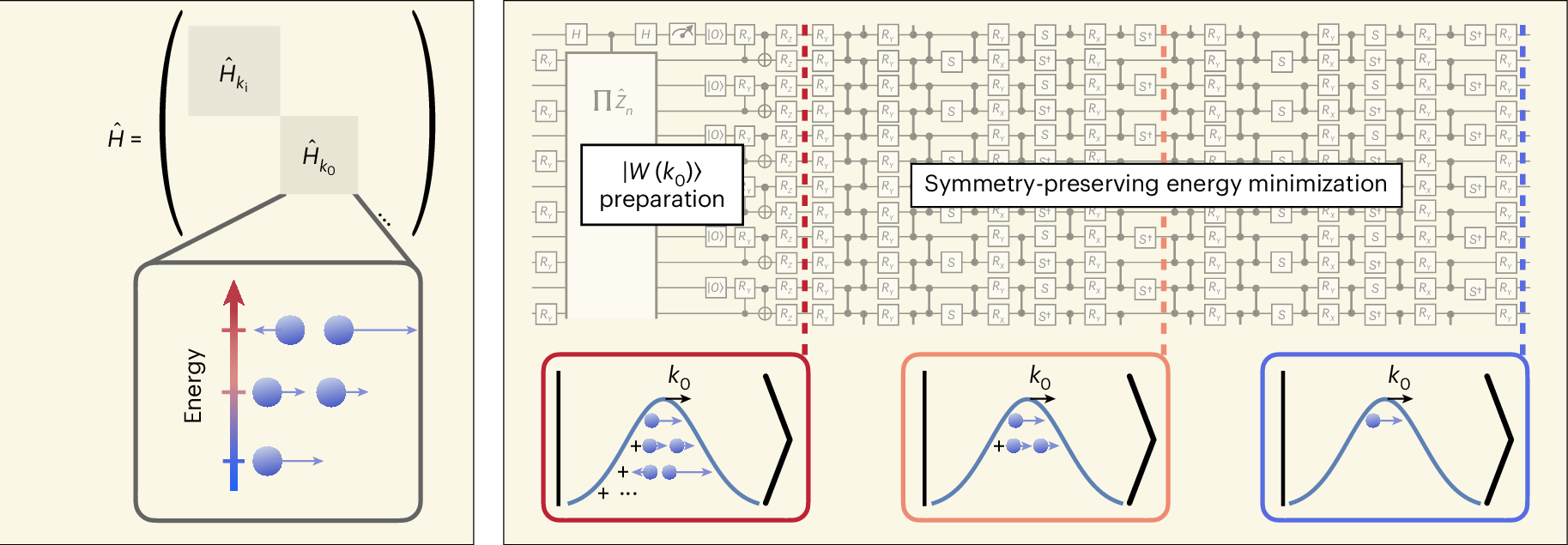
Caltech and University of Washington physicists simulated a particle collision on a 104-qubit IBM chip using a more efficient way to prepare wavepackets. The test used a simplified one-dimensional theory, so it shows the preparation step that had blocked such runs now fits on current hardware for toy models.
The Scientist · Science desk
Drafted by a language model from the sources cited here and checked against its claim ledger before publication. How we use AISend a correction
What happened
- The work appears in Nature Physics, with Roland C. Farrell as first author and Nikita A. Zemlevskiy as a co-author.
- After preparing two wavepackets, the team applied gates approximating Hamiltonian evolution so the particles moved together, interacted and formed a post-collision state.
- In low-energy runs on IBM's machine the two light particles moved apart with nothing new made, while higher-energy runs could turn one light particle into a heavy one.
- The team read the heavy particle's appearance from a rise in the skewness of the measured energy density after high-energy collisions.
Compiled by The ScientistSomething wrong?How this is made
Why it matters
- capability Researchers can now start collision simulations in simple field theories from properly prepared wavepackets on existing processors, a starting point Farrell said earlier methods could not reach on current hardware.
- constraint The jump from one-dimensional Ising field theory to the LHC-style predictions Farrell wants is untested, so collider applications remain a stated goal for now.
- precedent Since the authors say the preparation method could extend to other quantum many-body systems, other simulation groups have a candidate recipe for building entangled initial states.
"The first step in such a quantum simulation is to prepare the initial state: two high-energy particles (wavepackets) moving toward each other," Roland C. Farrell, the paper's first author, said. "Existing approaches made this infeasible on current hardware, so we needed to develop a more efficient quantum algorithm." [3][9] He traces the difficulty to entanglement. "Wavepackets have long-range entanglement which previously required many layers of quantum gates to build," Farrell said [8].
The Phys.org account breaks off before he explains how the new algorithm avoids those layers. It also does not report gate counts, circuit depth, error rates, or how large the measured signal was against hardware noise on the 104-qubit machine [2].
The experiment does have a built-in comparison [6]. A low-energy collision should make nothing new, and in that case, Zemlevskiy said, "the outgoing energy density has two bumps, one for each particle" [11]. At higher energy, he said, the process "can convert one of the light particles into a heavy particle, which generates additional bumps in the energy density" [11].
The heavy particle is inferred from the shape of that energy profile [7]. With one shape statistic compared across two collision energies, Zemlevskiy pitched the claim at the right strength: he called the rise in skewness "evidence that a heavy particle was created" [7].
The main limit is scale, because the run used a simplified model. One-dimensional Ising field theory is a simplified model of particle interactions [4]. Farrell's stated aim is much larger. "In the future, we would like to be able to predict what happens shortly after particles are smashed together in particle colliders like the LHC," he told Phys.org [12]. His case for quantum hardware is that simulating these collisions "is widely considered to be intractable using a classical computer but is believed to be efficient on a quantum computer" [13]. That case is about the full problem. The 104-qubit run shows its first step working in a far simpler theory [2][4].
I think the result holds up on its own terms, though moving the algorithm into the richer theories behind collider physics is a separate test. For this model, the preparation step Farrell described as infeasible with existing approaches now runs on an IBM processor [3][6]. The team also reported evidence of what it set out to observe: collision energy turning into the mass of a new particle in real time, the relation written as E = mc^2 [10][7].
The authors say the preparation method could also be used to simulate a wider range of quantum many-body systems, meaning systems made of many interacting quantum components [14].
What to watch
- Circuit depths and error figures in the Nature Physics paper, showing how much gate budget the new preparation leaves for longer post-collision evolution.
- A run of the same preparation algorithm in a theory richer than one-dimensional Ising field theory.
- Whether classical calculations of the same 104-qubit collision reproduce the skewness rise measured on IBM's hardware.