Security1 publisherNot yet confirmed elsewhere2 min readPublished
Cisco's prototype controller lets applications order quantum entanglement on demand
Cisco's prototype controller schedules quantum entanglement on request, for networks where 1,000 nodes wired point to point need nearly 500,000 links. Software scheduling is Cisco's route to quantum networks larger than a handful of nodes, and the controller doing it is still a research prototype.
The Watch · Security desk
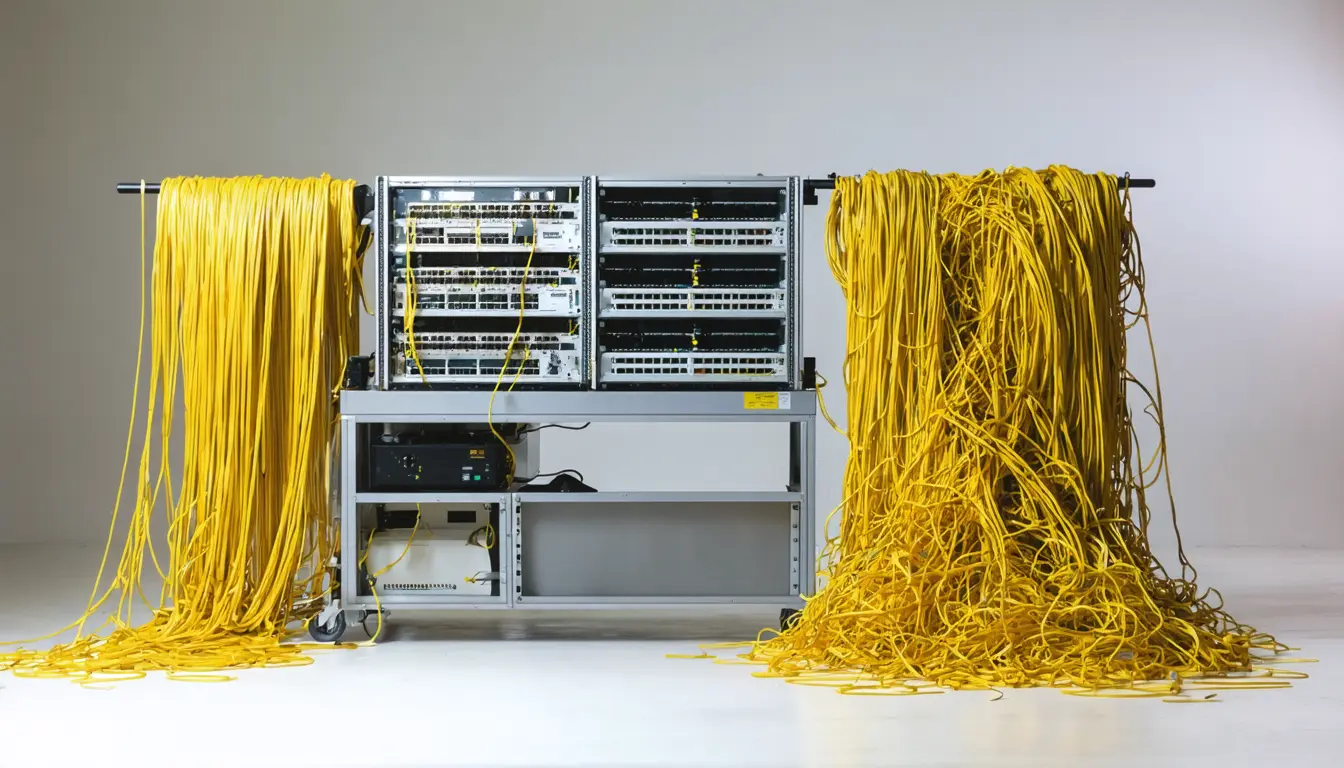
What happened
- Applications state the endpoints, rate, fidelity and timing they need and the Controller works out delivery, a model Cisco calls Entanglement-as-a-Service.
- The Controller is the scheduling software for Cisco's Universal Quantum Switch, a research prototype introduced earlier this year to replace point-to-point links with one shared fabric.
- Cisco's updated Network-Aware Quantum Compiler, the first native application, splits a program across processors and hands the Controller its entanglement request.
- Hardware from Brooklyn-based Qunnect and Swabian Instruments plugs in under the Controller's hardware abstraction layer.
Compiled by The WatchSomething wrong?How this is made
Why it matters
- constraint Anyone weighing Cisco's claim that the Controller lets networks scale is weighing a design, because the only field evidence on record was gathered before the Controller was introduced.
- exposure First-party and third-party applications share one interface, so the Controller's request handling decides who gets entanglement; the published account does not describe how requests are authenticated or prioritized.
- capability Gear in each device category plugs in the same way, so an operator could mix different vendors' sources, switches and detectors without per-vendor integration work.
Single quantum processors still hold fewer qubits than the work requires, so capacity has to come from linking machines [3]. Those links have been built point to point, and that has kept quantum networks to a handful of nodes, according to Help Net Security [4]. The link count grows with roughly the square of the node count. A thousand nodes wired point to point need close to 500,000 dedicated links [6]. The exact figure is 1,000 times 999, halved: 499,500 [21].
A shared fabric cuts the wiring but leaves the scheduling. Someone has to decide who gets entanglement, at what quality, in what order and on what timing, and in a bigger network that job is too large to run by hand [5]. Today operators set up the hardware that produces entanglement device by device, link by link [2].
The Controller has to run that job without seeing the traffic. Any read of a quantum state wipes out the information in it, so the Controller has no way to inspect traffic as a classical monitoring tool would [10]. It measures link quality statistically and applies predefined tuning, retries or reinitialization when performance drifts [11]. It keeps checking a link while an application uses it and reclaims the hardware when the job ends [12].
"Nobody has to keep a hand on every part anymore; we can now treat the quantum network as a system that delivers a service," wrote Vijoy Pandey, senior vice president of Outshift by Cisco [20]. A person still sits at the end of the chain. The Controller escalates to one when its self-correction fails [11].
The scaling claim has one field run behind it, and that run predates the Controller. In February 2026, Cisco software working with partner hardware directed entanglement distribution and swapping across multiple nodes on 17.6 kilometers of commercial telecom fiber already installed in New York City [13]. Polarization fidelity, roughly how closely delivered states matched the intended ones, came in above 99 percent at room temperature [14]. Help Net Security reports the run took place eight months before the Controller was introduced [15].
Both the Controller and the Universal Quantum Switch it schedules are research prototypes [1][7]. Quantum Alert, the security application in the stack, is designed to request entanglement through the same interface as the compiler [18].
What to watch
- A field run of the Controller itself scheduling competing requests across more than a handful of nodes, with fidelity figures.
- Details on how the Controller authenticates and ranks entanglement requests from first-party and third-party applications.
- Whether Quantum Alert moves from a design to a tested application on the shared request interface.