Product1 publisher2 min readPublished
China's HL-4 trades copper coils for 25-tesla superconducting magnets to keep plasma running
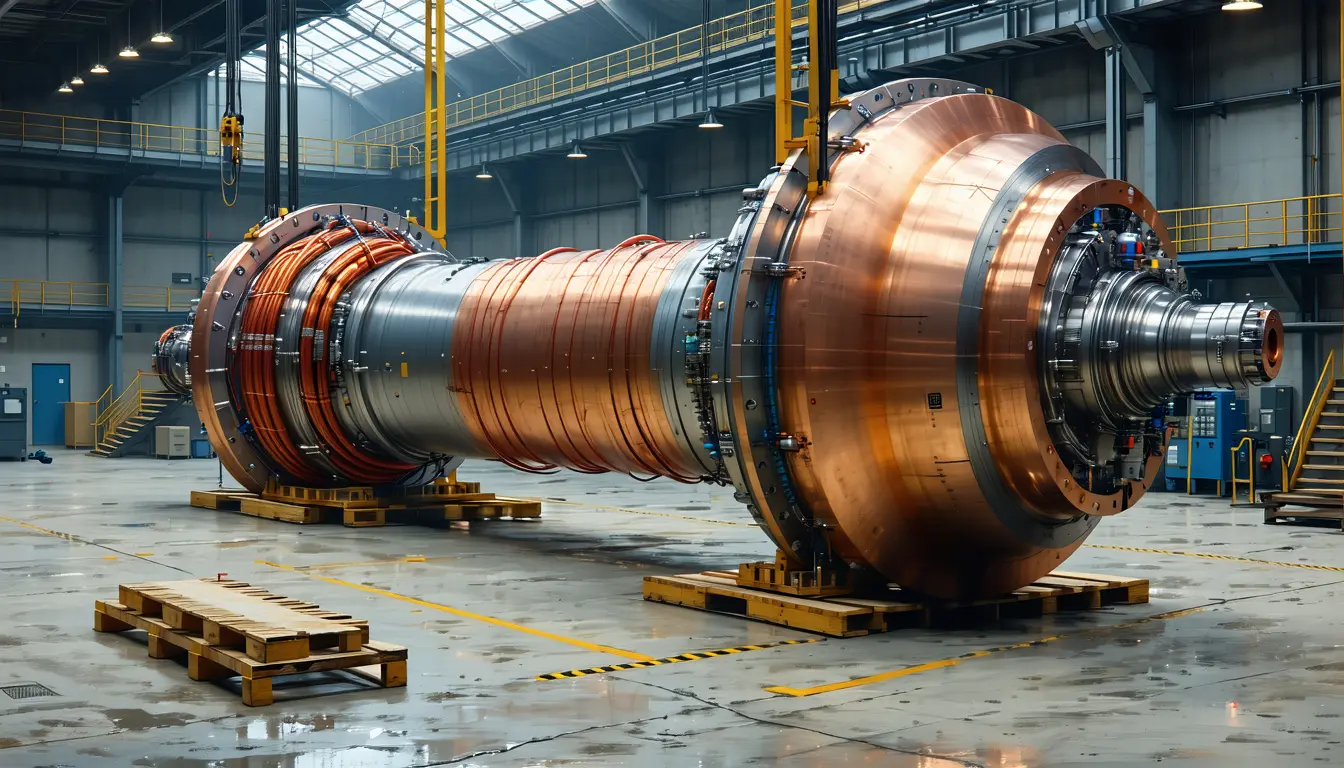
Chinese engineers have unveiled a tokamak billed as the first high-temperature superconducting steady-state burning platform. Its own stated first job is proving 25-tesla magnets survive fusion conditions.
The Product Desk · Product desk
What happened
- China showed the blueprint and concept art for the HL-4 tokamak at the Shanghai Fusion Energy Conference & Fusion Week 2026, a first public look at the next machine in the Huanliu series.
- The facility, now being built in Shanghai, is billed as the world's first high-temperature superconducting, high-field steady-state burning experimental platform.
- Its magnet system is fully high-temperature superconducting and is specified to generate a field of 25 tesla.
- The existing HL-3 already reproduces the core physics of a burning reactor, but its conventional copper coils overheat quickly, so that machine cannot run continuously.
- State broadcaster CGTN reported that by June next year the R&D team moves into a new 500-metre factory where full-scale magnet manufacturing and testing will begin.
Compiled by The Product DeskSomething wrong?How this is made
Why it matters
- constraint Nothing about plasma performance at HL-4 can be assessed until the coils pass full-scale manufacturing and testing, so the program's near-term output is magnet data.
- decision Anyone pricing Chinese fusion progress over the next year is scoring a factory opening and coil tests. The factory opening is the only dated commitment.
- capability A higher field in a smaller machine is cheaper to modify, so more design revisions fit into the same program before a demonstration reactor is committed.
- precedent On China Fusion Energy's own sequence, two stages sit between HL-4 and a commercial reactor.
China Fusion Energy describes HL-4 as a scaled-down engineering validation device, and its stated immediate target is proving that high-temperature superconducting magnets work reliably under complex fusion conditions [9].
Everything else in the design leans on those coils. China Fusion Energy's engineers list three advantages for the project: fully high-temperature superconducting magnets, AI-driven intelligent operation technology to manage reactor performance, and the chance to study plasma behaviour in conditions previously out of reach [7]. The high field is also what shrinks the machine, and the company says the smaller footprint speeds up the technical iteration cycle [5]. Crews on site are running preliminary process development to hold the construction schedule [13].
Chen Zhe, deputy director of the fusion engineering design department at China Fusion Energy, was specific about the order of things. "The next stage is the demonstration reactor," he said, and "Only after that do we move to the commercial reactor phase" [10]. The demonstration reactor is meant to prove commercially what HL-4 validates technically [14].
The institutional history behind this is long. The Southwestern Institute of Physics in Chengdu has led the design of the Huanliu series, HL-1 through HL-4, since the 1980s [11]. Huanliu translates as circulation, or toroidal flow [12]. From the 1980s to the 2026 unveiling is roughly four decades of design work in one series before the superconducting entry [16].
For anyone outside the program trying to score it, the useful sort is by which kind of number a disclosure contains. Magnet numbers: coils built at full scale, field reached, hours held at field, results from the new hall. Plasma numbers: temperature, duration, confinement, gain. The June milestone is set up to produce the first kind. No date for HL-4 completion, first plasma or steady-state operation has been announced [15].
The distinction matters because the two get pitched together. A platform billed as the world's first of its kind [3] and a rig built to check whether the coils hold [9] are the same building described at two levels of ambition.
What to watch
- Whether the 500-metre factory opens on the June schedule, and what field its first full-scale coils hold in test.
- Whether SWIP or China Fusion Energy publishes a target date for HL-4 completion or first plasma.
- Whether the AI-driven operation technology is described in enough detail to say what it controls.