Science1 publisher2 min readPublished
Orthogonally modulated lasers let one tuning fork report methane and acetylene at once
A Harbin Institute of Technology group modulated two lasers so that a single quartz tuning fork could report methane and acetylene at the same instant, with channel crosstalk held down by a phase angle. The hardware saving depends on scaling past two gases.
The Scientist · Science desk
What happened
- Researchers at the Harbin Institute of Technology in China built a gas sensor around light-induced thermoelastic spectroscopy, in which absorbed laser light warms gas molecules and sets a quartz tuning fork vibrating.
- They modulated two lasers so their signals sit orthogonal in signal space, letting a lock-in amplifier split one fork's output into an independent methane channel and an independent acetylene channel.
- Physics World identifies the outstanding test as whether the method stays stable outside controlled lab conditions and in more complex gas mixtures.
Compiled by The ScientistSomething wrong?How this is made
Why it matters
- capability A transformer monitor could time an acetylene rise against a methane rise on the same detector, which sequential scanning cannot do because each species is sampled at a different moment.
- constraint The hardware saving Physics World describes only arrives if phase slots can be packed beyond two without channels mixing, so claims about multi-gas instrument cost have to wait for a result past two gases.
- decision Anyone specifying this for field use is buying a phase-stability guarantee as much as a sensitivity figure, because the channel separation holds only while the two modulations stay orthogonal.
- exposure Sensitivity alone gives the approach no advantage, so its case rests entirely on the demodulation scheme holding up in real mixtures.
The separation depends on a phase angle. Physics World's account of the Harbin work says the unwanted mixing between the two channels stays very low when the two modulated signals are exactly orthogonal, and the team describes that separation using Lissajous figures, the patterns that appear when two vibrations combine [6][5]. Holding the angle is a calibration problem. If the relative phase of the two laser modulations drifts, the channels stop being orthogonal and methane begins to appear in the acetylene output [6].
The reported limits are 0.32 parts per million for methane and 0.29 ppm for acetylene, both after averaging, which Physics World calls good sensitivity but not record-breaking [7][8]. Those are the least interesting numbers here. The account does not give the averaging time, and averaging time is what decides whether a sub-ppm figure is usable in a leak alarm: a limit reached over several minutes describes a slower instrument than the same limit reached in a second. The two channels differ by about a tenth, since 0.32 divided by 0.29 is 1.10, so methane is the weaker of the pair [14].
Sensitive setups have generally needed one detector per gas, or they scan the gases in sequence, which means they cannot capture changes that happen at the same time [3]. What this design buys is simultaneity. That matters where the two gases mean different things about the same equipment: methane is a key sign of natural gas leakage, while acetylene can indicate a high-temperature fault such as arcing in transformer oil [11].
Whether this removes hardware is a separate question from whether it works. Physics World locates the significance in the method and not the detection limit, and says that if the phase-separation approach can be extended beyond two gases, future instruments might monitor several species with fewer detectors, fewer demodulation channels and less hardware complexity [9][10]. The demonstration covers two gases [4]. Each additional species would need its own phase slot, far enough from every other slot to keep mixing low, and how many slots fit is what the next experiment has to establish.
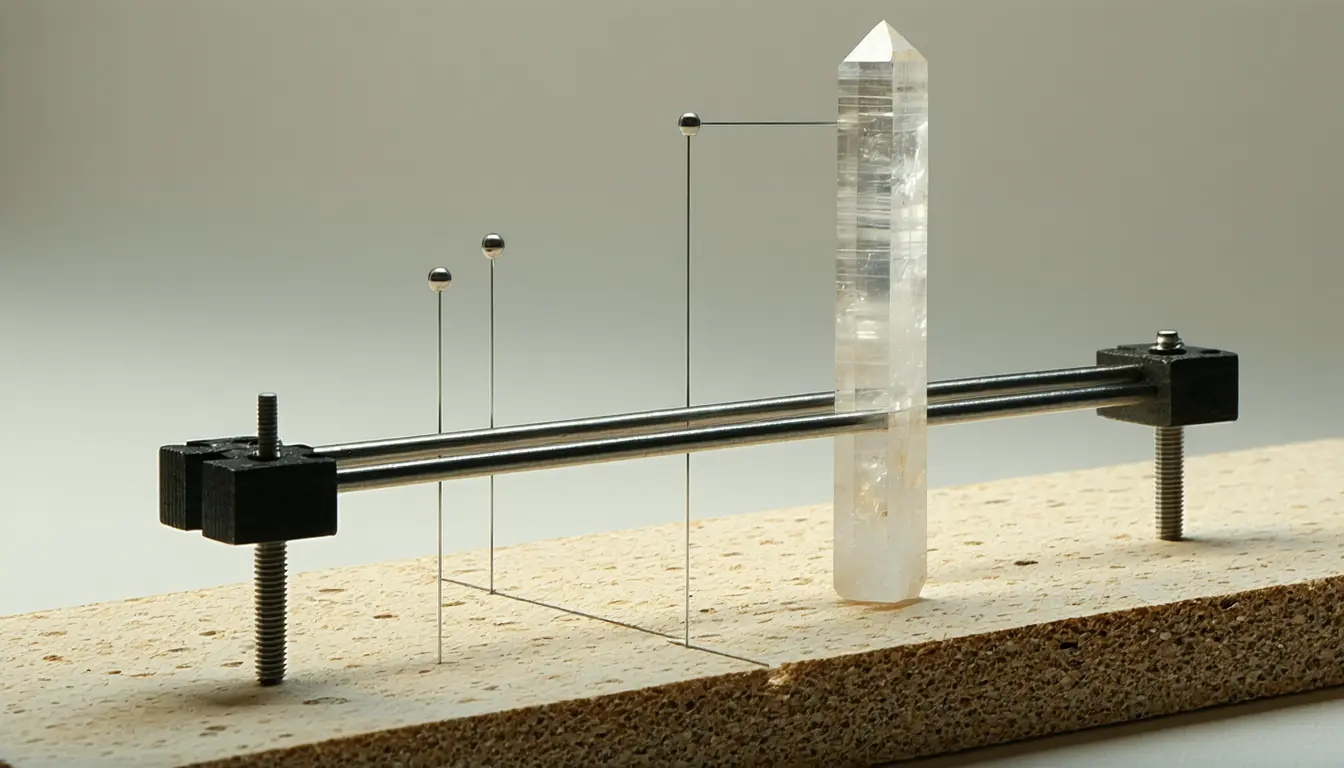
Gas molecules absorb modulated laser light and warm slightly, the warming drives tiny mechanical vibrations in the quartz tuning fork, and those vibrations are converted into an electrical signal [2]. That is light-induced thermoelastic spectroscopy, and what the Harbin group changed is the demodulation [1][4]. Physics World names the next step as showing the method stays stable outside controlled lab conditions and in more complex gas mixtures [12]. The paper is H. Ma et al, Reports on Progress in Physics 89 067902 [13].
What to watch
- A crosstalk figure measured in a complex gas mixture and outside the lab, which is the condition Physics World names as the next step.
- A three- or four-channel demonstration showing phase slots can be packed without mixing between them.
- Detection limits published alongside a response time, so a sub-ppm figure can be judged as an alarm specification.