Invest3 distinct publishers3 min readPublished Updated
Centcom's chief flew to a carrier with reported food, water and mental-health problems. The endurance limit, not the diplomacy, is what energy and shipping risk should be priced against.
The Investor · Invest desk

Compiled by The InvestorSomething wrong?How this is made
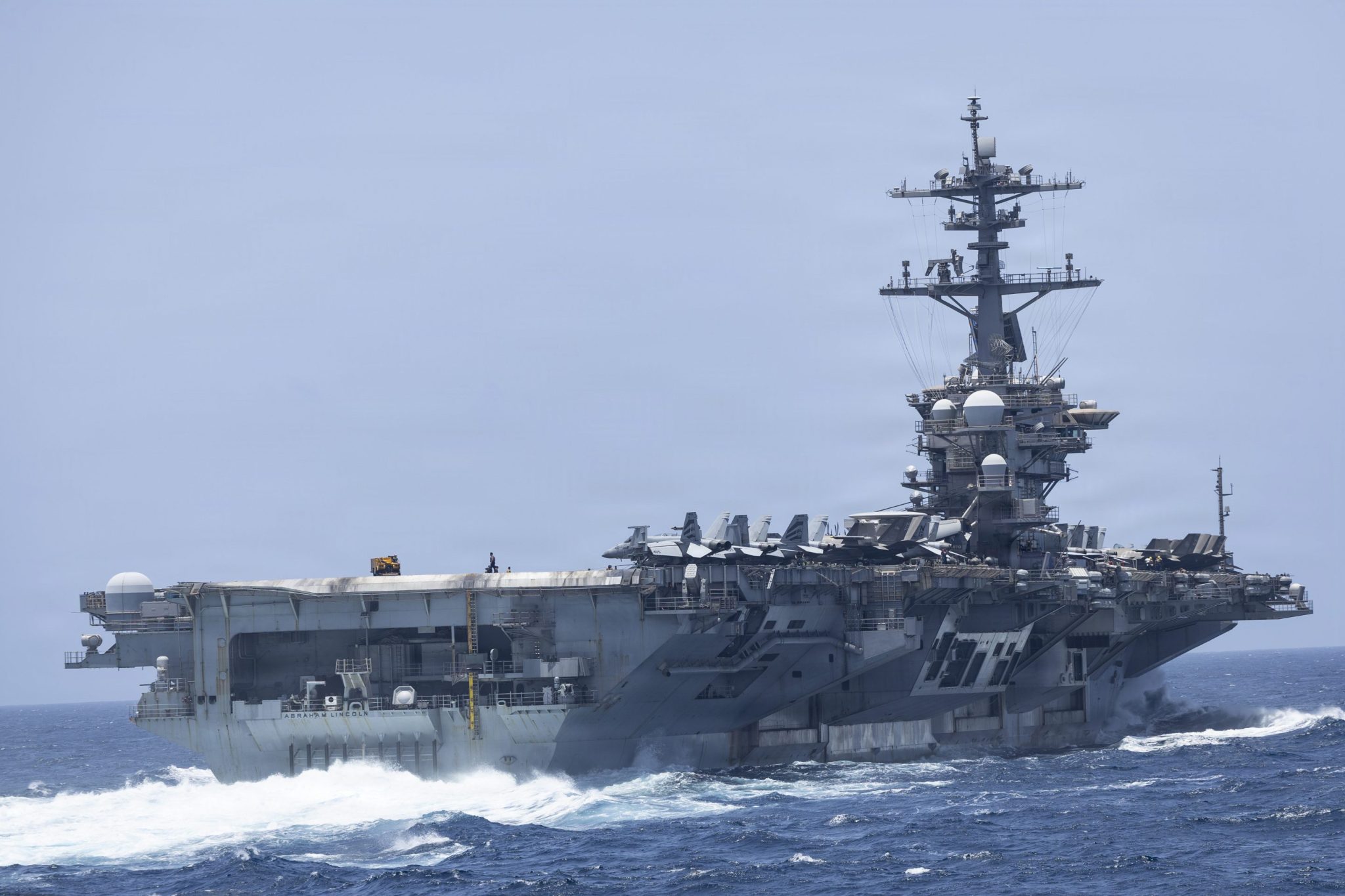
Adm. Brad Cooper, the top U.S. commander in the Middle East, went aboard the USS Abraham Lincoln in the Arabian Sea during a 10-day regional tour that ended Saturday, U.S. Central Command said [1]. He did it while family members were publicly describing food shortages, water contamination, mouldy showers and long wartime shifts on a ship that Centcom itself says has been at sea, uninterrupted, for more than 240 days [2][3]. That number is the first concrete evidence that the blockade of Iranian ports has a sustainment ceiling, and that the ceiling is measured in hulls and crews rather than in communiques.
The arithmetic is the story. The Lincoln arrived in the Middle East in January and has been supporting the U.S. war against Iran, including the blockade [4]. The war began on Feb. 28 with U.S. and Israeli strikes, and the Navy's blockade was a response to Iran asserting control over the Strait of Hormuz [5]. From Feb. 28 to the mid-August reporting date is roughly 170 days, which means about 70 of the carrier's 240-plus days at sea were already on the meter before the first shots [15]. Working back from mid-August, the run began around Dec. 19, 2025 [16]. The endurance being spent on this blockade was borrowed before the conflict started.
Carriers of this type can carry more than 5,000 sailors and Marines [7], and the reported conditions are not marginal. Family members quoted by the South China Morning Post said the situation had deteriorated so badly that some sailors attempted to throw themselves overboard [10]. That account is single-sourced and comes from families, not the Navy. The same report puts the run without a port call at more than 200 days [11], against Centcom's more-than-240-days-at-sea figure [3]; the two are not reconcilable from the material supplied.
Read the official language as a signal rather than a summary. Cooper said "history will record this deployment as one of the most operationally intense and consequential of the modern era" [8], called the visit "awe-inspiring," praised the crew's "resilience," and said mental health requires attention like physical and spiritual health [9]. Cryptobriefing's read is that the visit underscores continued U.S. commitment and that the deployment has been extended beyond typical durations for such operations [13]. Both things can be true: policy holds while practice thins.
For anyone pricing energy, that distinction matters more than the headline. About one-fifth of the world's traded oil and natural gas passed through Hormuz before the war [6]. According to Cryptobriefing, market pricing has moved to a lower probability of the U.S. announcing an end to the blockade by Aug. 31, and participants expect it to persist past the end of August [12]. That is a bet on announcements. It is not a bet on enforcement density, which is what a fatigued crew and a ship overdue for maintenance actually determine.
Meanwhile the diplomatic track is thin: U.S.-Iran talks have stalled, and Iran is discussing management of the strait with Oman, a waterway previously treated as international [14].
What to watch is physical, not verbal. A first port call for the Lincoln, or a relief hull appearing in the theatre, would be the tell that the Navy is trading enforcement continuity for crew recovery, and either would arrive before any policy change is announced. Cooper also met civilian and military leaders in Bahrain, Iraq, Israel, Jordan, Saudi Arabia and the United Arab Emirates [17]; basing and logistics access along that list is what determines whether the blockade can be sustained at lower cost. Watch statements from President Trump or Cooper on the blockade's future, and the Oman channel [18].
Ranked by verification strength, evidence, and original report placement.
Adm. Brad Cooper, the top U.S. military commander in the Middle East, visited the USS Lincoln in the Arabian Sea during a 10-day tour of the region that concluded on Saturday, U.S. Central Command said.
Cooper's visit to the carrier followed outrage among family members about reports of food shortages, water contamination, mouldy showers and long shifts in wartime aboard the vessel.
The Lincoln's deployment has included a record-setting uninterrupted time at sea of more than 240 days.
The Lincoln arrived in the Middle East in January and has been supporting the U.S. war against Iran, including the blockade on Iranian ports.
About one-fifth of the world's traded oil and natural gas passed through the Strait of Hormuz before the war started.
Cooper also went to Bahrain, Iraq, Israel, Jordan, Saudi Arabia and the United Arab Emirates to meet with civilian and military leaders, according to the Central Command statement.
Follow any of these and your For You feed starts watching them — no settings page required.
Evidence-backed comparisons of source perspectives and observed adoption signals. Read the methodology
Which Builder, Operator, and Investor concerns the observed source mix emphasized—not a truth score.
Evidence, demonstrated adoption, hype gap, incentives, and confidence are assessed independently, each on its own current evidence. How these are measured.
Solid on operational facts, thin on the alarming parts
The core operational record -- the visit and its itinerary, January arrival, 240-plus uninterrupted days at sea, Feb. 28 war start, Hormuz's pre-war share of traded oil and gas -- is attributed to a Central Command statement and carried consistently across publishers. The most consequential human claims are single-sourced and second-hand: the sanitation and supply allegations and the reported self-harm attempts come from family members via one outlet, with no Navy confirmation or denial anywhere in the cluster. The market claim carries no venue, price level or series. Two different endurance figures (240-plus days at sea versus 200-plus days without a port call) are also left unreconciled.
Blockade is materially in force, not prospective
This is not a proposal being assessed but an operation already running: a carrier strike group has been on station enforcing a blockade of Iranian ports since January, has passed 240 days uninterrupted at sea, and drew a personal visit from the theatre commander during a seven-stop regional tour. Market pricing reported by one source implies participants expect enforcement to continue past August. What is not measured anywhere is scale of effect -- no shipping volumes, cargo diversions or price impacts are given -- so the observed adoption is of the military posture itself rather than of any quantified economic consequence.
Rhetoric and inference run ahead of the disclosed record
Two kinds of overstatement sit on top of a factual base. Cooper's own framing -- 'one of the most operationally intense and consequential of the modern era', 'awe-inspiring', 'resilience' -- is superlative language offered by the party whose sustainment record is under scrutiny, published without independent assessment. Cryptobriefing then converts a single command visit into a directional signal about the blockade's duration and pairs it with an unquantified pricing claim. Against that, the welfare reporting is arguably understated rather than inflated: serious allegations are carried without official response, and the cluster's endurance-limit thesis is a derivation from published dates rather than a stated finding. Net modest positive.
Every voice in the cluster has a stake
The incentive structure is unusually legible. Central Command and Cooper are responding to public criticism of conditions aboard a ship they command, and their disclosed statements emphasise resilience, historic significance and attention to mental health rather than any operational shortfall. The family members sourcing the welfare allegations are advocating for relief for their relatives, which is a legitimate but interested position, and their accounts are relayed without official rebuttal. Cryptobriefing's analysis ends with a promotion to sign up for its own prediction-market product, giving it a direct commercial interest in framing the story as tradable. No source discloses these tensions.
Confident on posture and dates, not on cause or duration
Three independent publishers, two of them established news outlets, agree on the visit and the enforcement posture, and the dated operational figures come from an official statement, so the spine of the story is reliable. Confidence drops on the two things the cluster is really about: the severity of conditions aboard, which rests on second-hand family accounts with no Navy response in any source, and the blockade's likely duration, where the only forward-looking input is an undisclosed pricing claim from a commercially interested publisher. The endurance-clock thesis is a reasonable derivation but unconfirmed by any participant.
invest
Hormuz is leaking, not closed: 7-9M barrels a day still move against a 20M baseline1 distinct publisher
invest
Iran's Hormuz bill prices the chokepoint: 7% to pass, 20% to refuse1 distinct publisher
leadership
Six months of on-off war has turned Gulf interruption into a line item, not a scenario1 distinct publisher
invest
Vance wants stable energy prices; the instrument is an indefinite blockade2 distinct publishers
Distinct publishers with included, body-backed reporting in this cluster.
cryptobriefing.com
2 articles · August 17, 2026
fortune.com
1 article · August 16, 2026
scmp.com
1 article · August 16, 2026