Invest2 publishers3 min readPublished Updated
Vance wants stable energy prices; the instrument is an indefinite blockade
Treasury promises restrictions "never seen" and the Pentagon says the blockade can run indefinitely, while a record carrier deployment and 45 lost Reapers show what holding the line costs.
The Investor · Invest desk
Drafted by a language model from the sources cited here and checked against its claim ledger before publication. How we use AISend a correction
What happened
- The US Treasury secretary said he would soon unveil restrictions on Iran "that have never been seen."
- US Secretary of Defense Pete Hegseth said the US can sustain its naval blockade against Iran "indefinitely."
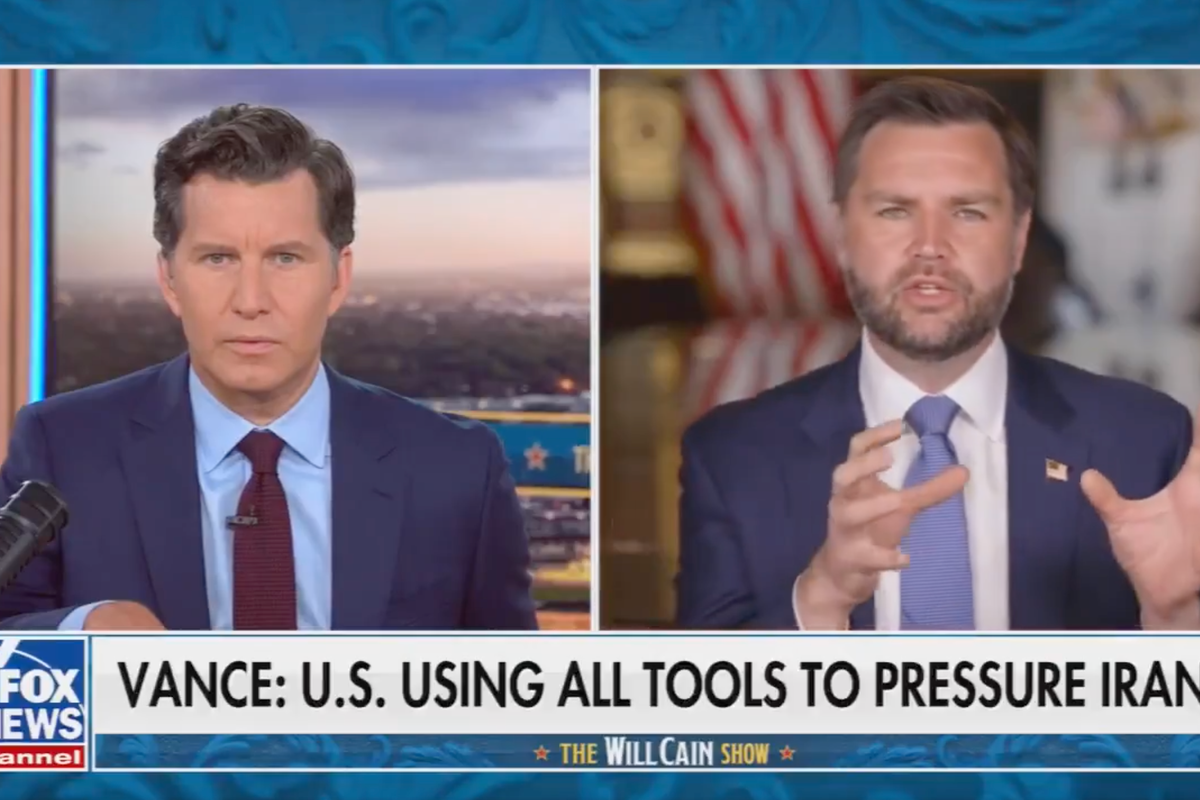
- US Vice President JD Vance outlined Washington's key objectives in the Iran conflict as keeping energy prices stable for Americans, preventing Tehran from acquiring nuclear weapons, and securing a stronger US position.
- Iran is continuing to attack UAE vessels, while action in the Strait of Hormuz arena has been limited.
- The Wall Street Journal reported that Washington will dispatch an aircraft carrier to relieve one that spent a record number of consecutive days at sea.
Compiled by The InvestorSomething wrong?How this is made
Why it matters
Washington spent the week promising more pressure on Tehran, not less: the Treasury secretary said he would soon unveil restrictions "that have never been seen," and the defense chief said the naval blockade can be maintained "indefinitely," according to Semafor [1][2]. That matters for anyone still carrying a flat 2026 energy strip, because the stated war aim and the chosen instrument pull against each other.
Vice President JD Vance has described US objectives as keeping energy prices stable for Americans, preventing Tehran from acquiring nuclear weapons, and securing a stronger US position [3]. The first of those is being pursued by blockading a Gulf oil producer while Iran keeps attacking UAE vessels, even if action in the Strait of Hormuz arena has been limited lately [2][4].
The cost of holding that posture is showing up in logistics rather than in headlines. The Wall Street Journal reported the US will dispatch an aircraft carrier to relieve one that has spent a record number of consecutive days at sea [5]. Naked Capitalism argues the navy is already cracking under the strain of the blockade, citing the scandal over conditions aboard the Abraham Lincoln and its overdue rotation out of theater once the press and Congress took up the story [6][7].
Attrition on the unmanned side is more countable. PressTV reported another MQ-9 Reaper downed over Hormozgan [8], a day after the Washington Post reported 45 Reapers lost since the war began on February 28, with Iranian air defenses responsible for roughly a quarter of the fleet [9][10]. The US started with about 185 Reapers, 165 Air Force and 20 Marine Corps [11]; 45 is about 24 percent of that [1]. Across the roughly 167 days to August 14, that is one airframe every 3.7 days [2]. The Post put the bill above $1.3bn at $30m to $50m per unit [12], which works out at about $29m each, the bottom of the range, so treat the figure as a floor [3].
Iran is trying to set the tempo. Mohammad Mokhber, an aide to the Leader, wrote that the strategy of shifting the war to an offensive phase if Iran's conditions are not met will "undoubtedly change the equations of power in the world" [13]. The Ansar Allah and Saudi front is now hotter than Hormuz [14].
The policy direction is not settled. Bloomberg read the White House focus on economic measures as a return to first-term strategy and "a marked pivot" for an administration that had repeatedly threatened a stepped-up military campaign [15]. Against that, Hindustan Times reported CENTCOM chief Brad Cooper was in Israel pushing for escalation, sourcing that traces to an Israel Channel 13 story amplified by the anti-Iran account Iran International [16]. Robert Barnes has said Joint Chiefs chairman Dan Caine has pushed back on the limits of viable operations, including a ground campaign, and is being marginalised [17].
Three things to watch. The contents of the Treasury package: unprecedented restrictions on an oil exporter are either a price event or an admission. The carrier handover, which is the tell on whether an indefinite blockade is sustainable at this tempo [5]. And the southern front, where DropSite reported that strikes since resuming in early July have hit fishing ports, bridges, telecommunications, power plants, hospitals and transport corridors in Khuzestan, Hormozgan, Sistan and Baluchestan, with dozens of communications towers knocked offline [18][19]. None of that shortens the list of reasons Iran has to keep going.