ScienceNot yet confirmed elsewhere1 publisher2 min readPublished
Zircon dating recovers a short-lived Cretaceous magmatic arc in northwestern Iran
Istanbul Technical University-led geologists date a previously unrecognized magmatic arc in northwestern Iran to about 101-97 million years ago. The Geoscience Frontiers study gives reconstructions of how the Neo-Tethys Ocean closed a dated subduction episode that earlier accounts of the region had missed.
The Scientist · Science desk
What happened
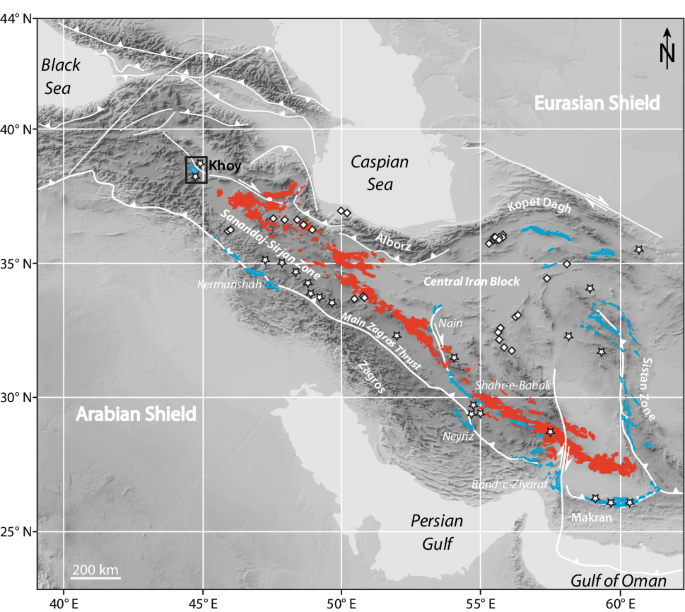
- The team calls the system the Azerbaijan Continental Magmatic Arc and places it in what is now the Arabia-Eurasia collision zone.
- Zircon U-Pb ages, hafnium isotopes and whole-rock geochemistry gave the rocks traits consistent with subduction-related continental arc magmatism.
- Tectonic deformation, erosion, basin burial and younger Eocene magmatism later obscured the arc's geological record.
- Accounts of Iran's magmatic history have largely centred on two other systems, the Sanandaj-Sirjan and Urumieh-Dokhtar arcs.
Why it matters
- constraint Tectonic reconstructions that ran northwestern Iran's subduction history through the two established arcs now have a separate Late Cretaceous arc to fit into the sequence.
- decision Anyone building on the result has to weight the ages and geochemistry above the slab-rollback and fault-boundary explanations, since the authors present those only as possibilities.
- precedent If later deformation and sedimentation can remove a whole arc from a region's standard history, apparent gaps in other old collision zones are open to the same re-examination.
Taking the reported age range at face value [5], the arc was active for roughly 4 million years [13]. The authors call it a relatively short-lived magmatic episode. They suggest that a reorganization of the subduction system, possibly involving slab rollback and migration of the arc, may have played a part [15].
The sampling followed one structure. The team worked on volcanic and plutonic rocks from several localities in northwestern Iran, mostly along the Siah Cheshmeh-Khoy-Misho-Tabriz Fault [7]. The authors propose that the fault may be an important tectonic boundary associated with the reorganization of the Neo-Tethyan system [14].
The study has two layers, and I'd give them different weight. The ages and the isotopic and chemical signatures are measurements. The fault-boundary idea and the slab-rollback explanation are interpretations, and the authors frame both with "may" [14][15]. The corresponding author, Ali Mohammadi of Istanbul Technical University, kept his own summary to the firmer layer. "This study shows that the magmatic history of northwestern Iran is more complex than previously recognized. By integrating geochronological, isotopic and geochemical evidence, we identified a Late Cretaceous continental arc that was subsequently obscured by later tectonic processes," he said [3].
The public account is a press release provided by Istanbul Technical University [11]. It does not say how many samples or zircon grains were dated, or how large the uncertainties on individual ages are. Those figures would show whether the four-million-year window rests on many consistent ages or on a few.
The ocean involved matters well beyond Iran. According to the release, the closure of the Neo-Tethys strongly shaped the geology across the eastern Mediterranean, the Middle East and western Asia [10]. The team included researchers from two Chinese Academy of Sciences institutes, ETH Zurich, Karadeniz Technical University and Damghan University [4].
What to watch
- The full paper's sample count, zircon age spread and analytical uncertainties, which would show how tightly the 101-97 million year window is defined.
- Independent work along the Siah Cheshmeh-Khoy-Misho-Tabriz Fault testing whether it is the Neo-Tethyan tectonic boundary the authors suggest.
- Whether regional plate reconstructions adopt slab rollback and arc migration to explain the arc's brief activity.
Clarity's read
What the record supports and how the coverage leans. The claims behind it follow.
Reality
- Evidence55
- Adoption
- Insufficient
- Hype gap+10
- Incentives35
- Confidence55
Claim ledger
Ranked by verification strength, evidence, and original report placement.
- [1]
An international research team led by Istanbul Technical University identified evidence of a previously unrecognized Late Cretaceous continental magmatic arc in northwestern Iran.
- [2]
The researchers call the system the Azerbaijan Continental Magmatic Arc, in a region that is now part of the Arabia-Eurasia collision zone.
- [3]
"This study shows that the magmatic history of northwestern Iran is more complex than previously recognized. By integrating geochronological, isotopic and geochemical evidence, we identified a Late Cretaceous continental arc that was subsequently obscured by later tectonic processes."
ReportedSupportedSource: Dr. Ali Mohammadi, corresponding author, Istanbul Technical University2 sources— create a free account to open themView cited source - [4]
The study was conducted with researchers from the Institute of Tibetan Plateau Research and the Xinjiang Institute of Ecology and Geography (Chinese Academy of Sciences), ETH Zurich, Karadeniz Technical University and Damghan University.
- [5]
Published in Geoscience Frontiers, the study indicates the arc was active approximately 101-97 million years ago, during the evolution of the Neo-Tethys Ocean.
- [6]
The arc's geological record was subsequently obscured by tectonic deformation, erosion, basin burial and younger Eocene magmatism.
- [7]
The researchers investigated volcanic and plutonic rocks from several localities in northwestern Iran, particularly along the Siah Cheshmeh-Khoy-Misho-Tabriz Fault.
- [8]
Using zircon U-Pb geochronology, Hf isotope analyses and whole-rock geochemistry, the team constrained the ages and sources of the rocks and identified characteristics consistent with subduction-related continental arc magmatism.
- [9]
The conventional framework for Iran's magmatic history has largely focused on the Sanandaj-Sirjan Magmatic Arc and the Urumieh-Dokhtar Magmatic Arc.
- [10]
The closure of the Neo-Tethyan Ocean played a major role in shaping the geology of the eastern Mediterranean, the Middle East and western Asia, according to the release.
- [11]
The press release was provided by Istanbul Technical University.
- [12]
According to the release, the discovery demonstrates how ancient magmatic arcs can become fragmented or obscured by later tectonic activity, erosion and sedimentation.
- [13]
The reported activity window spans roughly 4 million years.
- [14]
The authors suggest the Siah Cheshmeh-Khoy-Misho-Tabriz Fault may represent an important tectonic boundary associated with the reorganization of the Neo-Tethyan system.
- [15]
Changes in the subduction system, including possible slab rollback and arc migration, may have contributed to the development of this relatively short-lived magmatic episode, according to the authors.
Sources
1 independent publisher whose own reporting we read for this story.
- phys.orgGeologists uncover evidence of a missing Late Cretaceous magmatic arc in northwestern Iran
1 article · October 9, 2026
Topics and entities
Follow any of these and your For You feed starts watching them — no settings page required.
Topics
- Neo-Tethys OceanFollow
- GeochronologyFollow
- Plate TectonicsFollow