ProductNot yet confirmed elsewhere1 publisher3 min readPublished
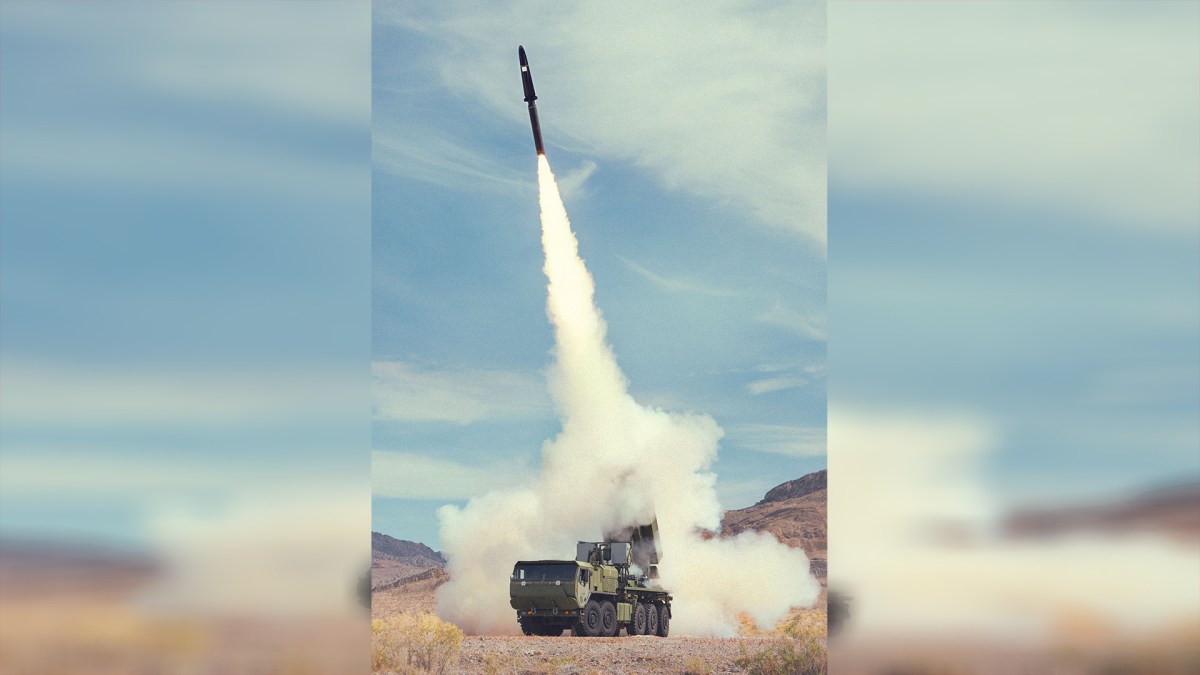
Castelion's Blackbeard fires from a truck-mounted test rig ahead of the Army's planned HIMARS trial
Castelion posted the first public image of Blackbeard firing from a truck, a hypersonic missile aimed at about 80% of PrSM Increment 4's capability for less. Whether it fits the Army's existing rocket launchers is still a planned step that the photo cannot confirm.
The Product Desk
What happened
- Reports say the truck in the photo looks like an Oshkosh logistics truck that Castelion had previously discussed converting for launch testing.
- Army fiscal 2027 budget documents list a live fire of a production-representative Blackbeard GL and its launcher pod as a planned milestone.
- The Navy gave Castelion a $105 million contract in April to integrate Blackbeard onto the F/A-18E/F Super Hornet and move it toward early operational capability.
Compiled by The Product DeskSomething wrong?How this is made
Why it matters
- constraint Castelion says its test hardware should not necessarily be read as the final weapon, so Army units cannot yet plan around this container's size or layout.
- capability If the dedicated pod clears the HIMARS fire-control test, the Army gets a hypersonic weapon fired from rocket artillery it already fields, without buying separate specialized launchers.
- cost The one unit price on record is the Navy's pre-production lot at about $468,000 a missile with containers, so there is no ground-launch price yet to test the Army's lower-cost promise against.
Picture a launcher crew looking at Castelion's photo. They would start with the box on the back of the truck. It is a compact, enclosed container on a military truck chassis [2]. The image does not confirm how many missiles it carries [7].
The coverage says the launcher appears designed to fit within the Army's existing mobile rocket artillery ecosystem [4]. The hardware in the frame did something narrower. It put a missile out of a container on a test truck [3]. Interesting Engineering reported that it remains unclear whether the pictured configuration is the production design [4].
The Army's development plan shows how much of the existing setup Blackbeard GL is meant to reuse. The first ground demonstration uses a modified pod from the MLRS Family of Munitions [5]. Prototypes then move to a dedicated launcher pod, and that pod is new hardware [5]. Existing equipment comes back at the end of the plan, in a minimum viable product flight test run through the HIMARS fire-control system [5]. Dark Eagle, the Army's current hypersonic weapon, relies on specialized launch equipment [10]. Interesting Engineering reported that Blackbeard's more compact design could make it easier to fit into existing mobile launch infrastructure [10].
Range is the one performance figure in circulation. Castelion has suggested a range approaching 500 miles, and a ground launch could cut that compared with a launch from an aircraft [11].
Launcher fit matters more once you see the procurement numbers. The Pentagon said in May that a two-year multiyear contract for at least 500 missiles a year could follow successful testing and validation [14]. The department is also seeking authority and funding to buy more than 12,000 over five years [15]. That averages about 2,400 missiles a year [17], roughly 4.8 times the multiyear floor [18]. I think a buy that size depends on the pod more than on the missile. Thousands of rounds a year only help if they can leave from launchers that units already operate. The Army describes Blackbeard as an affordable, mass-produced precision-fire capability [9].
Any claim that new equipment fits what a team already runs can be sorted with two questions. The first is which existing piece the new thing touches: the physical mount or the control system. The second is whether that contact has been demonstrated or only planned. Blackbeard GL has one demonstrated item, a launch from a container on a truck [3]. The mount is planned, pending a new dedicated pod, and the control link is planned, pending the HIMARS fire-control flight test [5]. So both items that touch the Army's existing setup are still in the planned column. The scheduled event that would move the mount into the demonstrated column is the fiscal 2027 live fire of a production-representative missile and launcher pod [6].
What to watch
- Whether the first ground demonstration flies from the modified MLRS munitions pod in the Army's plan or from the container shown in Castelion's photo.
- Whether lawmakers grant the multiyear procurement authority and funding the department is seeking, and whether they tie it to test results.
Clarity's read
What the record supports and how the coverage leans. The claims behind it follow.
Reality
- Evidence42
- Adoption30
- Hype gap+22
- Incentives58
- Confidence45
Claim ledger
Ranked by verification strength, evidence, and original report placement.
- [1]
Castelion released what appears to be the first public image of its Blackbeard hypersonic missile launching from a ground-based system; the US Army wants to develop the weapon as a lower-cost alternative to more expensive precision-strike systems.
ReportedSupportedSource: Interesting Engineering2 sources— create a free account to open themView cited source - [2]
The photograph, shared by Castelion on social media, shows a Blackbeard missile leaving an enclosed launcher mounted on a high-mobility military truck; it is the ground-launched version, Blackbeard GL, with a containerized launch architecture. The image shows a compact, enclosed launch container mounted on a military truck chassis.
ReportedSupportedSource: Interesting Engineering2 sources— create a free account to open themView cited source - [3]
According to reports, the vehicle in the image appears consistent with an Oshkosh logistics truck that Castelion had previously discussed converting for launch testing.
ReportedSupportedSource: Interesting Engineering, citing unnamed reports2 sources— create a free account to open themView cited source - [4]
The launcher appears designed to fit within the US Army's existing mobile rocket artillery ecosystem, but it remains unclear whether the pictured configuration represents the final production design.
- [5]
The Army's development plan calls for an initial ground-launch demonstration using a modified Multiple Launch Rocket System Family of Munitions (MFOM) pod, followed by Blackbeard GL prototypes and a dedicated launcher pod, with the longer-term goal of a minimum viable product flight test using the M142 HIMARS fire-control system.
ReportedSupportedSource: Interesting Engineering, describing the Army's development planView cited source - [6]
The Army's fiscal year 2027 budget documentation lists a live-fire launch of a production-representative Blackbeard GL and launcher pod as a planned milestone.
ReportedSupportedSource: Interesting Engineering, citing Army FY2027 budget documentationView cited source - [7]
The image does not confirm how many missiles the launcher can carry or how closely the test configuration matches the eventual production system.
- [8]
Castelion has emphasized that its test hardware is intended to support rapid development and should not necessarily be considered representative of the final weapon.
- [9]
The Army has described Blackbeard as an affordable, mass-produced precision-fire capability for time-sensitive, moving and hardened targets; its stated objective is roughly 80% of the capability planned for Precision Strike Missile Increment 4 at a substantially lower cost per missile.
- [10]
The Army's Dark Eagle Long Range Hypersonic Weapon relies on specialized launch equipment; Blackbeard is being developed around a more compact approach that could make it easier to integrate into existing mobile launch infrastructure.
- [11]
The production missile's propulsion, flight profile and performance specifications remain undisclosed; Castelion has previously suggested a range approaching 500 miles, though ground launches could reduce that range compared with aircraft launches.
ReportedSupportedSource: Interesting Engineering; range figure attributed to CastelionView cited source - [12]
In April, Castelion received a $105 million US Navy contract to support integrating Blackbeard onto the F/A-18E/F Super Hornet and the transition to early operational capability.
- [13]
A subsequent $23.4 million order covered 50 pre-production missiles for early operational capability, plus storage and shipping containers.
- [14]
In May, the Pentagon said a two-year multiyear procurement contract covering at least 500 Blackbeard missiles annually could follow successful testing and validation.
- [15]
The department said it was seeking authorizations and funding to purchase more than 12,000 Blackbeard missiles over five years.
- [16]
The Navy's pre-production order works out to about $468,000 per missile, an upper bound because the order also covered storage and shipping containers.
- [17]
More than 12,000 missiles over five years averages about 2,400 missiles a year.
- [18]
The five-year ambition's yearly average is roughly 4.8 times the 500-a-year multiyear floor.
Sources
1 independent publisher whose own reporting we read for this story.
- interestingengineering.comUS Army eyes Blackbeard hypersonic missile as Castelion tests truck launcher
1 article · October 9, 2026
Topics and entities
Follow any of these and your For You feed starts watching them — no settings page required.
Topics
- Hypersonic WeaponsFollow
- Long-range precision firesFollow
- Defense Procurement ContractingFollow