ScienceNot yet confirmed elsewhere1 publisher2 min readPublished
Plankton off Japan hosts an archaeon with the smallest archaeal genome yet recorded
Researchers report in Current Biology that the archaeon Sukunaarchaeum mirabile has a 238-kilobase-pair genome, the smallest ever seen in its domain. The sequence shows nearly no metabolism but intact copying machinery, so its status as a cell rests on inference.
The Scientist · Science desk
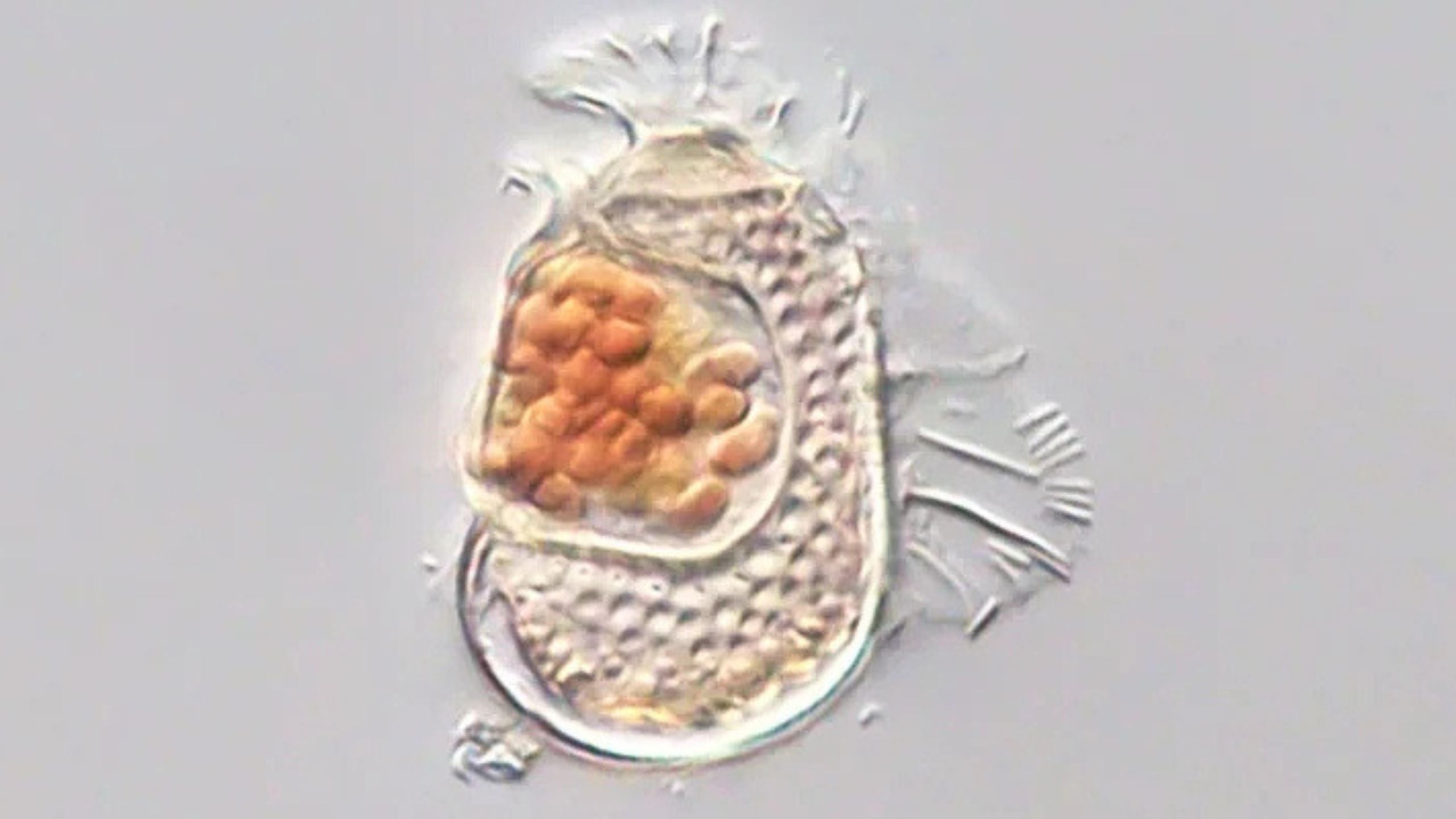
Three figures: Sukunaarchaeum's genome is 238,000 base pairs; some viral genomes reach 730,000 base pairs; some reach even 2.5 million base pairs.
| Figure | Value | Note | Claim |
|---|---|---|---|
| Sukunaarchaeum's genome | 238,000 base pairs | 14 | |
| Some viral genomes reach | 730,000 base pairs | 5 | |
| Some viral genomes, even | 2,500,000 base pairs | 5 |
What happened
- Researchers collecting the plankton Citharistes regius off Shimoda, Japan, were profiling its photosynthesizing cyanobacteria and were not looking for the archaeon.
- Nottingham's Thorsten Allers said the archaeon lost almost all genes for making nutrients and energy but kept much of the machinery to copy its genome and make proteins.
- The only organisms with smaller genomes are bacteria so dependent on a symbiotic host that they have almost lost their identity as separate organisms.
- The authors propose a parasite, because an endosymbiont needs a metabolism to give something back, and that would make it only the second parasitic archaeon on record.
- Scientists know the archaeon only through its genome and have yet to see it through a microscope.
Why it matters
- contradiction The authors wrote that the organism "can neither sustain itself independently", while Allers calls it near the minimum for "an independent cell"; the first speaks to metabolism, the second to copying machinery.
- decision A lab that defines life by metabolism files this organism with viruses, and one that defines it by autonomous replication files it with cells.
- constraint Anyone citing it as a minimal-cell benchmark is relying on a genome alone, since replication is inferred from gene content and has not been observed.
Genome length is a poor way to sort the living from the non-living here. Some viruses carry 730,000 base pairs and others 2.5 million [5]. Against the archaeon's 238,000 [2], that is about 3.1 and 10.5 times as much DNA [14][15]. By mainstream definitions those viruses are not living things, because they have no metabolism of their own [6].
Allers put replication first. "The key to defining life is whether something can replicate itself, and whether it can do this autonomously," he said [9]. On that test the gene list answers half the question. It shows what the archaeon has the equipment to copy. It cannot show whether the copying happens without a host.
ScienceAlert reported on the 2025 preprint that the microbe led a "virus-like" existence. The published version drops that analogy, and the outlet guessed the change was meant to avoid confusion about the microbe's classification [13].
The parasite proposal has a second leg. A quarter of the genome is given to large membrane proteins [18], roughly 60 kilobase pairs [19]. The same proteins appear in the only other known parasitic archaeon, where they are used to invade a host [18].
In our view, given the retained copying and protein machinery [10], the sequence supports reading this as a cell that has lost nearly all its metabolism. The parasite reading fits the genes best, but it is still a hypothesis. The account describes one genome from plankton collected off Shimoda [1][2] and does not say how many samples or cells it came from. It is not known what the archaeon does to its host or whether it can copy itself without one.
What to watch
- Direct observation of the organism, by microscope or any other means, to show whether it copies itself and what it does to its host.
- A second parasitic archaeon, or other genomes carrying the same large membrane proteins, to test the parasite proposal beyond one comparison.
Clarity's read
What the record supports and how the coverage leans. The claims behind it follow.
Reality
- Evidence55
- Adoption
- Insufficient
- Hype gap+10
- Incentives
- Insufficient
- Confidence50
Claim ledger
Ranked by verification strength, evidence, and original report placement.
- [1]
Researchers collecting the single-celled plankton Citharistes regius in surface seawater off Shimoda, Japan, were profiling the genetic material of its photosynthesizing cyanobacteria to understand how the symbiosis evolved; they weren't looking for the microbe they found.
- [2]
Among the genomes the researchers found was a tiny loop of genetic material made up of just 238 kilobase pairs of DNA.
- [3]
An international team describes the entity in Current Biology and has named it Sukunaarchaeum mirabile; it is a member of the domain Archaea.
- [4]
Scientists have never before seen an archaeon with a genome this tiny.
- [5]
There are viruses with genomes larger than this microbe's, with some reaching 730,000 base pairs or even 2.5 million.
- [6]
By mainstream definitions, those viruses do not qualify as living things, since viruses don't have their own metabolisms.
- [7]
Sukunaarchaeum is missing almost all the genes it would need to maintain its metabolism.
- [8]
"The near-complete absence of recognizable metabolic pathways in Sukunaarchaeum suggests that it can neither sustain itself independently nor provide an obvious metabolic benefit to its host," the researchers explain.
- [9]
"The key to defining life is whether something can replicate itself, and whether it can do this autonomously," said molecular biologist Thorsten Allers of the University of Nottingham.
ReportedSupportedSource: Thorsten Allers, University of Nottingham, quoted by ScienceAlertView cited source - [10]
"Although [Sukunaarchaeum] has lost almost all of the genes needed to make nutrients and energy, it has kept much of the machinery required to copy its genome and produce proteins from its genetic information," said Allers.
ReportedSupportedSource: Thorsten Allers, University of Nottingham, quoted by ScienceAlertView cited source - [11]
Allers said: "This suggests that Sukunaarchaeum may be close to the minimum level of genetic information needed for an organism to remain an independent cell."
ReportedSupportedSource: Thorsten Allers, University of Nottingham, quoted by ScienceAlertView cited source - [12]
The only other organisms with smaller genomes than Sukunaarchaeum are bacteria that have become so dependent on a symbiotic host that they have almost lost their identity as separate organisms.
- [13]
ScienceAlert reported when the preprint was released in 2025 that the microbe led a 'virus-like' existence; the final published version of the paper drops that analogy, presumably, ScienceAlert writes, to avoid confusion about the microbe's true taxonomic classification.
- [14]
The 730,000-base-pair viral genome is about 3.1 times the size of Sukunaarchaeum's 238,000-base-pair genome.
- [15]
The 2.5-million-base-pair viral genome is about 10.5 times the size of Sukunaarchaeum's 238,000-base-pair genome.
- [16]
Scientists know Sukunaarchaeum mirabile only via its genome and have yet to see it through a microscope.
- [17]
Endosymbionts need a metabolism to give something back to their host, so the researchers propose that Sukunaarchaeum may be a parasite; if so, it would be only the second parasitic archaeon on record.
- [18]
A quarter of Sukunaarchaeum's genome is dedicated to producing large membrane proteins; the same proteins have been seen in the only other known parasitic archaea, where they are weaponized as a way to invade a host.
- [19]
A quarter of a 238-kilobase-pair genome is roughly 60 kilobase pairs.
Sources
1 independent publisher whose own reporting we read for this story.
Topics and entities
Follow any of these and your For You feed starts watching them — no settings page required.
Entities
- Candidatus Sukunaarchaeum mirabileFollow
- Current BiologyFollow
- Thorsten AllersFollow
- University of NottinghamFollow
- Citharistes regiusFollow
- ScienceAlertFollow