Science2 publishersIndependently confirmed3 min readPublished Updated
Tail physics sorts four mosasaurs into ambush sprinters and open-water chasers
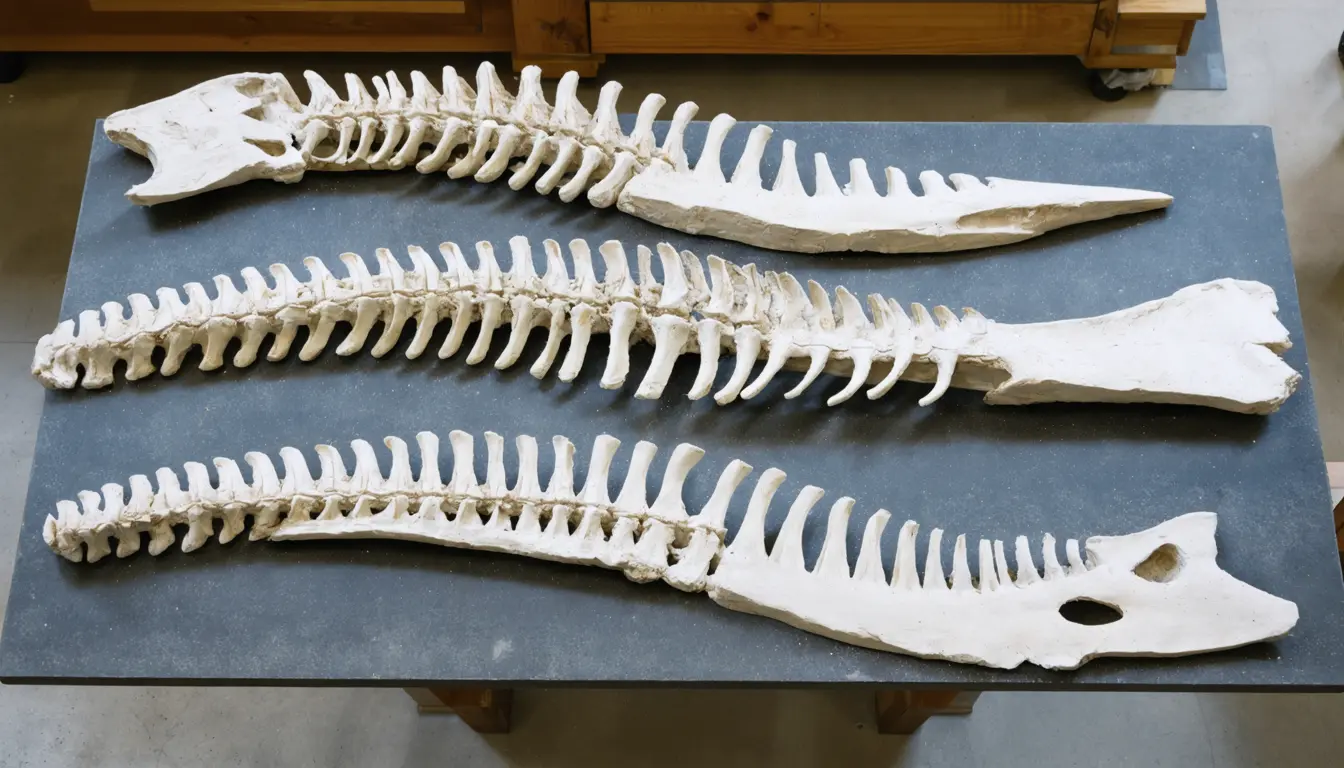
Rutgers-led physics models of four mosasaur skeletons find Platecarpus and Tylosaurus lunged faster for their size than Mosasaurus and Plotosaurus. Most of that gap comes from how far each tail could curl, so the split in hunting styles is an inference drawn from anatomy.
The Scientist · Science desk
What happened
- The team modelled a single burst it calls a slam-start, in which the animal curls its tail to one side and then sweeps it back hard against the water.
- A particularly large Tylosaurus reached about 24 km/h in one tail stroke, an estimate for a brief burst and not for a speed the animal could hold.
- Of all the conditions tested, how far the tail could curl changed the modelled speeds much more than any other assumption did.
- The researchers say the split agrees with separate evidence from bite force, tooth wear and the chemical makeup of mosasaur fossils.
Compiled by The ScientistSomething wrong?How this is made
Why it matters
- constraint Because tail curl dominates the model, a revised estimate of how far mosasaur tails could bend would move these speeds more than any better guess about extinct muscle power.
- capability With the tools released publicly, other groups can run burst estimates on other extinct swimmers and check whether tail curl sorts them the same way.
- precedent Burst speed can now be estimated alongside cruising for dinosaur-age marine reptiles, giving claims about how related predators divided their hunting a mechanical check beside teeth and chemistry.
Formoso's question started with the bones. Two major branches of the mosasaur family tree have differently proportioned tails, and she wanted to know whether that changed how fast an animal could launch an attack [7]. Earlier work had mostly studied cruising, the steady swimming an animal does by beating its tail over and over [8]. A lunge is a different physical problem. Formoso compared the opening surge to a swimmer pushing off the wall of a pool. "It's the tail itself pushing off the water," she said [10].
The skeletons were nearly complete, so body size and tail shape came from the fossils [11]. The tail muscles were missing, and the team filled that gap with anatomy from living lizards, including Komodo dragons [11]. They then reran the model while varying what they assumed about muscle power, how flexible the tail was and how much drag the water exerted, to check whether the result held as those inputs changed [19].
It held. Platecarpus and Tylosaurus beat Mosasaurus and Plotosaurus on lunge speed for body size across the tested conditions [3]. The sensitivity result is the most useful part of the work as reported: how far the tail could curl had a much larger effect on modelled speed than everything else [13]. Muscle power in an extinct animal is a guess, so I think the ranking is sturdier for depending little on it. Its weak point is that it depends heavily on one trait the team had to vary across a range, the longer flexible tail section that let Platecarpus and Tylosaurus curl farther before the sweep [12].
The speed figure needs the same care. A particularly large Tylosaurus comes out at about 24 km/h on a single stroke, and that describes a brief burst [5]. I would cite the ranking ahead of the speed, because the source itself says the exact speeds remain uncertain and that the differences among the animals are what offer clues to hunting [6].
The thing this doesn't tell you is whether any of these animals actually hunted the way its tail allowed. The model estimates what a body could do. The step to ambush hunting in shallow seas, with Mosasaurus and especially Plotosaurus suited to chasing prey in the open ocean, is the researchers' interpretation [14]. It is a reasonable one, since it agrees with independent evidence from bite force, tooth wear and fossil chemistry [17].
Formoso was careful about the other end of the ranking. "That doesn't mean Plotosaurus was slow," Formoso said [15]. "Its tail was built for sustained, tuna-like swimming rather than sudden bursts" [16].
The sample is four kinds of mosasaur [2], plus some exceptionally large individuals, including a Mosasaurus based on a New Jersey fossil held by the New Jersey State Museum in Trenton [20]. To the authors' knowledge, it is the first study to put numbers on burst swimming in any marine reptile from the age of dinosaurs [21]. The work appears in Current Biology [1], and the team has made its tools freely available for use on other extinct swimmers [18].
What to watch
- Whether groups using the released tools on other extinct swimmers find that tail curl again outweighs every other assumption.
- New anatomical work on how far mosasaur tails could bend, since that single input moves the modelled speeds most.
- Published results for the exceptionally large specimens, including the New Jersey Mosasaurus, and whether they change the ranking.
Clarity's read
What the record supports and how the coverage leans. The claims behind it follow.
Reality
- Evidence55
- Adoption
- Insufficient
- Hype gap+25
- Incentives
- Insufficient
- Confidence60
Claim ledger
Ranked by verification strength, evidence, and original report placement.
- [1]
The research, published in Current Biology, was led by Kiersten Formoso, an assistant professor in the Department of Ecology, Evolution, and Natural Resources in the Rutgers School of Environmental and Biological Sciences.
- [2]
Researchers reconstructed the bodies of four kinds of mosasaurs from fossil skeletons and applied physics to estimate how quickly each could surge forward with a single powerful sweep of its tail.
- [3]
Across the tested conditions, Platecarpus and Tylosaurus achieved faster lunges for their body size than Mosasaurus and Plotosaurus.
- [4]
Platecarpus was the fastest of the four mosasaurs modelled.
- [5]
A particularly large Tylosaurus could have reached about 15 miles per hour (24 kilometers per hour) with a single tail stroke; the estimate describes a brief burst rather than a sustainable speed.
- [6]
Although the exact speeds remain uncertain, the differences among the animals offer clues to how they hunted.
- [7]
Two major branches of the mosasaur family tree had differently proportioned tails; Formoso asked whether those differences affected how quickly the animals launched an attack.
- [8]
Previous research had largely focused on cruising, a steady type of swimming in which an animal repeatedly beats its tail.
- [9]
The team modelled a movement it calls a slam-start, in which an animal curls its tail to one side, then forcefully sweeps it back, pushing against the water and driving its body forward.
- [10]
"It's the tail itself pushing off the water," Formoso said, comparing the initial surge to a swimmer pushing off the wall of a pool.
ReportedSupportedSource: Kiersten Formoso, via phys.org2 sources— create a free account to open themView cited source - [11]
The nearly complete fossils provided body size and tail shape; to reconstruct the missing tail muscles, researchers drew on the anatomy of living lizards, including Komodo dragons.
- [12]
The advantage came largely from a longer, flexible section of the tail that allowed Platecarpus and Tylosaurus to curl it farther before sweeping it back.
- [13]
How far the tail could curl had a much larger effect on the modelled speeds than all other conditions.
- [14]
The researchers said the burst advantage would favour ambush hunting in shallow seas, while Mosasaurus and especially Plotosaurus appear better suited to pursuing prey in the open ocean.
ReportedSupportedSource: Rutgers-led research team2 sources— create a free account to open themView cited source - [15]
"That doesn't mean Plotosaurus was slow,"
ReportedSupportedSource: Kiersten Formoso2 sources— create a free account to open themView cited source - [16]
"Its tail was built for sustained, tuna-like swimming rather than sudden bursts."
ReportedSupportedSource: Kiersten Formoso2 sources— create a free account to open themView cited source - [17]
The findings agree with other clues to mosasaur lifestyles, including studies of bite force, tooth wear and the chemical makeup of fossils.
- [18]
The researchers are making their tools freely and publicly available so other researchers can apply the approach to additional extinct swimmers.
- [19]
The team tested a range of assumptions about muscle power, tail flexibility and resistance from the water to see whether the findings held up under different conditions.
- [20]
Alongside the four main reconstructions, the team modelled exceptionally large animals, including a Mosasaurus based on a fossil from New Jersey held by the New Jersey State Museum in Trenton.
- [21]
To the authors' knowledge, this is the first study to put numbers on burst swimming performance in any marine reptile from the age of dinosaurs.
Sources
2 independent publishers whose own reporting we read for this story.
- phys.orgFlexible tails could boost ancient sea predators' ambush speeds, fossil-based models suggest
1 article · October 7, 2026
- popsci.com20,000-pound mosasaurs ambushed prey with sneak attacks
1 article · October 8, 2026
Topics and entities
Follow any of these and your For You feed starts watching them — no settings page required.
Topics
- BiomechanicsFollow
- Mesozoic marine reptilesFollow
- PaleontologyFollow