ScienceIndependently confirmed2 publishers2 min readPublished Updated
Whole-body light-sheet maps turn up hundreds of previously unknown hair cells on squid
Case Western Reserve researchers found hundreds more hair cells across squid bodies than were known, in a study in Current Biology. The team hopes the animals can help explain human hearing loss, a case that so far rests on anatomy mapped in squid.
The Scientist · Science desk
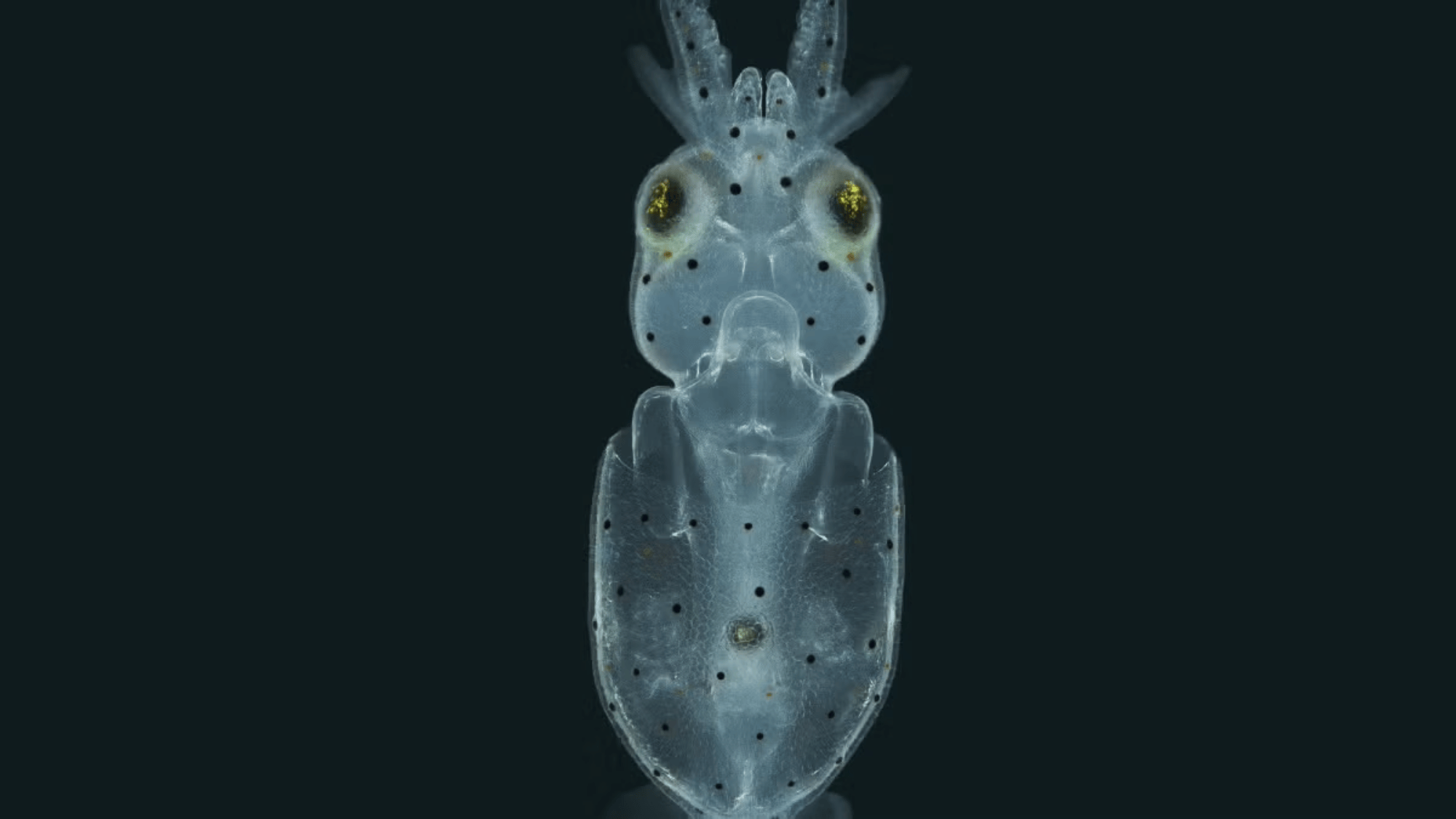
Evidence map. Supported: squid carry hair cells across the body, not just head and arms; first full-body lateral-line map; bundle length appears tuned to frequency; account omits species, animal count, cell count and response recordings. Insufficient: co-author's hearing-loss promise.
- Supported Researchers already knew squid had hair cells on their heads and arms; the new work indicates hundreds more of them all over their bodies., claim 2
- Supported The work included the first full-body mapping of lateral lines, features made up of hair cell clusters, on squid., claim 5
- Supported The research suggests squid regulate the length of their hair bundles to tune hair cells to various frequencies, similarly to human ears., claim 6
- Supported PopSci's account of the study does not name the squid species, the number of animals imaged, an exact count of newly found hair cells, or any recording of the cells' response to water movement., claim 10
- Insufficient evidence "So, studying the squid's hair bundle holds promise for understanding how hearing loss occurs.", claim 13
| Claim | State | Claim number |
|---|---|---|
| Researchers already knew squid had hair cells on their heads and arms; the new work indicates hundreds more of them all over their bodies. | Supported | 2 |
| The work included the first full-body mapping of lateral lines, features made up of hair cell clusters, on squid. | Supported | 5 |
| The research suggests squid regulate the length of their hair bundles to tune hair cells to various frequencies, similarly to human ears. | Supported | 6 |
| PopSci's account of the study does not name the squid species, the number of animals imaged, an exact count of newly found hair cells, or any recording of the cells' response to water movement. | Supported | 10 |
| "So, studying the squid's hair bundle holds promise for understanding how hearing loss occurs." | Insufficient evidence | 13 |
What happened
- Before this study, hair cells on squid had been documented on the head and arms.
- The team imaged the animals with light-sheet microscopy, which lights one thin plane at a time to build 3D images with little tissue damage.
- The work includes the first full-body map of the squid's lateral lines, the clusters of hair cells that run along the body.
- The research suggests squid regulate hair-bundle length to tune cells to different frequencies, as the human ear does.
Why it matters
- capability If the length tuning holds, labs gain frequency-tuned hair bundles that sit on an animal's skin, where whole-body light-sheet imaging can reach them.
- decision Researchers studying how hair cells tune to frequency now have a reason to weigh squid against fish, whose lateral-line bundles share a single length.
- constraint The hearing-loss case stays a proposal until squid bundles are recorded responding to water movement and shown to fail the way human bundles do.
Bundle length is the detail that ties squid to the human ear. In the human cochlea, thousands of hair cells carry stereocilia that are longer where low pitches are detected and shorter where high pitches are, so a cell's position sets the frequency it responds to [8]. Hair bundles in fish lateral lines are all one length [7]. Squid bundles that vary [6] would give researchers length-based tuning on the outside of an animal, a feature the fish system lacks. The squid seem to need it. Their survival appears to depend on detecting water movement across a range of frequencies [9].
The whole-body design matters for the count. A survey of the head and arms could only find cells on the head and arms [2]. Mapping the entire animal, lateral lines included, is what turned up the rest [5].
How many the rest amounts to is harder to pin down. PopSci's account does not name the species or report how many animals were imaged, the exact number of new cells, or any recording of how the cells respond to moving water [10]. "Hundreds more" is a difference without a baseline. It cannot tell a reader whether the known total doubled or rose by a modest fraction. The length tuning, too, is something the research suggests [6]. Confirming that a longer squid bundle responds to lower frequencies takes a physiological recording.
Brian McDermott, a biologist who studies hair cells and a co-author of the Current Biology paper [3], put the payoff in human terms. "Squid are cephalopods with a diverse population of hair cells on the surface of their bodies, which may yield insights not only into how these fascinating animals detect water movement to survive, but also into how hearing and deafness occur in humans," he said in a statement [11]. His argument rests on where the damage happens. "Often, when a child is born deaf or a hearing person loses their hearing, it is the hair bundle that has been damaged," he said [12]. "So, studying the squid's hair bundle holds promise for understanding how hearing loss occurs" [13].
I think the case for squid as a hearing model is reasonable, on two conditions. The bundles have to be shown to be tuned by length, and they have to fail in ways that resemble human bundles. The thing this doesn't tell you is the second. What has been shown so far is anatomy, in squid [5]. Testing the second condition means damaging squid bundles and comparing the result with the kind of hair-bundle injury McDermott described in deaf children [12].
What to watch
- Recordings showing whether longer squid hair bundles respond to lower-frequency water movement, as cochlear tuning would predict.
- The Current Biology paper's species, sample size and cell counts, which would put a baseline under 'hundreds more'.
- Any experiment that damages squid hair bundles and compares the failure with hair-bundle injury in human hearing loss.
Clarity's read
What the record supports and how the coverage leans. The claims behind it follow.
Reality
- Evidence55
- Adoption
- Insufficient
- Hype gap+30
- Incentives
- Insufficient
- Confidence60
Claim ledger
Ranked by verification strength, evidence, and original report placement.
- [1]
Scientists at Case Western Reserve University discovered that squid have significantly more hair cells than was previously known.
- [2]
Researchers already knew squid had hair cells on their heads and arms; the new work indicates hundreds more of them all over their bodies.
- [3]
Brian McDermott, a biologist who investigates hair cells, is a co-author of the squid study published in the journal Current Biology.
- [4]
The team used light sheet microscopy, in which a thin sheet of light illuminates one plane of a specimen at a time, letting researchers produce detailed 3D images while minimizing tissue damage.
- [5]
The work included the first full-body mapping of lateral lines, features made up of hair cell clusters, on squid.
- [6]
The research suggests squid regulate the length of their hair bundles to tune hair cells to various frequencies, similarly to human ears.
- [7]
The hair bundles in fish lateral lines are all the same length.
- [8]
The human cochlea holds thousands of hair cells with stereocilia that are longer in areas where low pitches are detected and shorter in high-pitch areas, orienting each cell to a specific sound frequency.
- [9]
Squid survival appears to depend on detecting various frequencies of water movement.
- [10]
PopSci's account of the study does not name the squid species, the number of animals imaged, an exact count of newly found hair cells, or any recording of the cells' response to water movement.
ReportedSupportedSource: Reading of the PopSci account2 sources— create a free account to open themView cited source - [11]
"Squid are cephalopods with a diverse population of hair cells on the surface of their bodies, which may yield insights not only into how these fascinating animals detect water movement to survive, but also into how hearing and deafness occur in humans,"
ReportedInsufficientSource: Brian McDermott, in a statement quoted by PopSci2 sources— create a free account to open themView cited source - [12]
"Often, when a child is born deaf or a hearing person loses their hearing, it is the hair bundle that has been damaged,"
ReportedInsufficientSource: Brian McDermott, quoted by PopSci2 sources— create a free account to open themView cited source - [13]
"So, studying the squid's hair bundle holds promise for understanding how hearing loss occurs."
ReportedInsufficientSource: Brian McDermott, quoted by PopSci2 sources— create a free account to open themView cited source
Sources
2 independent publishers whose own reporting we read for this story.
- popsci.comSquid are covered in little hairs like the ones in your ear
1 article · October 9, 2026
- sciencealert.comScientists Find Squid Are Covered in Hair-Like Cells Remarkably Similar to The Ones in Human Ears
1 article · October 10, 2026
Topics and entities
Follow any of these and your For You feed starts watching them — no settings page required.
Topics
Entities
- Case Western Reserve UniversityFollow
- Brian McDermottFollow
- Doryteuthis pealeiiFollow
- Current BiologyFollow