Science1 publisherNot yet confirmed elsewhere2 min readPublished
One grave, 81 in the whole corpus: the Suzdal chamber burial with a horse and a dog
A 10th-century timber chamber at Gnezdilovo held a man, a horse, a dog and riding gear. With only 80 others known in western Russia, one find carries unusual inferential weight.
The Scientist · Science desk
What happened
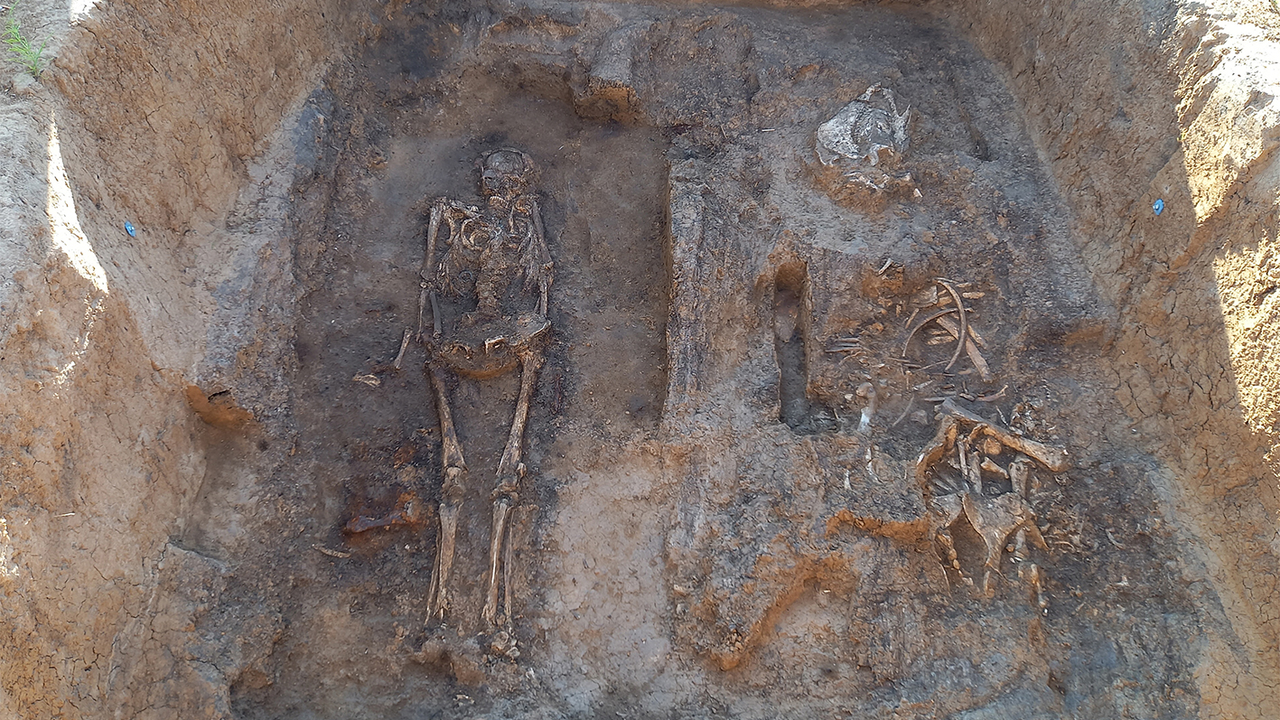
- A wooden chamber tomb holding a man buried with a horse and a dog was found this summer at the Gnezdilovo cemetery in Suzdal, and is dated to the 10th century.
- The chamber lay about a metre down, measured 3.1 by 2.7 metres, and its rotted roof had fallen in onto the body.
- Objects with the man included a battle ax, an iron knife, stirrups and riding gear, a bone comb and a silver horseshoe-shaped brooch at the neck.
- The Institute of Archaeology says only 80 other medieval chamber burials have been found across western Russia.
Compiled by The ScientistSomething wrong?How this is made
Why it matters
- constraint With a corpus this small, its geography is set by where excavation has happened rather than by where the rite was practised, so each addition moves the pattern further than a season of ordinary...
- precedent If chamber architecture is the marker that certifies a place as a Rus' centre of power, then the next example found away from a known town redraws the political map by exactly the same reasoning...
- exposure Both load-bearing claims, the date and the earliness, are currently unverifiable outside the announcing institute, which leaves the wider argument about imported Scandinavian practice resting on...
The package is what carries the argument. A chamber of roughly 8.4 square metres [14] has to be dug, timbered and roofed; the horse has to be killed; the stirrups, the ax and a silver brooch have to be taken out of circulation [5]. Those are separate costs, paid at one funeral. That is what an imported rite looks like when it arrives whole rather than as a taste for one of its components, and nothing in the institute's description of this grave reads as trimmed for local convenience: both the animals and the underground timber architecture belong to the practice the Institute of Archaeology says Rus' nobility took from Scandinavia by the 10th century [6][2].
The cemetery did not extend that practice widely. Fifteen graves were excavated at Gnezdilovo this season, and fourteen of them were earthen pits or barrow mounds [9][15]. Weapons and horse-riding equipment turn up in the ordinary male graves, silver rings and rock-crystal bead necklaces in the female ones [10], so portable goods were reaching plenty of people at this site. The chamber reached one [15]. Since the Kievan Rus' of the late ninth century already contained Baltic, eastern Slavic and Norse peoples [11], the rite is not by itself a statement about who was in the grave. The objects diffused. The architecture was rationed.
Which is why the count matters more than the contents. Add this burial to the 80 already excavated and the entire known corpus of Rus' chamber graves stands at 81 [12][7]. One find is about 1.2 percent of everything there is [13]. Set that against 15 graves lifted from one site in one season and the arithmetic is plain: with a type this scarce, a single burial is a revision rather than a data point. The institute has used it accordingly, arguing that Suzdal was already a magnet for Old Rus' nobility and a centre of military-administrative control over the northeastern territories, a role it says was previously unknown [17].
The man was 25 to 35 when he died, and the decayed roof collapsed onto him [4][3], which is part of why the assemblage survived in a state worth arguing about. The two load-bearing statements are the 10th-century date and the description of the tomb as an early example of the type, and both come from the same translated announcement [2]. In a corpus of 81, where the grave falls inside that century decides whether it records the arrival of the practice at Suzdal or its settled use there, and those are different claims about how far north and east Rus' power reached, and when.
What to watch
- Dendrochronology or radiocarbon dates for the chamber timbers, which would fix where inside the 10th century the burial sits.
- A peer-reviewed excavation report from the Institute of Archaeology, rather than a translated press statement.
- Any chamber burial excavated away from a known Rus' urban centre, which would break the rule the Suzdal reading depends on.
Clarity's read
What the record supports and how the coverage leans. The claims behind it follow.
Reality
- Evidence38
- Adoption
- Insufficient
- Hype gap+22
- Incentives58
- Confidence44
Claim ledger
Ranked by verification strength, evidence, and original report placement.
- [1]
A rare wooden chamber tomb containing an elite man buried with a horse and a dog, dated to the 10th century, was discovered unexpectedly this summer during excavations at the medieval cemetery at Gnezdilovo, an archaeological site in Suzdal, Russia, about 137 miles (220 km) northeast of Moscow.
- [2]
The discovery was reported in an Aug. 15 translated statement from the Institute of Archaeology of the Russian Academy of Sciences, as relayed by Live Science.
ReportedSupportedSource: Institute of Archaeology of the Russian Academy of Sciences, via Live ScienceView cited source - [3]
The wooden burial chamber was found about 3.3 feet (1 m) underground and measured 10.2 by 8.9 feet (3.1 by 2.7 m); its wooden roof had decayed and collapsed onto the deceased.
- [4]
The skeleton was of a man who was about 25 to 35 years old when he died, found with the remains of a horse and a dog.
- [5]
Grave goods included an iron knife, stirrups and other riding gear, a bone comb and a battle ax; the man wore a garment secured by a silver, horseshoe-shaped brooch near his neck, and the assemblage signifies high status, according to the statement.
- [6]
By the 10th century, the custom of burying medieval Rus' nobility in underground wooden crypts with a multitude of grave goods was imported from Scandinavia.
- [7]
Only 80 other medieval chamber burials have been found across western Russia, according to the statement.
- [8]
All previously excavated chamber tombs were found in urban centres of the Kievan Rus' territory, suggesting the nobility formed relationships of power across the land.
- [9]
Archaeologists unearthed 15 burials at Suzdal this summer; most were simple burials in earthen pits, while others had been covered with barrow mounds of dirt.
- [10]
Female burials included silver rings and necklaces with rock-crystal beads, while male burials included weapons and horse-riding equipment.
- [11]
In the late ninth century, what is now western Russia was ruled by the Kievan Rus', a conglomeration of settlements and territories that included Baltic, eastern Slavic and Norse peoples.
- [12]
Including the new find, the known corpus of medieval chamber burials in western Russia is 81.
- [13]
A single chamber burial accounts for about 1.2 percent of the known corpus of the type.
- [14]
The chamber floor area is about 8.4 square metres.
- [15]
The chamber tomb is 1 of the 15 graves excavated at the site this season, or about 7 percent, leaving 14 pit or barrow burials.
- [16]
The account rests on a single translated institutional statement; no dating method, excavation report or independent verification of the 10th-century date is cited.
- [17]
The statement says the chamber tomb shows that as early as the 10th century Suzdal was already a magnet for the Old Rus' nobility and served as a centre of military-administrative control over the northeastern territories of Rus', a role previously unknown.
Sources
1 independent publisher whose own reporting we read for this story.
Topics and entities
Follow any of these and your For You feed starts watching them — no settings page required.
Topics
- Funerary ArchaeologyFollow
- Norse-Slavic Cultural ContactFollow
- Single-Source Science ReportingFollow
- ArchaeologyFollow
- Medieval Rus'Follow