Science1 publisher3 min readPublished
A fourth-century B.C. lecture hall at Mieza matches the school Plutarch described
Greece's culture ministry reports a fourth-century B.C. complex at Mieza with two banquet halls, a stadium and a lecture hall of stone desks, while the name of the teacher who worked there still comes from Plutarch.
The Scientist · Science desk
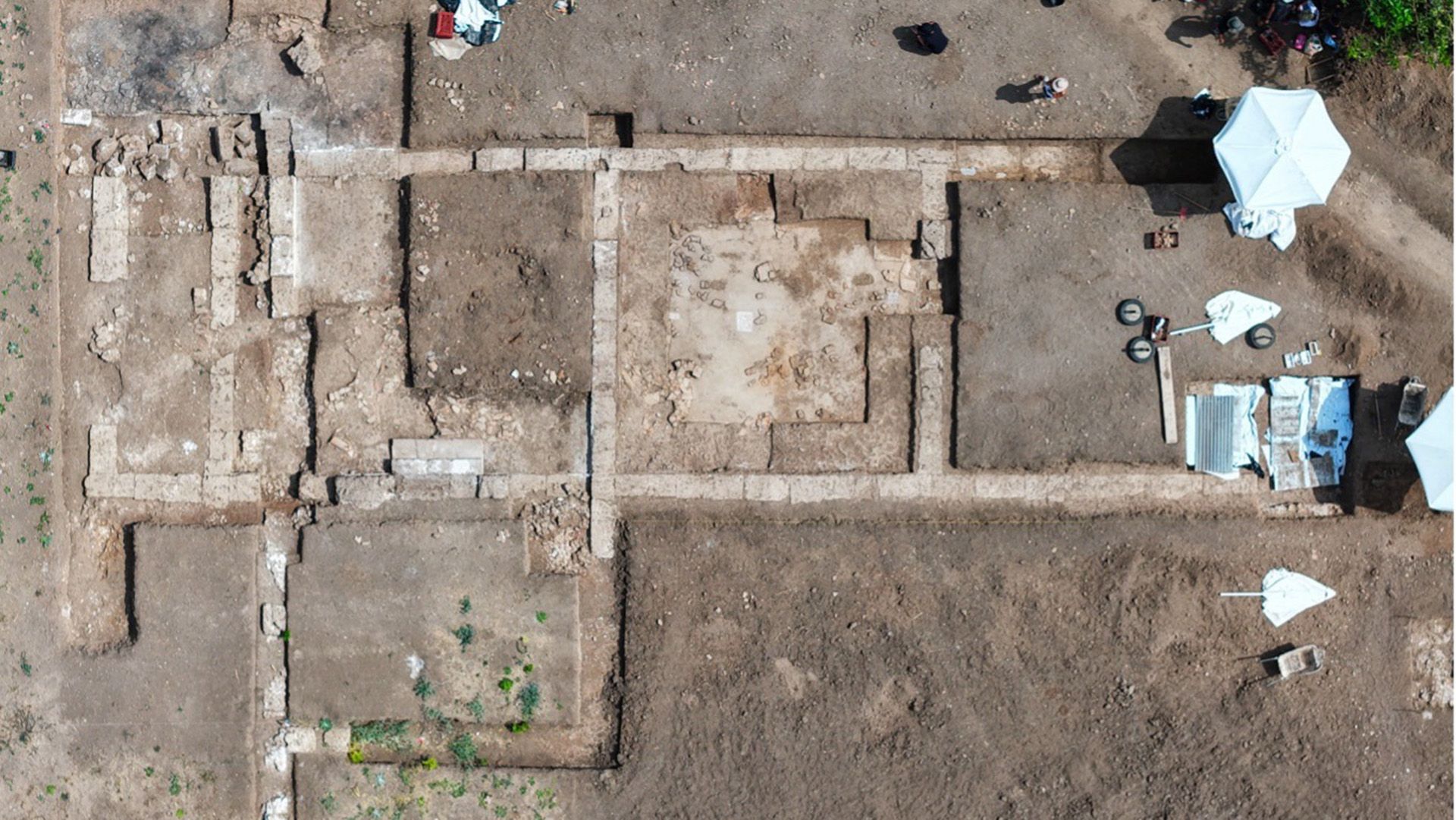
What happened
- The Hellenic Ministry of Culture said in a translated statement that the school where Aristotle educated Alexander the Great has been uncovered at the ancient Macedonian city of Mieza, in northern Greece.
- The excavated complex holds two banquet halls, a sporting arena, a stadium, a roofed porch and a lecture hall fitted with stone desks, decorated with mosaic floors and columns.
- Kottaridi's team began digging the complex in 2024, more than 20 years after an earlier round of excavation there that turned up a nearby monument dedicated to the nymphs.
Compiled by The ScientistSomething wrong?How this is made
Why it matters
- capability Questions about how elite Macedonians were schooled in the later fourth century B.C. can now be put to a standing building with rooms and fittings. Reames says that is what she wants the publication to address.
- constraint Material of this kind can characterise an institution without identifying an individual pupil, so the specific claim about Alexander stays an argument about Plutarch's text and its reliability.
- contradiction The outside scholars Live Science contacted back the identification, while a historian in the same report says the site needs more archaeological information.
What connects this complex to Aristotle is a text. Plutarch, who lived around A.D. 50 to 120, wrote in "Life of Alexander" that Alexander was educated at a school in Mieza where Aristotle taught [6]. Angeliki Kottaridi, the archaeologist leading the excavation, says that is why she believes the building complex is that school [7]. The physical arguments are location and architecture: the ministry's statement notes that the decoration and plan resemble the Macedonian royal palace at Aigai, modern Vergina, where Philip II and Alexander lived [5].
Plutarch was writing somewhere between roughly 350 and 520 years after the century the ruins date to [21]. That interval is why the architecture matters. Schools in the ancient Greek world, the gymnasia, taught a range of subjects and also trained students physically [11]. A lecture hall with stone desks, a roofed porch, a sporting arena and a stadium are the fittings of that institutional type [2].
Four styluses came out of the ruins, with coins and ceramics [4]. Writing implements establish that pupils wrote in the building, though they do not attach a name to a desk. Graham Wrightson, a history professor at South Dakota State University, was candid about the gap: the discovery of "four stylus writing implements allows us to dream that one belonged to Alexander," he said, even if none of them truly did [16]. No inscribed material appears in the reported inventory of finds [20].
Kottaridi told Live Science in an email that, according to Plutarch, Philip II had the school built "for the education of his son Alexander and the children of the noble Macedonians" [10]. The dining arrangements fit a small group. The banquet halls have raised pedestals where nearly a dozen couches would originally have been placed [3].
Elizabeth Baynham, a senior lecturer at the University of Newcastle in Australia, said the opulence is unsurprising given Philip II's great wealth [17]. She also tied the site's distance from the Macedonian capital at Pella, about 43 kilometers, to Alexander's safety: the school was "far enough away to potentially give Alexander a chance for escape if his father was assassinated," she said [18][19]. On the teaching itself, Baynham noted that Aristotle "would have only been in his early 40s" [22].
Live Science asked scholars not involved with the dig, and they supported the identification [12]. Jeanne Reames, who directs the Ancient Mediterranean Studies program at the University of Nebraska at Omaha, said: "I agree that all the evidence suggests this is the school Philip provided for Aristotle to tutor the young Alexander and his fellow students" [13]. One historian in the same report said the site needs more archaeological information [14]. Reames, for her part, hopes the discovery will "shed more light on elite education in Macedonia in the second half of the 4th century" B.C. [15].
What to watch
- Publication of the excavation report, with stratigraphy and how tightly the lecture hall itself can be dated within the fourth century B.C.
- Whether the find contexts place the four styluses in the lecture hall or somewhere else in the complex.
- Whether further seasons at Mieza turn up inscribed material that names the institution or its staff.