Science1 publisher2 min readPublished
Archaeologists in Hesse find a temple to Mars among the workshops outside Kapersburg's Roman fort
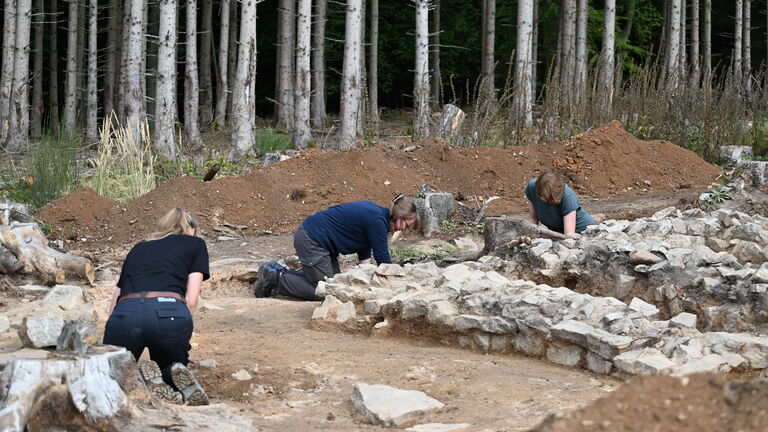
Hessen Archaeology has found a temple to Mars, with remains of a Mars statue and a likely Victory figure, beside the Kapersburg Roman fort north of Frankfurt. It lies in what excavators take to be the fort's craft area, so who built it, soldiers or civilians, is still open.
The Scientist · Science desk
Drafted by a language model from the sources cited here and checked against its claim ledger before publication. How we use AISend a correction
What happened
- Several fragments of a dedicatory inscription lay inside the temple, and the portion translated so far records a dedication to Mars.
- The Hesse State Office for Monument Preservation has been excavating the fort and its vicus, the civilian settlement beside it, since 2024.
- The dig found far fewer houses than the team expected and much more craft evidence, including blacksmith pits and ovens for drying wheat and baking bread.
- Once the fort was no longer useful, the Romans leveled it and put residential buildings on the site.
Compiled by The ScientistSomething wrong?How this is made
Why it matters
- constraint Until the full inscription is read and a dedicator identified, the temple cannot show that a vicus population kept a formal cult separate from the garrison's.
- constraint Comparisons with vici on farmland are skewed, because the burnt layers that survive under Kapersburg's forest floor are almost always lost to ploughing, so claims about rarity need that correction.
- contradiction Live Science calls the settlement third-century while dating the fort to the early second, so the temple's place in a sequence lasting about 150 years depends on a construction date of its own.
Both gods named so far are gods of war. Mars was the Roman war god [1], and the winged statuette is likely Victoria, a personification of victory in battle [5]. The fort next door was home to a Roman unit, with cavalry as well as soldiers, for roughly 150 years, until about AD 275 [7]. A vicus was usually home mainly to merchants, families and other civilians [16]. Even so, a dedication to Mars and Victory fits soldier patrons at least as well as civilian ones, and the report does not name who dedicated this one.
The temple's location points the same way. Kai Mueckenberger of Hessen Archaeology called the temple an unexpected discovery [3]. He interprets the shortage of houses and the abundance of workshops in the excavated area as signs of a service zone. "These are all very technical elements related to local services, indicating that we're in a kind of intermediate area not directly adjacent to the fort itself, but perhaps more like the fort's craft area," he said [12].
That leaves the larger interpretation open. A formal temple in a settlement on the frontier would matter more if it showed civilians keeping a cult of their own, apart from the garrison's. A war-god temple in what may be the fort's craft area is equally consistent with the garrison's religion extending into the settlement. The state office's statement claims less than either: that the temple and votive statues give new insight into Roman beliefs on the empire's border [13].
The site's preservation also limits what it can be compared against. The temple sits in the wooded foothills of the Taunus mountains [1], and practically nothing was known about this vicus before 2024 [8]. "The astonishing thing is the exquisite preservation of the archaeological layers that start right beneath the forest floor," Mueckenberger said [9]. Those layers, burnt material among them, almost never survive in agricultural areas [10]. In my view, that makes it hard to say how rare such temples were. Vici under ploughed fields lose the deposits that survived here, so the number of temples known from other vici partly measures what survived.
The report's dates need care. It describes the settlement as built in the third century to defend the border against Germanic tribes [18]. It also dates the fort to the early second century, likely under Trajan, who ruled from AD 98 to 117, or Hadrian, who reigned from 117 to 138 [6]. A start in either reign and an end around 275 gives an occupation of roughly 137 to 177 years [17]. The headline gives the temple an age of 1,800 years [19].
What to watch
- A full translation of the dedicatory inscription, especially any dedicator's name, military unit or rank.
- Next year's excavation season, and whether it finds more houses or ties the temple to the fort's buildings or the later residential phase.
- A published construction date for the temple itself and the evidence behind it.