Science1 publisher2 min readPublished
Ice Age carvers at Mizyn cut their engravings along the mammoth tusk's internal lines
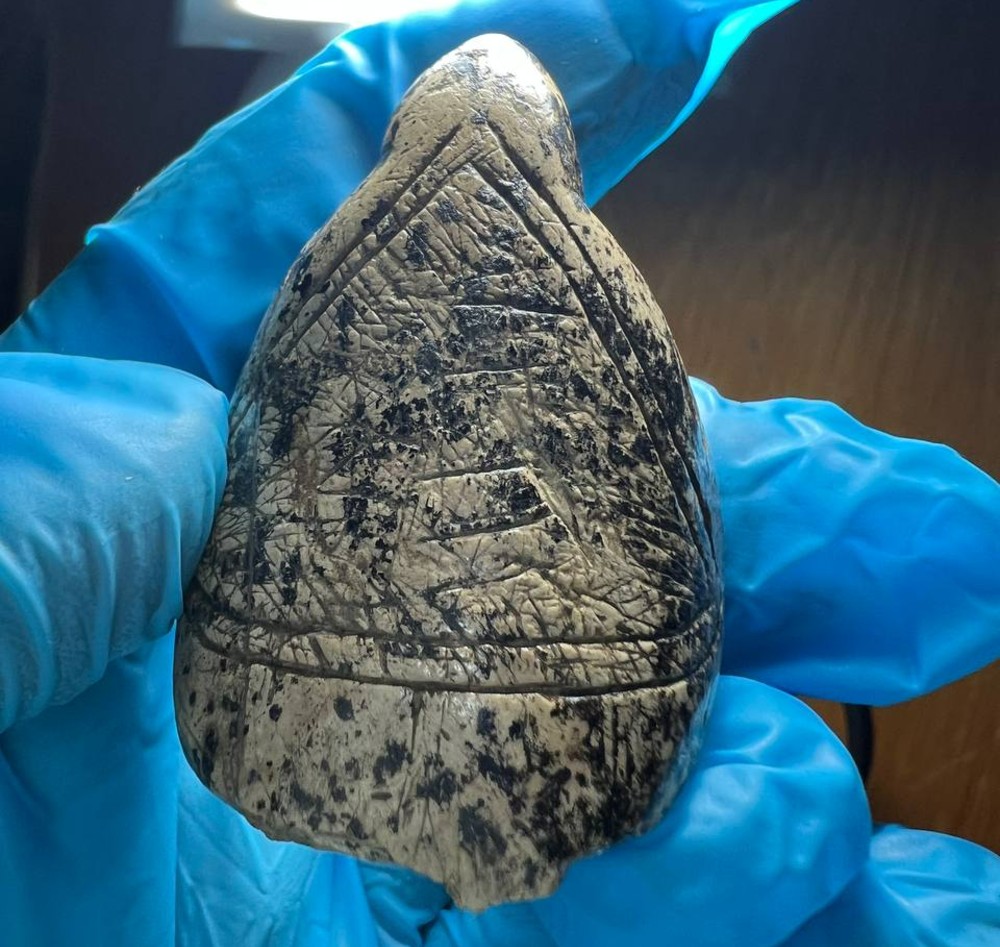
A reanalysis of 18 mammoth ivory figurines dug up in northern Ukraine between 1908 and 1913 finds their engraved lines following structures inside the tusk. Mizyn is so far the only site where the pattern has been reported.
The Scientist · Science desk
What happened
- An international team reanalyzed 18 mammoth ivory figurines from the Mizyn site in northern Ukraine and reported in Heritage Science that the engravings follow structures inside the tusk itself.
- The figurines came out of excavations at Mizyn between 1908 and 1913, at a site whose dwellings were built from mammoth bone, and each is crisscrossed with carved markings.
- The carvings date to roughly 18,000 years ago, among the first figures made after a gap of several thousand years in European figure-making during the peak of the last Ice Age.
- Co-author Andrew Needham of the University of York said figurine-making resumed earlier in Eastern Europe than in the West, and that no later Western style reproduced the internal tusk patterns seen at Mizyn.
Compiled by The ScientistSomething wrong?How this is made
Why it matters
- constraint Eighteen objects from a single site cannot separate a regional tradition from the habits of a few carvers, so the independent-path reading stays provisional until comparable figurines from elsewhere are examined the same way.
- capability Digital records made under wartime permission mean the surface evidence outlives the objects themselves, and other groups can in principle remeasure the engravings without handling the ivory.
- contradiction The study is presented as challenging linear progression in prehistoric art, while the evidence reported is one assemblage's unusual technique at one date. Those are two claims, and the measurement covers the second one.
Mammoth ivory contains structural features known as Schreger lines and growth increments known as Owen lines, and both sit inside the tusk [10]. An engraver working a shaped surface either follows something the material already holds or cuts against it. The team's modelling found that the carvings followed and recreated the natural lines present in the ivory, and the researchers report that the artists incorporated those patterns into the engravings [9][10].
A correspondence between an engraved line and an internal structure is a measurement; calling it deliberate inscription is an interpretation added to it. Aimee Little, an archaeologist at the University of York and a co-author, said: "Identifying visual evidence of how mammoths were integrated into artistic traditions, both through the use of their ivory and the deliberate inscription of its natural patterns, represents a genuine breakthrough in our understanding of prehistoric art and material culture" [12][13].
Eighteen objects, one site [2]. The Discover account does not give a count of how many of the 18 show the correspondence, or the scan resolution [20]. Andrew Needham, of the University of York's Department of Archaeology, concluded that "This indicates that Ice Age artists in Eastern Europe forged their own independent artistic path rather than simply following trends from Western Europe" [14][15].
Dmytro Kiosak, an archaeologist at the Leibniz Centre for Archaeology and a co-author, said "Our findings challenge the long-held assumption that ancient art simply evolved in a straight line from basic to complex forms" [11]. The bracket the authors use for Upper Palaeolithic Europe runs from 50,000 to 12,000 years ago [6], a span of 38,000 years [18]. At roughly 18,000 years old [3], the Mizyn figurines fall about 84% of the way through it [19]. That puts them late in the period, and one unusual assemblage measures variation at a single date. Testing a simple-to-complex trajectory needs a dated sequence of assemblages. This study works from a single assemblage.
The work establishes something narrower and still interesting: at one site, at one moment after figure-making resumed in Europe, the engraved design tracks the internal anatomy of the raw material [9][17]. Permission to scan came from the National Museum of the History of Ukraine, which holds the figurines, and the team also examined the surfaces under microscopes [7][8]. Oleksandr Naumenko, a researcher at the museum, said: "At a time when war continues to threaten Ukraine's cultural heritage, creating high-quality digital records of artifacts is a crucial step in preserving them" [16].
What to watch
- Whether comparable Western European figurines of the same age are scanned for the same internal-line correspondence. Those scans would show whether the Mizyn pattern extends beyond the site or is confined to it.
- Whether the Heritage Science paper gives a count of how many of the 18 figurines show the match, and the scan resolution.
- Where the digital records are deposited, and whether the museum releases them for independent remeasurement.