BuildReports disagree2 publishers3 min readPublished Updated
Nvidia rented Poolside's team for $12B and left the company standing
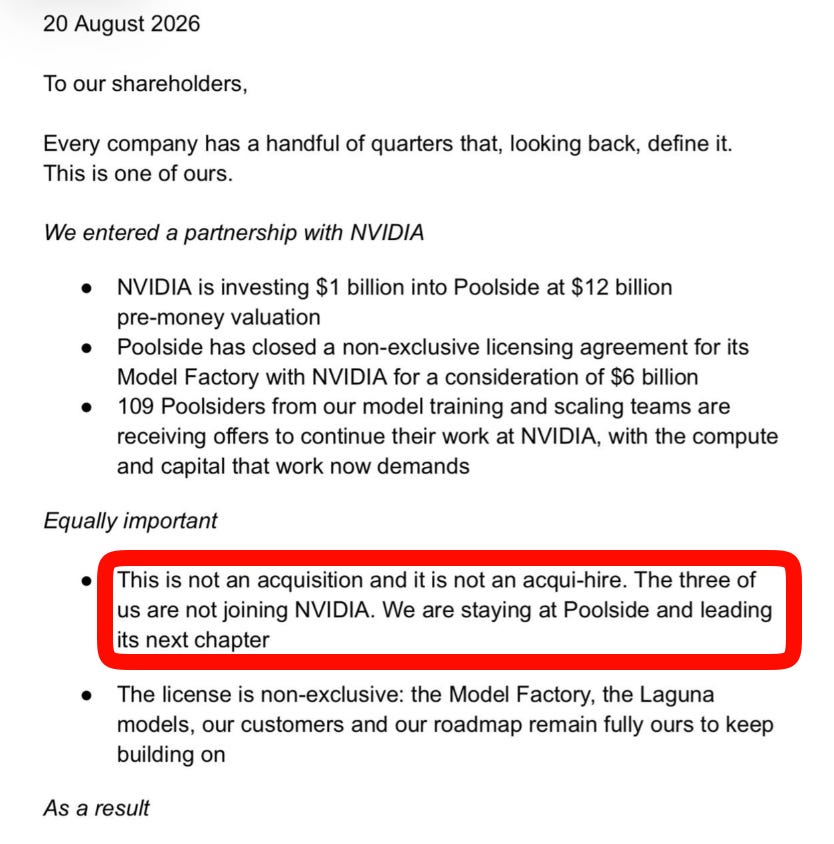
Nvidia licensed Poolside's Model Factory and hired 109 of a team its CEO put at fewer than 115 engineers and researchers. The corporate shell survives; the roadmap does not.
The Engineer · Build desk
What happened
- Nvidia licensed Poolside's Model Factory and hired 109 of Poolside's employees in what the report characterises as a $12 billion reverse-execuhire, without acquiring the company.
- The report says Nvidia's Jensen went from being an investor in Poolside to licensing its Model Factory and hiring 109 of its employees.
- Eiso Kant said on the podcast: 'Less than 70 people built this model. Less than 115 between engineering and researchers, like, together did this effort, and that's a very broad definition 'cause I put myself in the 115 list.'
- If fewer than 115 people made up Poolside's combined engineering and research staff and 109 were hired by Nvidia, at most six technical staff remain.
- Poolside's founders say the deal is 'not an acquisition and not an acquihire'.
Why it matters
Nvidia has licensed Poolside's Model Factory and hired 109 of the company's employees in a deal reported at $12 billion, and it did not buy the company [1]. It went from investor in Poolside to licensor of the factory and employer of the people who built it [2], which leaves the corporate entity intact and the engineering bench empty.
Less than a month before the deal, Poolside's Eiso Kant told the Latent Space podcast that fewer than 70 people had built the model and fewer than 115 across engineering and research had done the whole effort, a count he said generously included himself [15][7]. Take 109 out of a ceiling of 115 and at most six technical staff remain [8]. The founders describe the transaction as "not an acquisition and not an acquihire" [3].
Latent Space, which reported the deal, also supplies the taxonomy. It has been calling Windsurf-Google, Character-Google, Scale-Meta and Instacart-OpenAI execuhires: deals where the executives leave with the buyer while the employees take a payout and are left holding what remains of the company [4]. Poolside inverts the direction, with the founders staying and the staff going [5]. According to the report's headline, founders stay for $1 billion and employees go for $6 billion out of the $12 billion total [18], which works out to roughly $55 million per hired employee [19].
The stated reason is compute, and it reads literally. Poolside says it had a six-week window at the end of last year to raise $2 billion for a 40,000-GB300 cluster due to come online in January, did not close in time, and lost the cluster [10]. That implies about $50,000 per GPU of committed cost [16]. The company also says 10,000 to 20,000 GB300s would have produced a model rivalling the current frontier, but next year's frontier requires more than an order of magnitude more, and the binding constraint is no longer only capital but physical data center space and contracted compute [11]. At the same implied rate, the frontier-rivalling cluster was a $500 million to $1 billion line item [17], and the one after it is unreachable without a power contract.
For anyone whose plan depends on an independent code-model vendor, that is the arithmetic that matters. A team of 115 can build a competitive coding model [7]; a team of 115 cannot finance the cluster the next one needs [11]. When continuity rests on roughly a hundred named people rather than on a balance sheet, the vendor's roadmap is really a hiring decision at a larger company. Diligence should follow: who employs the researchers, what happens to your licence and your weights if they are hired en masse, and whether the counterparty keeps shipping when its shell outlives its staff [5].
Poolside's own parting position is the tell. It wrote that human-level capability will be fully commoditised by open source models while superintelligence likely will not [12], and that today's coding revenue is the intelligence-bound, low-margin kind, with durable value sitting in experiment-bound scientific discovery instead [13].
Watch PIC, the infrastructure company spun out of Poolside in January 2026, whose ambitions the report frames as scaling to 7GW of neocloud capacity [20]; watch the founders' new direction, which they say they are not ready to share [6]; and watch whether anything recognisably from the licensed Model Factory appears in Nvidia's own products. The dispatch covers 19-20 August 2026 [14].
Clarity's read
What the record supports and how the coverage leans. The claims behind it follow.
Reality
- Evidence55
- Adoption20
- Hype gap+35
- Incentives60
- Confidence55
Claim ledger
Ranked by verification strength, evidence, and original report placement.
- [1]
Nvidia licensed Poolside's Model Factory and hired 109 of Poolside's employees in what the report characterises as a $12 billion reverse-execuhire, without acquiring the company.
ReportedSupportedSource: latent.space AINews2 sources— create a free account to open themView cited source - [2]
The report says Nvidia's Jensen went from being an investor in Poolside to licensing its Model Factory and hiring 109 of its employees.
- [3]
Poolside's founders say the deal is 'not an acquisition and not an acquihire'.
- [4]
latent.space has been calling the Windsurf-Google, Character-Google, Scale-Meta and Instacart-OpenAI deals execuhires, because usually the executives go, leaving the employees with a rich payout but holding the company that remains.
- [5]
The Poolside-Nvidia deal is the first time the execuhire pattern has run the other way, with the founders staying and the employees going.
ReportedSupportedSource: latent.space AINews2 sources— create a free account to open themView cited source - [6]
The founders say they are 'not ready to share the updated vision'.
- [7]
Eiso Kant said on the podcast: 'Less than 70 people built this model. Less than 115 between engineering and researchers, like, together did this effort, and that's a very broad definition 'cause I put myself in the 115 list.'
- [8]
If fewer than 115 people made up Poolside's combined engineering and research staff and 109 were hired by Nvidia, at most six technical staff remain.
- [9]
Poolside wrote: 'For the last 3 1/2 years we've been directionally correct in a race where capital requirements went vertical.'
- [10]
Poolside says that at the end of last year it had a six-week window in which to raise $2 billion to pay for a 40,000 GB300 cluster coming online in January, did not close it in time, and lost the cluster.
- [11]
Poolside says 10,000-20,000 GB300s would produce a great model that could rival the current frontier, but next year's frontier models require far more than an order of magnitude larger cluster, and the constraint today is not only capital but physical data center space and contracted compute.
- [12]
Poolside wrote that it believes human level capabilities of intelligence will be fully commoditized by open source models, while super intelligence will likely not.
- [13]
Poolside wrote that today's model revenue is from coding and soon from all knowledge work, that intelligence-bound work will become a low margin commodity, and that AI's ultimate value will derive from experiment-bound problems and scientific discovery where a data moat comes from real world experimentation.
- [14]
The dispatch reporting the deal covers AI news for 8/19/2026 to 8/20/2026.
- [15]
Less than a month before the deal, latent.space had featured Poolside's Model Factory with Eiso Kant on its podcast.
- [16]
The $2 billion required for 40,000 GB300s implies about $50,000 per GPU of committed cluster cost.
- [17]
At an implied $50,000 per GB300, a 10,000-20,000 GPU cluster is a $500 million to $1 billion commitment.
- [18]
Per the report's headline, within the $12 billion the founders stay for $1 billion and the employees go for $6 billion.
- [19]
The $6 billion allocated to departing employees is about $55 million per hired employee.
- [20]
The PIC infraco was spun out of Poolside in January 2026, and the report's headline describes Infraco scaling to a 7GW neocloud.
Sources
2 independent publishers whose own reporting we read for this story.
Topics and entities
Follow any of these and your For You feed starts watching them — no settings page required.
Topics
- Agentic Coding ModelsFollow
- AI ComputeFollow
- License-and-Hire DealsFollow
Entities
- PoolsideFollow
- Model FactoryFollow
- Latent SpaceFollow
- NvidiaFollow
- Jensen HuangFollow
- Eiso KantFollow
- Nvidia GB300Follow
- PIC infracoFollow
- NemotronFollow