Invest2 publishersIndependently confirmed3 min readPublished
Most of Washington's $215 million quantum prize pays only after teams reach 100 logical qubits
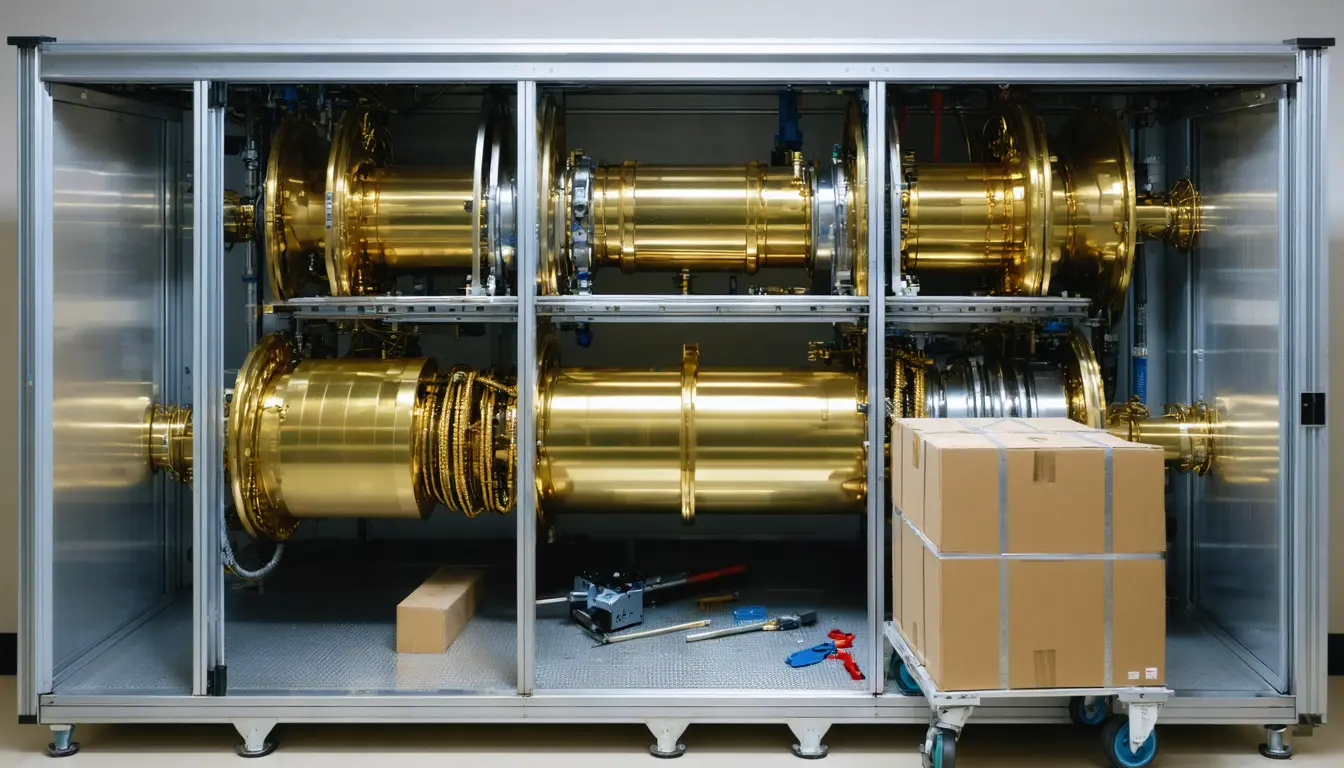
President Trump's administration put up to $215 million behind a fault-tolerant quantum computing contest in a science package of more than $6 billion. Nearly all of it pays out only after a team has a working error-corrected machine, so startups still fund the build privately.
The Investor · Invest desk
What happened
- The Energy Department reserved $100 million for teams showing at least 100 logical qubits and two $50 million pools for machines reaching 150 and 200.
- Eleven technology companies pledged $2.4 billion in AI tools and compute credits to support research at 15 federal agencies.
- Europol's Oct. 7 reports warned that a sufficiently powerful quantum computer could derive private keys from exposed public keys and move coins without permission.
Compiled by The InvestorSomething wrong?How this is made
Why it matters
- constraint Quantum startups still need private rounds to cover the years before a machine qualifies for the $100 million pool, because federal money before that point is capped per award.
- decision Crypto developers have to set their own upgrade schedule; the contest attaches no date to the threat, and Europol's advice to prepare stands on an uncertain timeline.
- cost Nvidia supplies about 42% of the $2.4 billion AI pledge, so the compute side of the package depends heavily on one chipmaker's credits.
Add up the three prize pools and $200 million of the $215 million, about 93%, goes only to teams that have already shown an error-corrected machine of 100, 150 or 200 logical qubits [17][18]. If all of the remaining $15 million went to early-milestone awards at the $1.5 million cap, it would pay for ten of them [19]. Logical qubits use error correction to make calculations more reliable [16]. The entry requirement is a machine with at least 100 of them that can perform hundreds of millions of fault-tolerant operations, according to crypto.news [9].
For a startup, the contest pays after the work is done. Before a team clears that bar, federal money comes in awards of up to $1.5 million [3], so the years spent building toward 100 logical qubits still run on private capital, or rather on investors willing to bet that the $100 million pool [10] will still be funded when they get there. That part is open. The department said the awards depend partly on future congressional appropriations [11]. The government is not paying for the build-out up front. The counter-case is that a federal prize with a stated dollar figure gives venture investors a milestone they can underwrite, and could pull private rounds forward. I think that effect is real but small while the money still waits on Congress [11].
Nothing in the package sets a date for the threat to bitcoin keys. The announcement does not describe the quantum contest as a cryptocurrency security program, crypto.news reported [4]. Europol, in two reports on Oct. 7, said a sufficiently powerful machine could derive private keys from public keys that are already visible and move coins without the owner's permission [14]. The agency did not claim existing machines can do this, and it called the timing uncertain [15]. Three EU financial watchdogs issued a similar warning on Sept. 23 [7], and Cointelegraph reported that no quantum computer capable of the attack exists [8]. Neither source says how many logical qubits an attack on bitcoin signatures would take, so the contest's 100-qubit bar cannot be placed against Europol's warning from this record.
Two outcomes would change that. If a team claims the 100-qubit pool soon, developers get a federal judgement that a machine of that size exists [10], and the Energy Department's separate $45 million laboratory program for testing and verifying quantum hardware and software gives the government its own way to check [13]. If the applicants are far short of the bar, the pools sit unclaimed and developers learn nothing new. The view here, that this package leaves crypto's clock where Europol left it, is wrong if the first outcome comes quickly and the EU authorities tighten their timing in response.
The bigger number in the package is compute for agencies. Eleven companies pledged $2.4 billion in AI tools and compute credits for research at 15 federal agencies [5]. Nvidia's $1 billion, AMD's $500 million, OpenAI's $200 million and $150 million apiece from Anthropic and Google add up to $2 billion, so the other six companies account for $400 million between them [6][20]. Against that, the quantum contest is under 4% of the more than $6 billion headline [22].
What to watch
- Whether Congress appropriates enough for the 150- and 200-logical-qubit pools to exist as cash.
- DOE's phase-one awardee list after applications close on Oct. 19, 2026, and how many teams draw the $1.5 million maximum.
- Whether Europol or the three EU financial watchdogs attach a date or a qubit count to the threat to exposed public keys.
Clarity's read
What the record supports and how the coverage leans. The claims behind it follow.
Reality
- Evidence55
- Adoption
- Insufficient
- Hype gap+35
- Incentives40
- Confidence58
Claim ledger
Ranked by verification strength, evidence, and original report placement.
- [1]
The Trump administration announced more than $6 billion in science initiatives, including a $215 million quantum computing competition and $2.4 billion in AI industry commitments.
ReportedSupportedSource: crypto.news; also reported by Cointelegraph2 sources— create a free account to open themView cited source - [2]
The Department of Energy's Quantum Genesis Q Competition offers up to $215 million in planned funding to companies developing fault-tolerant quantum computers.
ReportedSupportedSource: Cointelegraph2 sources— create a free account to open themView cited source - [3]
The competition distributes funding in two phases; companies meeting early milestones may receive awards of up to $1.5 million each, while later funding depends on demonstrating working quantum systems.
- [4]
The announcement does not describe the quantum initiative as a cryptocurrency security program.
- [5]
The White House said 11 technology companies pledged $2.4 billion in AI tools and compute credits to support research at 15 federal agencies.
ReportedSupportedSource: Cointelegraph, citing the White House2 sources— create a free account to open themView cited source - [6]
Commitments include $1 billion from Nvidia, $500 million from AMD, $200 million from OpenAI and $150 million each from Anthropic and Google.
ReportedSupportedSource: Cointelegraph2 sources— create a free account to open themView cited source - [7]
On Sept. 23, three EU financial watchdogs warned that more powerful quantum computers could undermine cryptographic systems used to secure blockchains and financial transactions.
ReportedSupportedSource: Cointelegraph2 sources— create a free account to open themView cited source - [8]
No quantum computer capable of deriving private keys from exposed public keys currently exists.
ReportedSupportedSource: Cointelegraph2 sources— create a free account to open themView cited source - [9]
Participants must demonstrate quantum computers capable of operating with at least 100 logical qubits and performing hundreds of millions of fault-tolerant operations.
- [10]
A $100 million incentive pool is reserved for teams demonstrating machines with at least 100 logical qubits; two separate $50 million pools reward systems reaching 150 and 200 logical qubits.
- [11]
The DOE said the awards will depend partly on future congressional appropriations, meaning the full $215 million has not yet been distributed or guaranteed.
- [12]
Applications remain open to private companies until October 19, 2026.
- [13]
The DOE is separately preparing a $45 million laboratory program to support the testing and verification of quantum computing hardware and software.
- [14]
On October 7, Europol published two reports warning that sufficiently powerful quantum computers could derive private keys from exposed public keys, potentially allowing attackers to move cryptocurrency without the owner's permission, particularly where public keys are already visible.
- [15]
Europol did not claim that existing quantum computers can carry out such attacks, said the timing remains uncertain, and recommended that cryptocurrency developers begin preparing for future security upgrades.
- [16]
Logical qubits use error correction to make quantum calculations more reliable.
- [17]
The three logical-qubit prize pools total $200 million.
- [18]
The prize pools are about 93% of the $215 million competition.
- [19]
The $15 million not in the prize pools would fund ten early-milestone awards at the $1.5 million cap if all of it went to such awards.
- [20]
The five named AI pledges total $2 billion, leaving $400 million across the other six companies.
- [21]
Nvidia's $1 billion is about 42% of the $2.4 billion AI pledge.
- [22]
The $215 million quantum competition is under 4% of the more than $6 billion package.
Sources
2 independent publishers whose own reporting we read for this story.
- cointelegraph.comTrump administration outlines quantum, AI initiatives in $6B science push
1 article · October 8, 2026
- crypto.newsPresident Trump unveils $215M quantum computing plan amid crypto fears
1 article · October 8, 2026
Topics and entities
Follow any of these and your For You feed starts watching them — no settings page required.
Topics
- Quantum ComputingFollow
- AI ComputeFollow
- Post-Quantum CryptographyFollow
- US federal science fundingFollow