Product1 publisherNot yet confirmed elsewhere2 min readPublished
AGILINK's OmniHand 3 Ultra splits silk into 16 strands in an embroidery demo
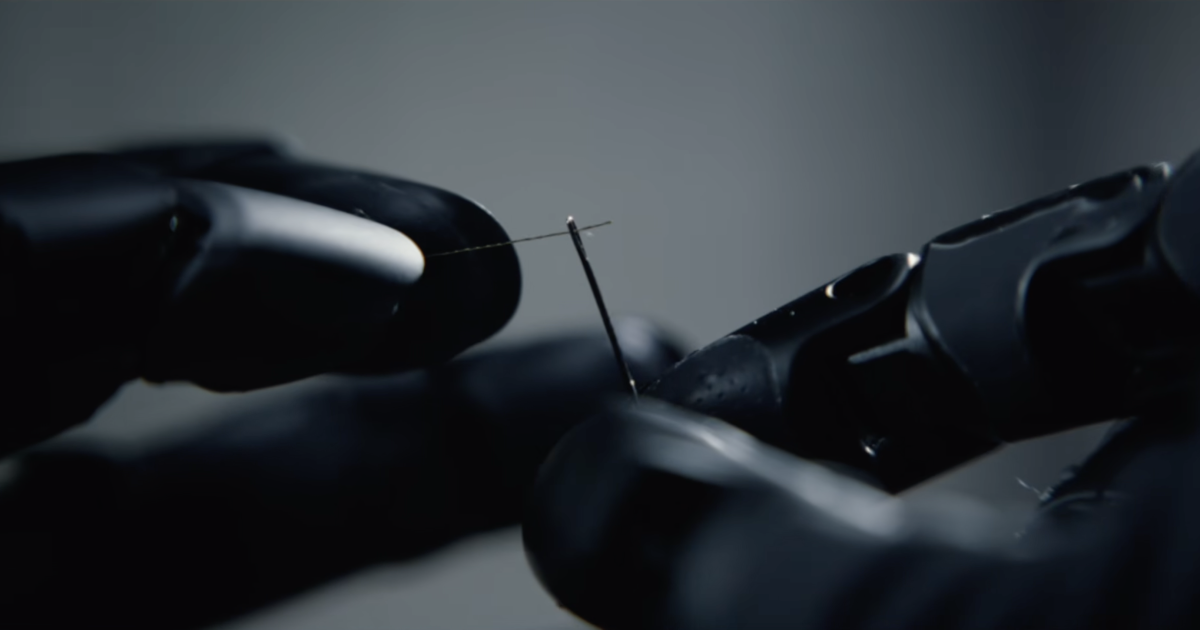
AGILINK's OmniHand 3 Ultra split a silk thread into 16 strands, threaded a needle and made its first stitches in a company video of Suzhou embroidery. Silk slips under small changes in force, so it is a hard test of touch-guided control, and so far the only evidence comes from AGILINK's own video.
The Product Desk · Product desk
Drafted by a language model from the sources cited here and checked against its claim ledger before publication. How we use AISend a correction
What happened
- AGILINK said the hand learned the silk work from teleoperation data combined with reinforcement learning.
- The 630-gram hand drives 21 active degrees of freedom with motors mounted directly at the joints, without tendons or intermediate transmissions.
- Each fingertip has a vision-based sensor that AGILINK says measures force in three dimensions, and the palm carries a 300-point contact sensor.
- Rival hands take other routes: LinkerBot's L30 Pro uses five tendon-driven fingers built for speed, and Boston Dynamics' four-digit Atlas hand targets drills and welding tools.
Compiled by The Product DeskSomething wrong?How this is made
Why it matters
- decision Buying a dexterous hand now means picking a priority: touch-led direct drive for material that shifts, or tendon-driven fingers tuned for fast, repeatable motion.
- cost If the silk recipe is the template, a new task means collecting teleoperation demonstrations and running reinforcement learning on that material, so the hardware price alone understates the bill.
- constraint With only company footage and specs on record, a team piloting the hand has to measure its own success rate on its own material before it can compare the hand with a human worker.
To split the main thread, one finger worked the strands apart while the hand's other fingers kept them taut [2]. During twisting, the fingertips had to stay on the silk and still let the thread rotate [3]. "Silk has no rigid shape. The force of the fingers decides it," AGILINK wrote in the description of its video [4].
What is being pitched and what was actually done are two different things. The pitch is a hand for material that bends, slips and changes shape under small changes in force [5]. What was done is basic technique and the first stitches on a hoop, in a video the company posted [1]. AGILINK is a spin-off of AgiBot [6]. The most useful footage comes at the end. In one continuous twist-and-pick-up, the thread landed in a different place each time, so the hand had to adjust its movements instead of replaying a fixed sequence [7].
The spec sheet suggests how it copes. AGILINK says each fingertip sensor detects surface deformation as small as 0.08 millimetres [8]. The hand's positional repeatability is about 0.2 millimetres [9]. So the fingertips register changes 2.5 times smaller than the distance the hand can reliably return to [17]. On silk, I'd expect the control loop to trust what the fingertip feels over the commanded joint position.
For a team deciding whether to pilot one, I'd sort the task on two axes: whether the material keeps its shape under grip, and whether it lands in the same place each cycle. Rigid parts in fixed positions are the predictable, repetitive work AGILINK sets its approach apart from [10]. Material that deforms and moves is the quadrant this demo speaks to. The two mixed quadrants, rigid parts that wander and soft material held in a fixture, are judgement calls. In those two, I'd give a simpler hand the first trial.
The forcing function is one number: completed cycles out of 100 attempts on the buyer's own material, with the material left to land wherever it lands. If the task deforms and moves, a direct-drive hand with touch sensing in every fingertip, like this one [11][12], is the class to put through that test. The tradeoff is setup. The silk work was taught by embroidery master Fu Xianghong [13], and I'd assume a buyer's own material needs its own teacher.
What to watch
- A published success rate for the silk tasks, counted as completed cycles per attempt, from AGILINK or an independent tester.
- Whether AGILINK shows the hand on a second deformable material without a fresh round of expert demonstration.
- Price and availability for the OmniHand 3 Ultra set against tendon-driven rivals such as LinkerBot's L30 Pro.