Invest1 publisher3 min readPublished
Figure commits $3.5bn of compute to a humanoid market that shipped 19,100 units
Figure's software finished 56% of chores in 30 unfamiliar homes, Boston Dynamics began training Atlas inside a Hyundai plant, and Unitree priced a 22-joint hand at $6,500.
The Investor · Invest desk
What happened
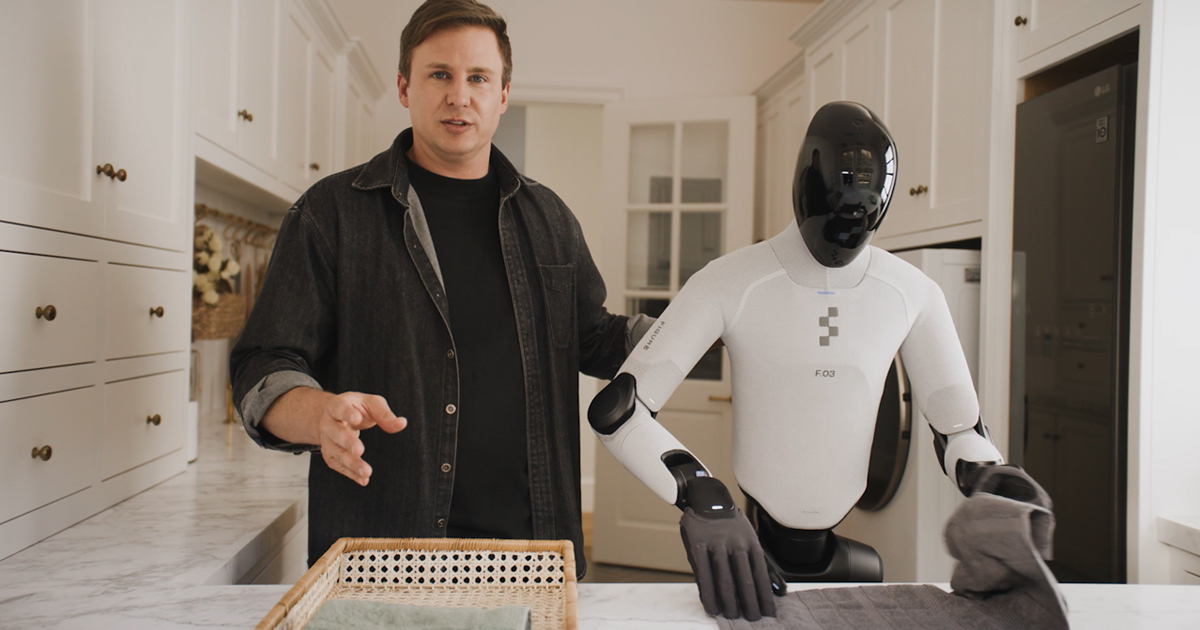
- Figure took its Figure 03 robot into 30 Bay Area homes it had collected no data in and, across 420 attempts at tidying, folding towels and making beds, finished the task 56% of the time.
- Boston Dynamics opened a Robotics Metaplant Application Center inside Hyundai's Metaplant America outside Savannah, where Atlas robots will sort and sequence car parts before they reach assembly.
- Hyundai said it intends to build a U.S. factory able to make up to 30,000 robots a year by 2028.
- Unitree put the Dex5-S on sale from $6,500 before tax and shipping, a dexterous hand with 22 degrees of freedom sized to match a real human hand.
- AgiBot overtook Unitree as the largest humanoid vendor in the first half of 2026, shipping about 8,400 units for 44% of the global market on a 562% rise year over year.
Compiled by The InvestorSomething wrong?How this is made
Why it matters
- constraint About 185 of the 420 attempts ended unfinished, so a household buyer still staffs the chore, and the per-task price stays unknown.
- decision With Cryptopolitan reporting that analysts expect any listing in 2029 or 2030, Atlas training is paid for out of Hyundai group cash, and the robot program competes for allocation against everything else a carmaker builds.
- cost At about $295 a degree of freedom, dexterity becomes a component any integrator can order, and the vendor selling it is Chinese.
- precedent Figure published a control arm alongside its headline number. That sets the test for the next company's home-task claim: what the same robot does without the pretraining set.
The 9% is the more interesting half of Figure's result. An identical model, trained without the company's Index dataset, finished 9% of the same chores, against 56% with it, a factor of about 6.2 [3][3]. Figure said it collected no data in those 30 homes and did no tuning when the robot arrived [2]. Spread over 420 attempts, that is 14 tries a home [1].
Figure says Index grows by about 35 minutes of footage every second, which it puts at roughly 5.7 years of human activity a day [6]. Multiply 35 by the 86,400 seconds in a day and you get 3.02 million minutes, or 5.75 years, so the claim holds [8]. Figure has committed $3.5bn of compute through a partnership with Nscale to keep training Helix, with room to scale past $6bn [7]. That money buys pretraining, not tooling, inventory or a field service organisation.
Boston Dynamics put its robots in a plant instead. Zack Jackowski, its chief product and technology officer, described the new center as a "Robot Behavior Factory" that feeds Atlas high-quality training data [19]. The company does not expect Atlas to handle component assembly until 2030 [5]. The 25,000 units Hyundai says it intends to put across its and Kia's plants is about 1.3 times every humanoid shipped worldwide in the half [8][6].
The center is due to grow roughly tenfold when operations move to a new building next year [10]. Cryptopolitan reported that a senior Hyundai official ruled out a Boston Dynamics IPO in 2027, citing a 528.4 billion won loss in 2025 and the absence of large-scale Atlas deployment, and that analysts expect any listing in 2029 or 2030 [11][12].
The shipments are elsewhere. Chinese manufacturers accounted for more than 97% of about 19,100 humanoids shipped worldwide, with Unitree second on roughly 5,900 units and 31%, its volume concentrated in the G1 [13][15]. Unitree and AgiBot sum to 14,300 units, which is 75% of 19,100, so the 19,100 is the first-half 2026 count [5]. Above 97% Chinese means every other vendor in the world, Tesla and Figure and Agility Robotics included, shipped fewer than 573 units between them [16][4]. Set $3.5bn of committed compute against that and it works out at $6m per unit the non-Chinese industry managed, which is a scale comparison and not a cost per robot [9].
Unitree's hand is the one item here an integrator can put on a purchase order, and Unitree said on X that every joint is backdrivable, so it yields to external force instead of fighting it [18]. In my view the week moved capability into measurable range and left the economics where they were, because none of the three published a price per task, an uptime figure or a robot revenue line. If the Index effect holds as the dataset grows, 2030 for assembly work looks conservative and $3.5bn of compute looks cheap. If completion stalls near 56%, the rest of the job needs a person and what gets sold is supervision. The view fails if the next unseen-home run comes back well above 56% on more attempts, or if one of the three prices a completed task.
What to watch
- Whether Hyundai attaches a site and a capital figure to the 30,000-robots-a-year U.S. plant before 2028.
- Whether Boston Dynamics narrows the 528.4 billion won 2025 loss as the Georgia center scales tenfold next year.
- Whether AgiBot's 562% growth rate holds into the second half, or any American vendor's shipments show up in the share count.