Science1 publisherNot yet confirmed elsewhere2 min readPublished
Acoustic experiments find topology persisting at gapless critical points
Two Nature papers led by Baile Zhang and Jianhua Jiang use sound waves to show topology persisting at gapless critical points. That goes against the long-held rule that topological protection needs an energy gap. The published account gives no measure of how strong the effect is.
The Scientist · Science desk
What happened
- At a critical point in a continuous phase transition the energy gap closes completely and only long-wavelength collective behaviour survives.
- In gapped topological materials, edge states stay robust only against impurities and perturbations that preserve the relevant symmetry.
- Yu's group proposed a classification of topology at quantum critical points in 2022 and a critical bulk-edge correspondence in 2024.
Compiled by The ScientistSomething wrong?How this is made
Why it matters
- constraint Gapped protection covers only symmetry-preserving disorder. Until the papers show which kinds the critical-point version survives, designers cannot assume it tolerates arbitrary fabrication defects.
- constraint One theorist guided both papers, and that makes the pair weaker support for the framework than two unconnected labs would give. An outside replication would add more weight than a third paper from the same collaboration.
- capability A classification first proposed on paper in 2022 now has acoustic experiments behind it. The critical-topology programme can be checked against measurements as well as against other theory.
In the standard account, a topological invariant is defined only while the bulk of a material has an energy gap. Close the gap and the invariant loses its meaning, and the edge states go with it [4]. A critical point in a continuous phase transition is where that gap closes completely, leaving only collective, long-wavelength behaviour [6]. At the same point, materials with very different microscopic make-ups share critical exponents and fall into one universality class, work recognised by the 1982 Nobel Prize in Physics [7]. According to the phys.org account, the two frameworks spent decades as separate domains with limited overlap [11].
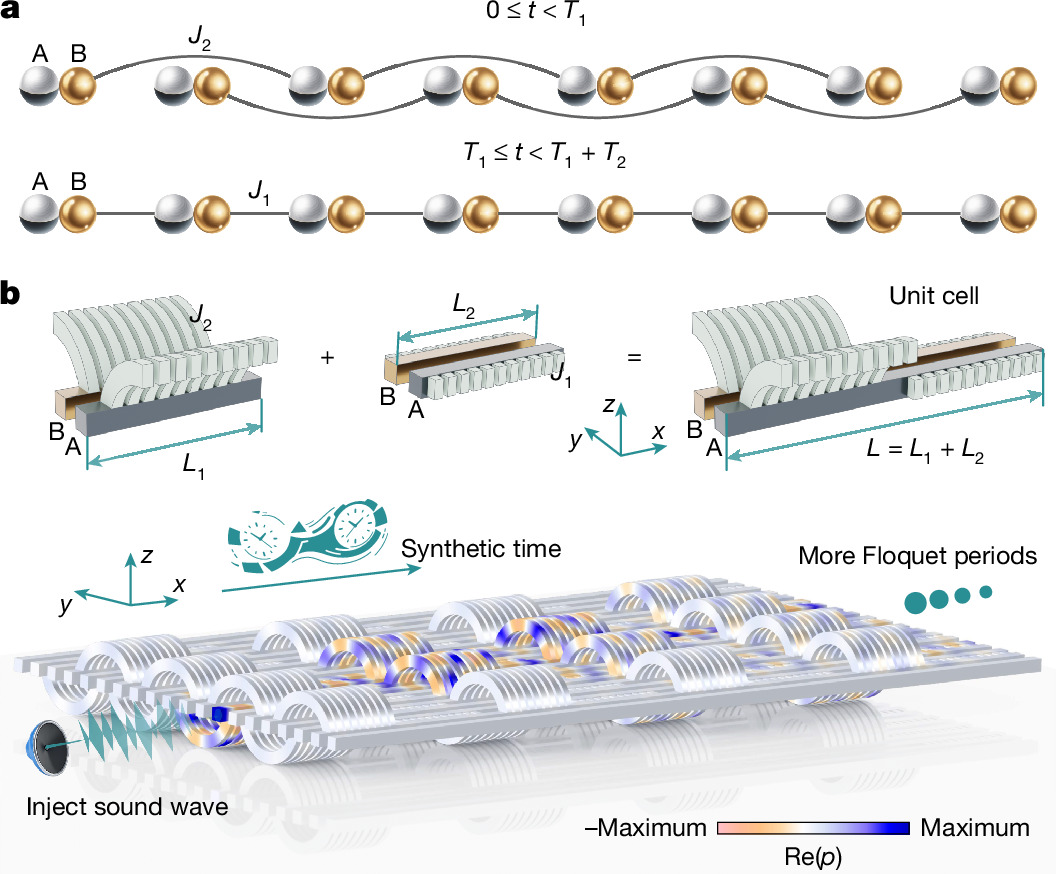
The experiments test a young theory. Yu and collaborators proposed a classification of topology at quantum critical points in 2022, a generalised bulk-edge correspondence for critical points in 2024, and an extension to nonequilibrium dynamics in 2026 [9]. With Limei Xu of Peking University and Hai-Qing Lin of Zhejiang University, Yu was invited to write what the account calls the first comprehensive review of the topic, in Physics Reports [10]. The 2022 theory was framed for quantum critical points [9]. The new tests use sound [1].
The account does not describe the acoustic setups or give the size of the edge signal. Most of its length goes to the theory and to Yu, who was co-corresponding author on both papers and supplied theoretical guidance [3]. That shared author matters when weighing the pair. Separate groups at Nanyang Technological University and the University of Science and Technology of China led the two studies [2]. They were testing a framework with a common theorist, though, so they confirm each other less than two unconnected labs would [2][3].
For anyone hoping to build on this, the useful comparison is the gapped case. There, edge states in the quantum Hall effect and in topological insulators stay robust against impurities and perturbations, but only those that preserve the relevant symmetry [8]. A critical-point version needs its own list of what it survives and what breaks it. For a fabricated acoustic or photonic part, that list is the property that would decide whether the effect is usable.
In my view the papers are a physics result first. They put topology on ground the field had long treated as off limits [5]. The engineering case for defect-tolerant waves at critical points depends on how much disorder the edge signals withstood in the Nature papers, and of which kind.
What to watch
- Whether the Nature papers report the edge signal under deliberately added disorder, and whether that disorder preserves or breaks the protecting symmetry.
- A test of critical topology by a group outside Yu's collaboration, or on a platform other than acoustics.
- Any experiment aimed at the 2026 extension of the theory to nonequilibrium dynamics.