ScienceNot yet confirmed elsewhere1 publisher2 min readPublished
First stellar stream found outside our galaxy turns a faint arc into a dark-matter scale
Astronomers modelled a ribbon of stripped stars around a faint dwarf galaxy to weigh its dark matter, the first time the trick has worked anywhere but the Milky Way.
The Scientist · Science desk
What happened
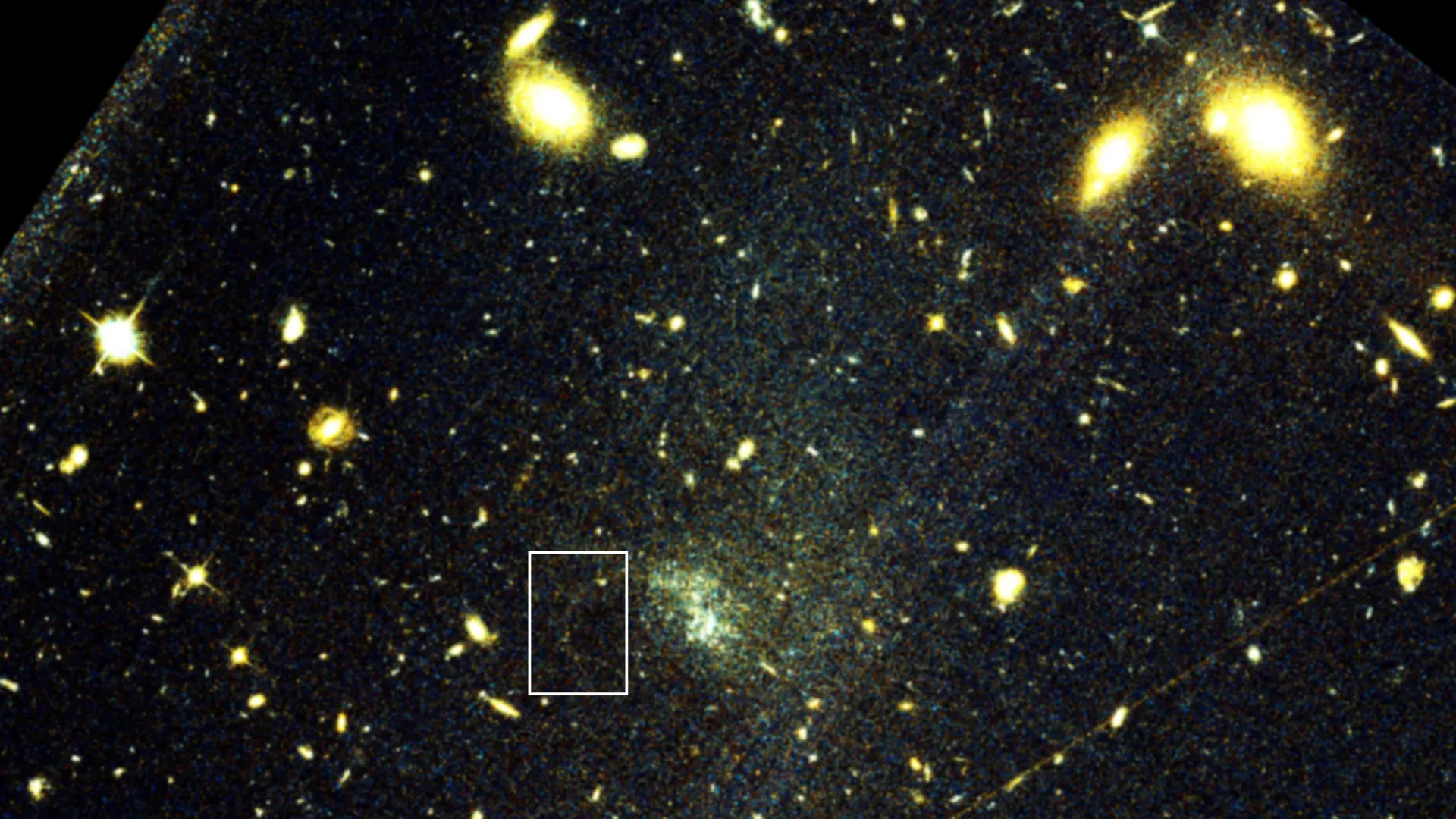
- A faint ribbon of stars around the ultra-diffuse galaxy UGC 9050-Dw1 is the first globular cluster stellar stream identified outside the Milky Way.
- The host galaxy sits roughly 115 million light-years from Earth.
- The arc was noticed in archival Hubble images by a coauthor who was examining the galaxy for a different paper.
- The team used the stream to estimate both how much dark matter surrounds the galaxy and how it is arranged.
- The paper ran in Nature on August 12, co-led by researchers in Copenhagen and at the Technical University of Denmark.
Why it matters
- capability Stream-based weighing now has two galaxies to work with instead of one, so a technique previously tied to our own halo can in principle be repeated elsewhere.
- constraint Faintness against host starlight is still the binding limit, which keeps the method away from bright, star-rich galaxies and towards dim ones.
- precedent Target selection is now defined by empty backgrounds, so the next candidates will be chosen for how few stars they contain rather than for how interesting their halos are.
- cost The expense sits in the modelling rather than the observing: thousands of simulations per stream, paid for in compute and analyst time by whoever wants the halo number.
The measurement is a subtraction, and the ratio between its two terms decides how much it is worth. Every star in the ribbon travels along nearly the same orbit, and that orbit is set by the host galaxy's gravity, so a model of the gravity returns a total mass; take out the mass already accounted for by starlight and the remainder has to be dark. That is how Northwestern's Tjitske Starkenburg, a coauthor, describes the logic [6][7]. She works on extragalactic astronomy at the university's Center for Interdisciplinary Exploration and Research in Astrophysics [c2b]. The helpful asymmetry is that dark matter is about 85 percent of all matter [9], which leaves roughly 15 percent in the term being subtracted [15]. A stellar mass estimate can be wrong by a fair margin and the halo mass still survives it.
What has been missing is a second laboratory. Dozens of globular cluster streams have been catalogued, and until this one every single one sat inside the Milky Way [12]. So every gravitational field reconstructed by this method has belonged to the galaxy we live in, measured from the inside, with our own position and motion baked into the model. An external stream is seen from outside, wrapped around a host picked from a catalogue rather than the one we were issued.
The release is thinner than the framing. No halo mass and no profile shape appear anywhere in Northwestern's summary text, only the statement that both were estimated [17]. That matters for how the result should be quoted: what has been demonstrated is that a stream around another galaxy can be modelled at all, not a published number for this galaxy's halo that anyone can compare against other dwarfs. The team's own forward claim, according to the Northwestern summary, is that the approach could eventually help map how dark matter is distributed across many galaxies [14]. That is a claim about a future sample, and the sample currently has one member in it.
What to watch
- Whether a second extragalactic stream comes out of the same Hubble archive, which is what turns one measurement into a method.
- Whether the halo mass and profile from the simulation grid are published with error bars that can be compared against other dwarfs.
- Whether the approach survives a host with a brighter stellar background, where no empty field hands you the arc.
Clarity's read
What the record supports and how the coverage leans. The claims behind it follow.
Reality
- Evidence62
- Adoption15
- Hype gap+22
- Incentives66
- Confidence58
Claim ledger
Ranked by verification strength, evidence, and original report placement.
- [1]
A faint ribbon of stars around the ultra-diffuse galaxy UGC 9050-Dw1 is the first globular cluster stellar stream ever identified beyond the Milky Way.
- [3]
The stream was spotted in archival NASA Hubble Space Telescope observations presented by coauthors David Sand and Catherine Fielder of the University of Arizona; coauthor David Hendel noticed a faint narrow arc while examining images of UGC 9050-Dw1 for that publication.
- [4]
Researchers used the stream to estimate how much invisible dark matter surrounds the host galaxy and how that matter is distributed.
- [5]
The study was published Aug. 12 in Nature and was co-led by Julie Kiel Holm of the University of Copenhagen and Sarah Pearson of the Technical University of Denmark.
- [6]
Starkenburg: "The stars in a stellar stream all travel along nearly the same orbit, and that orbit is shaped by the galaxy's gravity. By modeling that gravity, we can estimate the galaxy's total mass."
ReportedSupportedSource: Tjitske Starkenburg, Northwestern University, quoted in the releaseView cited source - [7]
Starkenburg: "We already know roughly how much of that mass comes from visible matter like stars, so the rest must be dark matter."
- [8]
Starkenburg is an expert in extragalactic astronomy and a research assistant professor at Northwestern's Center for Interdisciplinary Exploration and Research in Astrophysics.
- [9]
Dark matter accounts for roughly 85% of all matter in the universe and cannot be seen directly because it neither emits nor reflects light.
- [10]
Because UGC 9050-Dw1 contains relatively few stars, it provided an unusually dark background that made the dim stream easier to distinguish.
- [11]
Astronomers long predicted such streams around other galaxies, but the structures are generally so faint that they disappear against the light of their host galaxies.
- [12]
Astronomers have identified dozens of streams produced by globular clusters inside the Milky Way, and until this detection no comparable stream had been found in another galaxy.
- [13]
Once the stream was identified, the team ran thousands of computer simulations.
- [14]
The findings could eventually help scientists investigate how dark matter is distributed across many different galaxies and throughout the universe.
- [15]
Non-dark matter is therefore roughly 15% of all matter, making the visible term the smaller side of the subtraction used to infer a dark halo mass.
- [16]
The number of galaxies with a globular-cluster-stream-based gravitational mass estimate goes from one, the Milky Way, to two.
- [17]
The Northwestern release states that the dark matter amount and distribution were estimated but gives no halo mass value and no profile shape anywhere in its text.
Sources
1 independent publisher whose own reporting we read for this story.
- sciencedaily.comA ghostly ribbon of stars reveals hidden dark matter
1 article · August 24, 2026
Topics and entities
Follow any of these and your For You feed starts watching them — no settings page required.
Topics
Entities
- UGC 9050-Dw1Follow
- Hubble Space TelescopeFollow
- Northwestern UniversityFollow
- Center for Interdisciplinary Exploration and Research in AstrophysicsFollow
- University of CopenhagenFollow
- Technical University of DenmarkFollow
- University of ArizonaFollow
- Tjitske StarkenburgFollow
- Julie Kiel HolmFollow
- Sarah PearsonFollow
- David HendelFollow
- David SandFollow
- Catherine FielderFollow
- NatureFollow