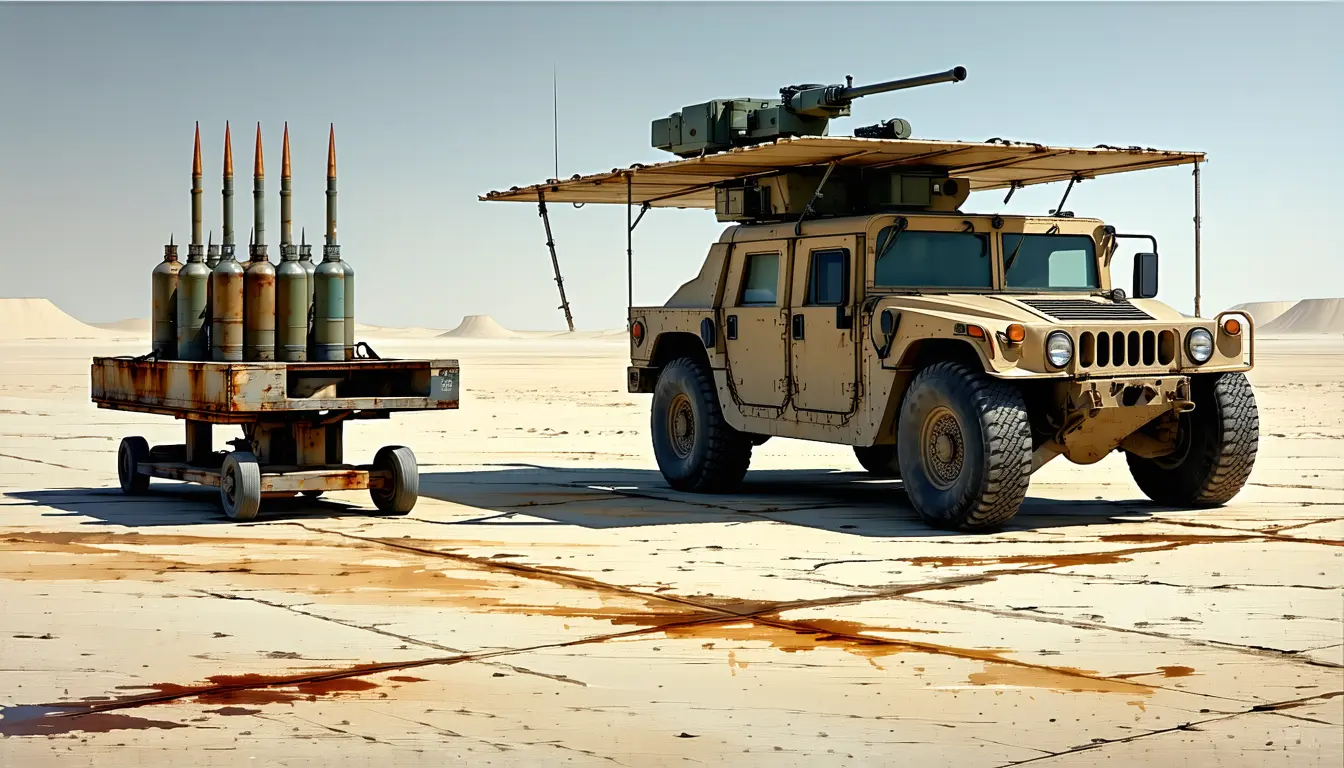
The Army's first AMP-HEL lasers arrive mounted on GM Defense squad vehicles
AeroVironment's two 20kW-class LOCUST prototypes cleared government acceptance testing at Yuma and went through new equipment training at Fort Sill, which finally gives counter-drone planners a delivered mobile system to price against interceptors.
The Product Desk
What happened
- Both lasers are integrated onto the General Motors Defense Infantry Squad Vehicle, after integration work at AeroVironment's directed energy plant in Albuquerque, New Mexico.
- The prototypes passed government acceptance testing at Yuma Proving Ground in Arizona, where the criteria covered performance, mobility, safety, and lethality rather than shot results alone.
- Army units then went through new equipment training on the systems at Fort Sill, Oklahoma, and AeroVironment says soldier feedback from that event is feeding into ongoing enhancements.
Why it matters
- Who has to decide decision Counter-drone program offices weighing lasers against interceptor stockpiles can now argue from accepted hardware on a named chassis with four vehicles in prospect, instead of from a vendor range video.
- What it limits constraint Because the sensing and command layer is only described with the second increment, the first two trucks have to be cued by something a unit already owns, and that borrowed dependency belongs in the cost comparison.
- Who's exposed exposure Once crews have been trained at Fort Sill, AeroVironment's reliability claims stop being a marketing position and start being measured by users who cannot return the product.
- What's now possible capability Testing mobility and safety alongside lethality makes it possible to write tactics and parking rules for a beam weapon, which is the work that has to happen before quantity buys are credible.
The government acceptance testing at Yuma Proving Ground covered performance, mobility, safety, and lethality [5]. Lethality is the one that gets filmed. Mobility and safety are the two that decide whether a platoon can actually operate the thing, and they are the two a range demo can skip. A laser that burns a quadcopter with the truck parked and the range cleared is a physics result, but a laser that gets driven, then handed to Army units at Fort Sill for new equipment training, becomes a piece of equipment somebody has to sign for [6].
Now look at how the capability is split. Increment one is the effector on a light truck: two 20kW-class LOCUST systems from AeroVironment on the General Motors Defense Infantry Squad Vehicle, delivered to the Army's Rapid Capabilities and Critical Technologies Office [1][2][3]. Increment two, which AeroVironment says arrives next month, is the same 20kW-class laser on two Joint Light Tactical Vehicles, this time with radar and command-and-control [12]. Add them and RCCTO holds four vehicles when both increments land [13]. As the release describes them, the first pair carries the beam and the second pair carries the sensing and the cueing [9].
That distinction is the whole comparison against kinetic interceptors. The pitch is cost per shot, effector against effector. The thing being done is a vehicle, a radar, a C2 link, and a crew roster. If your two lasers depend on somebody else's air picture, the honest line item includes the laser plus whatever you had to borrow to point it. Increment two is where that stops being borrowed [12].
AeroVironment's Mary Clum describes LOCUST as extensively validated with demonstrated reliability and operational readiness for the counter-UAS fight [10], and John Garrity says the company stands ready for full-scale manufacturing across mobile and fixed-site platforms [11]. Two accepted prototypes and one training event is enough evidence to write tactics against, though establishing an availability rate, a mean time between failures on a moving vehicle, or a number of engagements per maintenance cycle will take more data than that, and those are the figures a program office will be asked for. The release says soldier feedback from Fort Sill is shaping ongoing enhancements, without saying which ones [6].
Here is the two-question grid I would put any C-UAS candidate through, now that this delivery makes both questions answerable. First: does the effector arrive with its own sensor and command-and-control, or does it borrow them from a system you have not budgeted? Second: has the government tested it moving, or only firing? Increment one, tested for mobility [5], is described as the laser on a truck [9], while increment two, as described, already includes the sensing and cueing [12]. Anything a vendor brings you that fails both questions is a demo with a delivery schedule attached, and the useful thing about AMP-HEL is that it now sets the bar the demo has to clear.
What to watch
- Whether the two JLTV systems with radar and command-and-control actually arrive next month as AeroVironment says, or slip.
- Which specific enhancements from the Fort Sill soldier feedback show up in increment two hardware rather than in a later block.
- Whether RCCTO follows the prototypes with a production quantity and a per-unit price, which is what the full-scale manufacturing offer invites.
Clarity's read
What the record supports and how the coverage leans. The claims behind it follow.
Reality
- Evidence38
- Adoption31
- Hype gap+37
- Incentives81
- Confidence48
Claim ledger
Ranked by verification strength, evidence, and original report placement.
- [1]
Two 20kW-class LOCUST Laser Weapon Systems, a mobile counter-unmanned aircraft system developed by AeroVironment, have been delivered to the U.S. Army.
- [2]
The delivered systems consist of AeroVironment's 20kW-class LOCUST LWS integrated on the General Motors Defense Infantry Squad Vehicle (ISV) platform.
- [3]
The systems were delivered to the U.S. Army Rapid Capabilities and Critical Technologies Office (RCCTO) as the first increment of the Army Multi-Purpose High Energy Laser (AMP-HEL) prototyping effort.
- [4]
Integration was performed at AeroVironment's Directed Energy manufacturing facility in Albuquerque, New Mexico.
- [5]
The AMP-HEL prototypes underwent government acceptance testing at Yuma Proving Ground in Arizona to validate performance, mobility, safety, and lethality.
- [6]
Army units performed new equipment training at Fort Sill, Oklahoma, to prepare for potential employment of directed energy capabilities, and soldier feedback from the event is shaping ongoing enhancements.
- [7]
The AMP-HEL prototyping effort is part of the Army's broader modernization initiative to rapidly develop and field directed energy solutions to defeat threats including drones and other airborne systems.
- [8]
The release describes the ISV as a lightweight, highly mobile platform and frames the integration as a commitment to scalable, adaptable, expeditionary force protection.
- [9]
As described in the release, increment one comprises the LOCUST laser on the ISV, while radar and command-and-control are named only in the description of the second increment on the JLTV.
- [10]
Mary Clum said the milestone marks a major step forward in the Army's pursuit of fieldable directed energy capabilities and described LOCUST as an extensively validated system that has demonstrated reliability and operational readiness for the counter-UAS fight.
- [11]
John Garrity said the time is now for directed energy to get into the hands of warfighters and that AeroVironment stands ready for full-scale manufacturing of LOCUST systems, including AMP-HEL and other mobile and fixed-site platforms.
- [12]
AeroVironment is set to deliver the second increment of AMP-HEL next month: two Joint Light Tactical Vehicles with a 20kW-class LOCUST LWS, radar, and command-and-control systems.
- [13]
Across both increments the Army's RCCTO would hold four laser-armed vehicles: two Infantry Squad Vehicles and two Joint Light Tactical Vehicles.
Get this ledger inside ChatGPT. Ask about any of our stories and the answer brings its figure, each claim’s verdict and the sources. Free, no account.
Sources
1 independent publisher whose own reporting we read for this story.
Topics and entities
Follow any of these and your For You feed starts watching them — no settings page required.
Topics
- Directed-Energy WeaponsFollow
- Counter-Drone SystemsFollow
- Army Modernization and Rapid PrototypingFollow
- Defense Vehicle IntegrationFollow
Entities
- John GarrityFollow
- Infantry Squad VehicleFollow
- Yuma Proving GroundFollow
- Fort SillFollow
- Joint Light Tactical VehicleFollow
- Army Multi-Purpose High Energy LaserFollow
- General Motors DefenseFollow
- Mary ClumFollow
- AeroVironmentFollow
- LOCUST Laser Weapon SystemFollow
- U.S. Army Rapid Capabilities and Critical Technologies OfficeFollow