Skapion sets a 97% intercept target for 100-plus drones before any live-fire test
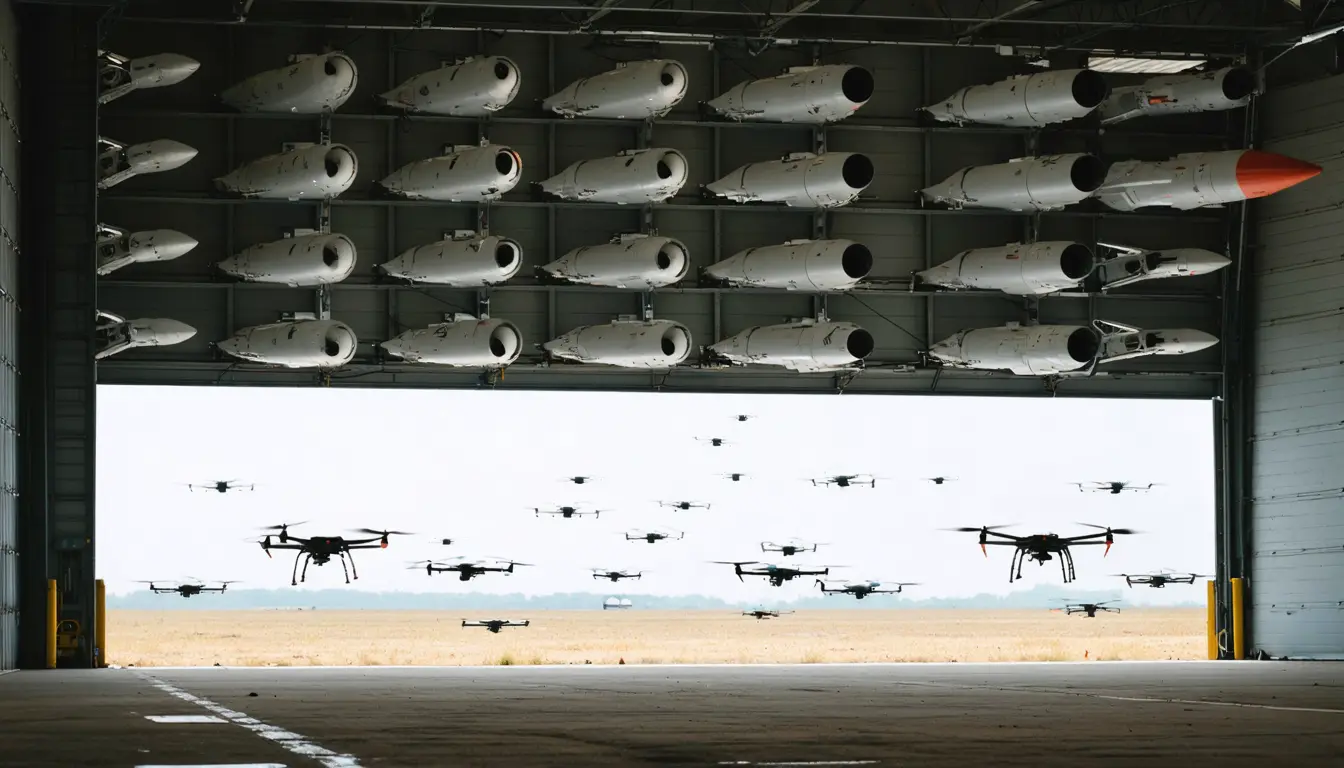
Skapion unveiled a counter-swarm interceptor system on October 14 that it says can engage more than 100 targets at once at over 97% success. Both figures are company-reported targets, and the first live-fire test is planned for the coming weeks.
The Product Desk
Three figures: up to 50 interceptors expected in Skapion's planned first live-fire test; more than 100 targets at once, which Skapion says the system is designed to engage; and an interception rate exceeding 97 percent, a company-reported target not yet shown in a live-fire test.
| Figure | Value | Note | Claim |
|---|---|---|---|
| Interceptors in planned first live-fire test, up to | 50 interceptors | 15 | |
| Targets engaged at once, more than | 100 targets | Skapion says, design figure | 2 |
| Interception rate, company target, over | 97% | not yet shown in a live-fire test | 3 |
What happened
- The design is many-to-many: several interceptors can be assigned to several targets at once, run by an AI command system that prioritizes threats and allocates interceptors.
- Its interceptors are fully kinetic, so they physically engage targets and do not rely only on electronic jamming.
- The planned test is expected to use up to 50 interceptors against small Class 2 and Class 3 drones, with a proximity-based kill mechanism.
- Skapion is aiming for an operational test evaluation in 2027 and hopes to reach operational capability in the second half of that year.
Why it matters
- What it costs cost The $10,000 interceptor cost is an aim at scale. The company did not state an early-production price for an early buyer to budget against.
- What it limits constraint Until Skapion says how many drones the planned test will fly, the 100-target claim cannot be checked against the test as described.
- Who has to decide decision A buyer can hold Skapion's row open for the live-fire result due within weeks, or commit evaluation time now against figures the company itself calls targets.
Take the person who has to put Skapion into a comparison table on Monday. The announcement hands over two numbers to copy: more than 100 simultaneous targets and an interception rate above 97 percent [2]. Interesting Engineering reports that both are company-reported performance targets, and that the system has not shown them in a public live-fire test [3].
We think the number gets copied and the caveat stays in the press release.
What is pitched goes beyond the architecture. According to the company, the system can run autonomously or with a human supervising engagements, depending on customer policy [5]. Interesting Engineering also reports engagement distances of roughly 1 to 7 kilometers, with either electro-optical or radio-frequency seekers [14].
What has been done is funding and a track record. The startup raised $36 million in seed money earlier in 2026, led by UP.Partners and Khosla Ventures [9]. Pini Yungman, a retired brigadier general and the company's founding architect, once headed the Air and Missile Defense Systems division at Rafael and worked on Iron Dome and David's Sling [7]. Interesting Engineering writes that this background informs the company's approach but does not alone establish the new system's performance [8].
The kinetic choice has a stated reason. Interesting Engineering says physical interception could matter against drones that operate autonomously or do not rely on communication links that can be disrupted [10]. The cost pitch has one too: militaries may end up spending expensive air defense weapons on drones that cost far less to build, an unfavorable exchange over a prolonged attack [11].
Two questions sort every figure on a vendor sheet: has it been shown in a live-fire test, and does your decision depend on it. A figure that is shown and matters goes in the table. A figure that does not matter can be dropped whether or not it has been shown. The cell that needs handling is the one where the figure is not shown and your decision turns on it.
Today that cell holds the 97 percent rate [2], the 100-target count [2], the 1-to-7-kilometer range [14] and the $10,000 interceptor [13]. We would put them in a column headed "claimed" and move each across only when test data covers it. The tradeoff is a thin row for Skapion until the first live-fire test, planned for the coming weeks, produces something to move [12].
What to watch
- The first live-fire result: how many target drones were flown, and whether the hit rate comes near 97%.
- Any price Skapion quotes for early-production interceptors, set against the $10,000 at-scale aim.
- Whether the company publishes the kill criteria for the proximity-based mechanism used in the test.
Clarity's read
What the record supports and how the coverage leans. The claims behind it follow.
Reality
- Evidence20
- Adoption3
- Hype gap+35
- Incentives70
- Confidence55
Claim ledger
Ranked by verification strength, evidence, and original report placement.
- [1]
Skapion announced its system, which it calls the world's first 'Native Counter-Swarm' defense system, on October 14, as defense companies gathered for the Association of the U.S. Army's 2026 Annual Meeting & Exposition in Washington, D.C.
- [2]
Skapion said the mobile, kinetic system is designed to engage more than 100 targets simultaneously, with an interception rate exceeding 97 percent.
- [3]
The 100-plus target and 97 percent figures are company-reported performance targets, and the system has not yet publicly demonstrated those results in a live-fire test.
- [4]
Skapion's many-to-many architecture lets multiple interceptors be assigned to multiple targets at the same time, and an AI-based command-and-control system is designed to combine sensor information, prioritize incoming threats, allocate interceptors, and manage engagements in real time.
- [5]
The system is intended to operate autonomously or with a human operator supervising engagements, depending on customer policy, according to the company.
- [6]
Skapion's interceptors use a fully kinetic approach, meaning they physically engage targets rather than relying solely on electronic jamming.
- [7]
Skapion's founding architect, retired Brig. Gen. Pini Yungman, previously led Rafael's Air and Missile Defense Systems division and contributed to Israel's Iron Dome and David's Sling programs.
- [8]
Interesting Engineering wrote that the founders' background informs the company's approach but alone does not establish the new system's performance.
- [9]
Skapion raised $36 million in seed funding earlier in 2026, with UP.Partners and Khosla Ventures leading the round.
- [10]
Interesting Engineering said the kinetic approach could be relevant against drones that operate autonomously or do not rely on communication links that can be disrupted.
- [11]
Militaries may end up using expensive air defense weapons against drones that cost far less to build, creating an unfavorable resource exchange during prolonged attacks.
- [12]
Skapion plans to conduct its first live-fire test in the coming weeks.
- [13]
Skapion aims to bring the cost of each interceptor down to approximately $10,000 at scale.
- [14]
Interesting Engineering reported that the interceptors are designed to engage drones at distances of roughly 1 to 7 kilometers and may use either electro-optical or radio-frequency seekers.
- [15]
The planned live-fire test is expected to involve up to 50 interceptors targeting small Class 2 and Class 3 drones, using a proximity-based kill mechanism. The source does not state how many target drones will be flown.
- [16]
Skapion is aiming for an operational test evaluation in 2027, with a hoped-for operational capability in the second half of that year.
Get this ledger inside ChatGPT. Ask about any of our stories and the answer brings its figure, each claim’s verdict and the sources. Free, no account.
Sources
1 independent publisher whose own reporting we read for this story.
- interestingengineering.com‘World-first’ counter-drone system targets swarms with an interception rate above 97%
1 article · October 15, 2026
Topics and entities
Follow any of these and your For You feed starts watching them — no settings page required.
Topics
- Defense startupsFollow
- Counter-Drone SystemsFollow
- Military AIFollow
Entities
- RafaelFollow
- Up.PartnersFollow
- SkapionFollow
- Interesting EngineeringFollow
- Pini YungmanFollow
- Khosla VenturesFollow