Science1 publisher2 min readPublished
Weak magnetic fields from the Big Bang may have sped up hydrogen formation, simulations suggest
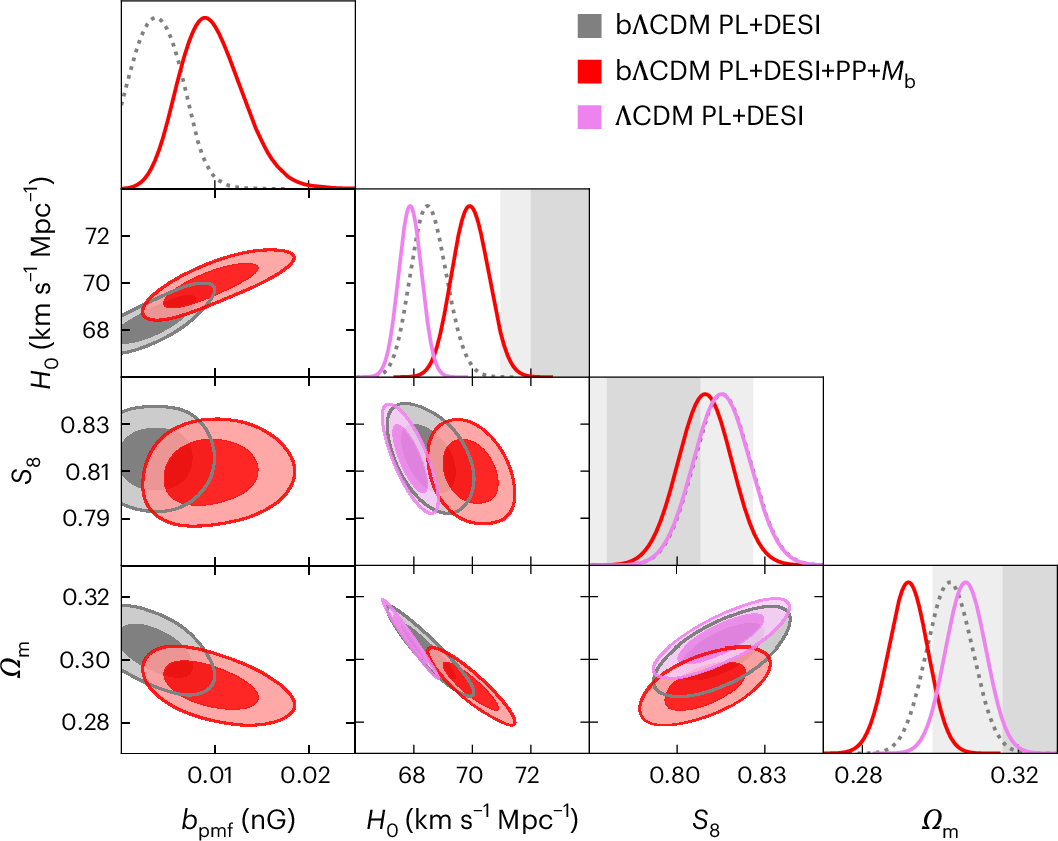
Cosmologists' simulations suggest primordial magnetic fields may have sped hydrogen formation, shifting the 67 km/s/Mpc rate read from the CMB. That gives the 6 km/s/Mpc Hubble tension a physical cause.
The Scientist · Science desk
Drafted by a language model from the sources cited here and checked against its claim ledger before publication. How we use AISend a correction
What happened
- Supernova distances calibrated against Cepheid stars, using the Hubble and Webb telescopes, put the expansion rate near 73 km/s/Mpc.
- In 2011, two of the authors pointed out that primordial fields would influence recombination, when electrons and protons first formed neutral hydrogen and the universe became transparent.
- The fields would push and pull on charged particles, making matter slightly clumpy so that crowded regions form hydrogen more readily and recombination comes sooner.
- Primordial magnetic fields were first studied as an explanation for the large-scale magnetism threading galaxies, clusters and possibly cosmic voids.
Compiled by The ScientistSomething wrong?How this is made
Why it matters
- capability A change to recombination physics would let the Planck-based and supernova-based values both be correct, locating the error in the model's early-universe assumptions.
- constraint Until the size of the shift is published with the field strength it requires, the proposal cannot be scored against the 6 km/s/Mpc gap it is meant to close.
- precedent Because the fields would leave their own imprints in CMB and other data, the hypothesis can be tested apart from how well it fits the Hubble numbers.
The cosmic microwave background figure of about 67 km/s/Mpc is an inference. Planck measured tiny fluctuations in the afterglow of the Big Bang, and the expansion rate comes out of a cosmological model tuned to match those patterns [1]. That model assumes a particular history for the moment the light was released. If clumpier matter brought recombination forward, the pattern the model is matched against was set at a different time, and the expansion rate read from it moves [8].
The new simulations add that step to the earlier argument. According to the authors, detailed simulations show the fields could have changed hydrogen formation enough to affect both the CMB and the rate inferred from it [8]. The researchers wrote the account themselves for The Conversation, and ScienceDaily republished it on October 4, 2026 [9]. The account does not include the field strength the simulations used, how far the inferred value moved, or where the work was published.
The target is about 6 km/s/Mpc, the distance between the two measurements [1]. That is roughly 9 percent of the CMB value [2]. The authors call the difference statistically highly significant [3]. Primordial fields would let both measurements stand, because the change sits in the early-universe physics the model assumes. "If both methods are correct, then our standard model of cosmology must be missing something important," the authors wrote [4].
Easing the tension makes the fields a better fit to two numbers, but showing they are real takes a separate measurement. Searches for their imprints in the CMB and other data have run for decades, and the authors note those searches also probe energies far beyond anything achievable on Earth [10]. The recombination idea dates to 2011, 15 years before this account appeared [3].
I think the proposal becomes persuasive if a single field strength fits the Hubble data, survives those imprint searches, and is enough to seed the magnetism in galaxies and clusters that the fields were first invoked to explain [5].
What to watch
- The published figure for how far the simulated fields move the CMB-inferred Hubble constant, and the field strength that requires.
- Whether that field strength is consistent with limits from searches for magnetic imprints in the cosmic microwave background and other data.
- Whether the same field strength is enough to seed the magnetic fields observed in galaxies and clusters.