Science1 publisher2 min readPublished
Female gray tree frogs pick the best caller less often as rival calls pile up in the lab
Female gray tree frogs got slower and worse at picking the most attractive call when up to seven weaker rivals played, an iScience study of 60 frogs finds. Because the calls never overlapped, hearing problems cannot explain the decline, though nobody has yet tested whether it changes which males mate in a real chorus.
The Scientist · Science desk
Drafted by a language model from the sources cited here and checked against its claim ledger before publication. How we use AISend a correction
What happened
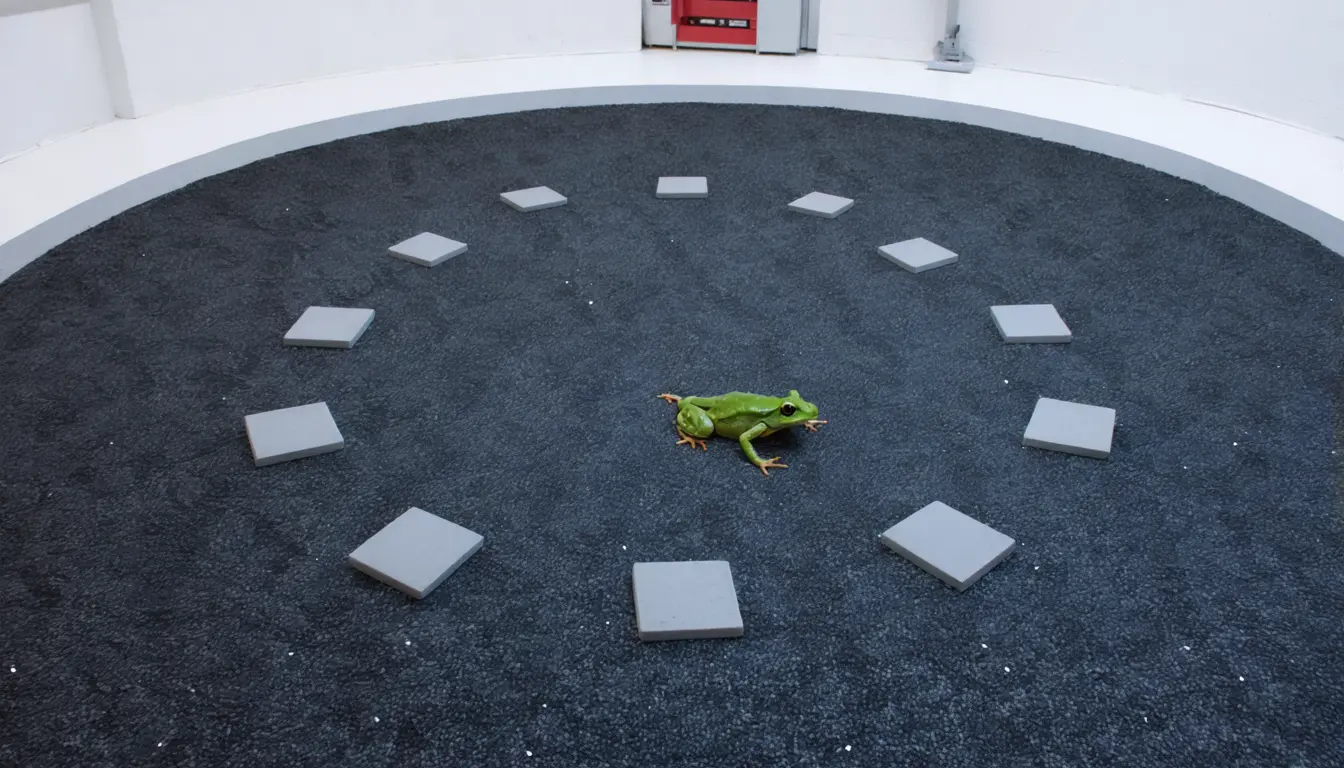
- Each female chose between one long, attractive target call and one, three or seven shorter distractor calls, hopping toward the speaker she preferred.
- The recordings played one after another with no overlap, which let the researchers rule out energetic masking, the usual explanation for weak preferences in choruses.
- With more distractors, females also became more likely to make no choice at all within the 10-minute trial window.
- The authors suggest less attractive males might gain by joining large choruses and attractive males by calling alone, a possibility they have yet to test.
Compiled by The ScientistSomething wrong?How this is made
Why it matters
- decision Field researchers who explain weak female preferences in choruses by masking alone now have to separate the number of calling males from how much their calls overlap.
- constraint Random choice already drops from 1 in 2 to 1 in 8 as options grow, so how strong the finding is depends on proportions the published account does not give.
- exposure If the effect holds in ponds, less attractive males in big choruses could pass on call traits linked to poorer offspring fitness.
The key design choice was to play the calls one at a time. In a real pond, calls overlap. Biologists have usually blamed weak female preferences in choruses on energetic masking, where overlapping signals stop a female from detecting or telling apart individual calls [6]. In this study the recordings played in sequence, so no two calls ever overlapped [3], and masking cannot explain the decline [5]. That leaves the female's decision-making. "The challenge comes from having too many males to choose from, not from being unable to hear the males clearly," one of the study's authors wrote in an account published by phys.org [14].
Chance performance matters here. Each trial offered two, four or eight calls in total [1]. A female hopping toward a speaker at random would hit the long call half the time with one distractor, and one time in eight with seven [2]. Some fall in hits is built into the design. What matters is how far above that floor the females stayed. The account reports which way the effects went but not the proportions, so the effect size cannot be checked from it. Random choice does not predict longer decision times, though, or more females choosing nothing within the 10-minute window [4]. Both point the same way as the hit rate.
The step to the wild is larger than the lab result. The arena capped the choice at eight calls and removed vegetation and predator risk [10]. A wild gray tree frog chorus can hold dozens or even hundreds of calling males [11]. The authors say the next step is measuring how much choice overload matters in a real chorus. There, they expect sensory and cognitive processing are probably both at work [12].
The stakes for sexual selection come from the calls themselves. Females favour longer calls [7], and call traits in this species are linked to offspring fitness [8]. If overload blurs that preference in a pond, the authors suggest, less attractive males might do better by joining bigger choruses and attractive males by calling in small groups or alone [9]. The experiment measured hops toward speakers. It did not measure matings.
I think the design supports a cognitive explanation for what happened in the arena. The claim that limited attention shapes who mates in the wild is, for now, the authors' proposal. Similar choice-overload effects have been reported in bees choosing flowers and ants comparing nest sites [13]. "We're particularly interested in seeing whether, in natural choruses, decisions do take longer and females really end up mating with less preferable males," the author wrote [15].
What to watch
- Field trials in natural gray tree frog choruses testing whether larger choruses slow female decisions and shift matings toward less preferred males.
- Evidence on whether less attractive males actually concentrate in larger choruses while attractive males call in small groups or alone.
- The iScience paper's proportions showing how far above the 1-in-8 chance level females stayed with seven distractor calls.