Synchrotron X-rays and machine learning separate two palm genera in 160 manuscript and reference samples
Researchers using X-rays from PETRA III and ESRF plus machine learning told two palm genera apart across 160 palm-leaf samples. The npj Heritage Science authors say regional origin cannot yet be attributed, since some provenance groups were small and aging effects were only partly assessed.
The Scientist · Science desk
What happened
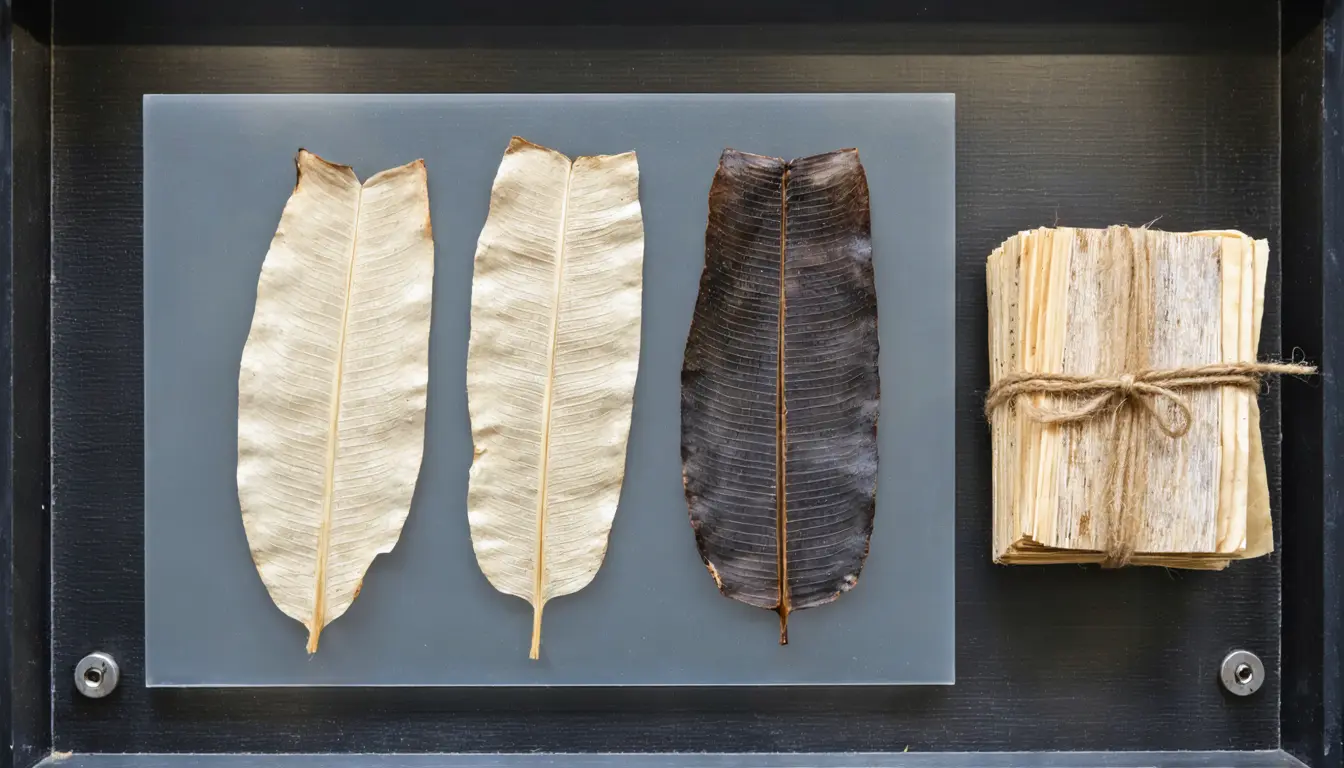
- The sample set mixed 85 manuscripts with 75 modern reference materials drawn from several collections and regions in South and Southeast Asia.
- The analyses are nondestructive, so no material has to be cut from a fragile manuscript.
- After treatment the differences between the two genera grew, so the measured properties reflect both botanical origin and how each genus responded to processing.
- Sri Lankan and southern Indian samples looked materially similar, while the Thai samples showed a comparatively distinct profile.
Why it matters
- What's now possible capability Conservators can compare many fragile objects in one systematic scheme without taking samples, which is the practical gain the first author points to.
- What it limits constraint Museums cannot yet use these data to say where a manuscript was made: some provenance groups were small, so regional attribution stays a hypothesis.
- Who has to decide decision A collection weighing this method should use it for genus and processing questions now and hold origin claims until larger reference sets exist for each region.
Nearly half the data set is modern reference material: 75 of 160 entries, or 46.9 percent [1][17]. That matters for reading the manuscript results, because the authors say the influence of aging and preservation conditions could only be partially assessed [11]. The data cannot yet separate how much of a measured difference between a manuscript and a reference leaf comes from centuries of storage and how much from the way the leaf was prepared.
The team measured three things at once. Small-angle scattering reads the structure and orientation of fiber networks, wide-angle scattering the balance of crystalline cellulose and amorphous material, and X-ray fluorescence the distribution of elements [5]. Machine learning then worked on the combined data, drawing on structural and chemical characteristics together [6]. None of it requires a sample to be removed from the object [4]. Laura Gallardo, first author and a scientist at Hamburg University of Technology, said: "For rare and fragile cultural artifacts, the ability to obtain rich structural and chemical information without taking a sample is essential." [13][16]
The team set out to distinguish genera, identify processing stages and look for links to provenance [14]. The two genera separated comparatively reliably [7]. For processing stages, what phys.org reports is indirect: treatment sharpened the differences between genera [8]. The account gives no classification accuracy, genus names or counts per provenance group, so "comparatively reliably" carries no error rate.
Origin was harder. Samples from Sri Lanka and southern India showed substantial material similarities, which the authors say may be associated with related processing traditions [9]. The Thai samples had a comparatively distinct profile [10]. Even so, reliable geographical attribution is not yet possible, because some provenance groups had relatively few samples [11].
Patrick Huber, who directs the Institute of Materials and X-ray Physics at TU Hamburg, said: "The material data alone cannot yet establish geographical provenance with certainty." [12][15]
In our view, conservators can use the method now to ask which genus and what processing a leaf shows. Any origin signal is a lead to check against other evidence.
What to watch
- Larger reference sets for the provenance groups that were represented by relatively few samples.
- Work that measures how aging and preservation conditions alter the same X-ray signatures.
- Published classification accuracy for genera and individual processing stages.
Clarity's read
What the record supports and how the coverage leans. The claims behind it follow.
Reality
- Evidence50
- Adoption
- Not scored
- Hype gap−10
- Incentives
- Not scored
- Confidence55
Claim ledger
Ranked by verification strength, evidence, and original report placement.
- [1]
The study examined 160 material entries: 85 manuscripts and 75 modern reference materials.
- [2]
The materials came from different collections and regions across South and Southeast Asia.
- [3]
The researchers combined X-ray analyses at PETRA III at DESY (station P62) and at the ESRF in Grenoble with machine learning; the work is published in npj Heritage Science.
- [4]
The analyses are nondestructive: no samples need to be removed from fragile historical objects.
- [5]
Small-angle X-ray scattering (SAXS) provides information about the structure and orientation of fiber networks; wide-angle X-ray scattering (WAXS) about the relative contributions of crystalline cellulose and amorphous substances; X-ray fluorescence (XRF) maps the distribution of chemical elements.
- [6]
The team used machine learning to analyze the measurement data together, drawing on combinations of structural and chemical characteristics rather than a single measurement.
- [7]
The two palm genera examined can be distinguished comparatively reliably on the basis of their material characteristics.
- [8]
After treatment, the differences between the palm genera became more pronounced, so the measurable properties reflect not only botanical origin but also different responses of both genera to manufacturing practices.
- [9]
Samples from Sri Lanka and southern India showed substantial material similarities, which may be associated with related processing traditions.
- [10]
The Thai samples displayed a comparatively distinct material profile in the data set.
- [11]
Reliable geographical attribution is not yet possible, as some provenance groups were represented by relatively few samples and the influence of aging and preservation conditions on the material properties could only be partially assessed.
- [12]
"The material data alone cannot yet establish geographical provenance with certainty."
- [13]
"For rare and fragile cultural artifacts, the ability to obtain rich structural and chemical information without taking a sample is essential."
- [14]
The team investigated whether material properties could help distinguish the palm genera used, identify different stages of leaf processing and reveal possible links to geographical provenance.
- [15]
Patrick Huber is director of the Institute of Materials and X-ray Physics at TU Hamburg and head of the High-Resolution X-Ray Analytics of Materials research group at DESY.
- [16]
Laura Gallardo is first author of the study and a scientist at Hamburg University of Technology (TU Hamburg).
- [17]
Modern reference materials were about 46.9 percent of the 160 entries.
Get this ledger inside ChatGPT. Ask about any of our stories and the answer brings its figure, each claim’s verdict and the sources. Free, no account.
Sources
1 independent publisher whose own reporting we read for this story.
- phys.orgPalm-leaf manuscripts reveal traces of their preparation through X-rays and machine learning
1 article · October 15, 2026
Topics and entities
Follow any of these and your For You feed starts watching them — no settings page required.