InvestNot yet confirmed elsewhere1 publisher3 min readPublished
Exporters' dollar sales hold the won to a 0.75% slide on a 5.46% Kospi plunge
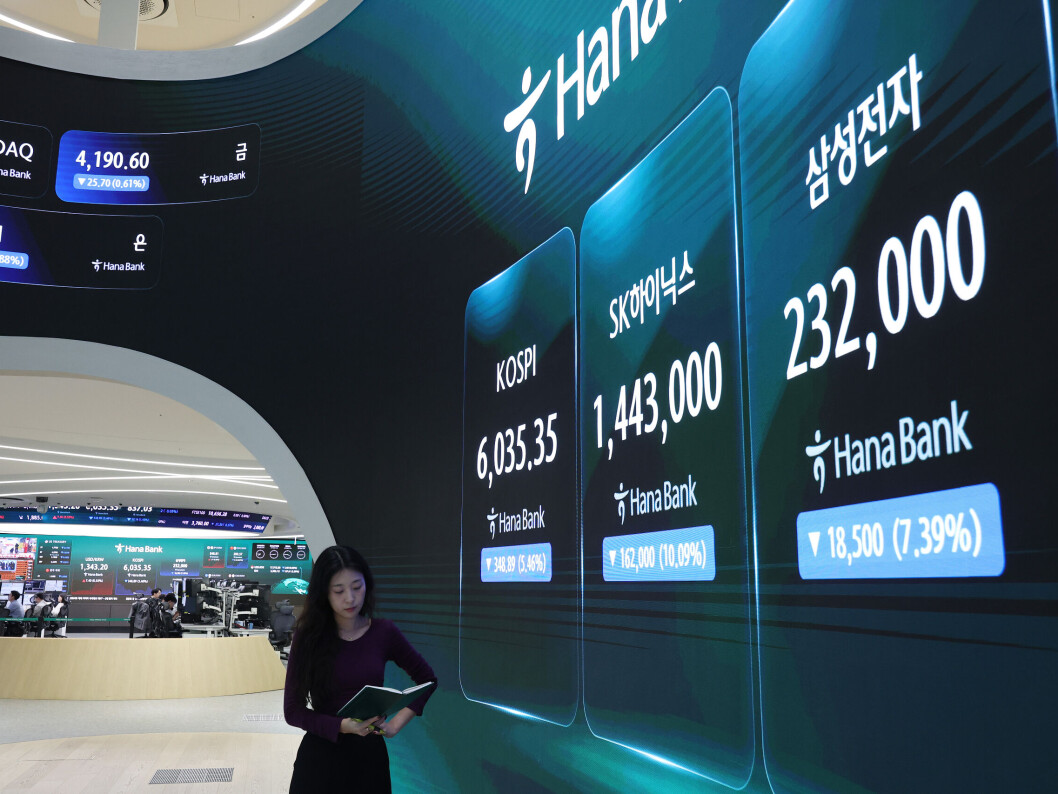
Korea's won weakened 0.75% to 1,345.1 per dollar on a day foreign investors sold more than 4.5 trillion won of Kospi shares in a 5.46% fall. Exporters' dollar sales blunted the demand for dollars, Korea JoongAng Daily reported, so a short-won hedge recovered little of the equity loss.
The Investor · Invest desk
A share bar: about 0.74 points of the roughly 6.2% loss an unhedged dollar-based holder of the index took on the day came from the won leg. That is roughly 12% of the loss, which a short-won hedge, before forward points, would have recovered.
- Won leg of dollar loss, about, claim 19 0.74 of 6.2 points 12%
Won leg of dollar loss, about The whole
| Share | Part | Whole | Percent | Claim |
|---|---|---|---|---|
| Won leg of dollar loss, about | 0.74 points | 6.2 points | 12% | 19 |
What happened
- The plunge triggered a sell-side sidecar, a five-minute halt to program trading, and the index briefly dipped below 6,000 before closing at 6,035.35.
- A day earlier the won had strengthened into the 1,333 range per dollar, its strongest level in two years.
- Record semiconductor exports have Korean companies converting large dollar earnings into won, which left an unusually heavy supply of dollars in the market.
- A securities industry source said third-quarter earnings forecasts were first prepared at 1,440 won per dollar, and the rate has since strengthened by more than 100 won.
Why it matters
- exposure An unhedged dollar-based holder of the index lost about 6.2% on the day, and the won leg was about 0.74 points of that, so a short-won hedge recovered roughly 12% before forward points.
- decision A manager with Korea exposure has to choose whether the won leg is sized as protection against equity drawdowns or held as a separate position on exporter dollar flow.
- cost At Tuesday's close a dollar of export sales converts into about 6.6% fewer won than the forecast rate assumed, so won-denominated earnings fall even if sales volumes hold.
- constraint According to iM Securities' Park Sang-hyun, foreign net selling is unlikely to ease until volatility in the won subsides, so a return of foreign buying has a currency condition attached.
Ten won on a prior close of 1,335.1 [15] is a 0.75% move [16]. The index fell 5.46% [7], so it fell about 7.3 times as far as the exchange rate rose [17]. The direction was the one the usual rule predicts, since foreign investors who sell and take their gains out do so in dollars [13]. The size was a fraction of it. In our view the correlation has shrunk more than it has broken, or rather it was swamped on this session by a flow of dollars the stock market does not set, and one session is a thin base for anything stronger.
The offset came from exporters. Korea JoongAng Daily quoted a foreign exchange trader at a commercial bank but did not name the trader. "Dollar supply continues from factors such as the conversion of SK hynix's U.S.-listed American depositary receipts and dollar selling by exporters." [2] The same trader said more sellers "are now looking to unload dollars in advance" [3]. Min Kyung-won, a researcher at Woori Bank, said: "Even if semiconductor stocks undergo a correction, the supply of dollars backed by actual exports will continue separately." [4]
Park Sang-hyun, a researcher at iM Securities, described a second channel that runs the other way. "This is a phenomenon that was rarely seen in the past," he said [20]. He gave a reason. "If we had to identify a reason, the sharp appreciation of the won's value and increased currency volatility appear to be encouraging foreign investors to sell Korean equities." [21] The article adds that some analysts see foreigners selling to pare the losses they would take converting gains into dollars [22]. If that holds, the strong won is partly a cause of the foreign selling it appeared to survive.
We think the near-term lesson is narrow. Min expects exporters to keep selling. In his words: "That means dollar selling is likely to emerge whenever the exchange rate rises [and the won weakens]." [6] On that view the won lags the index in a sell-off for as long as the export flow lasts. A short-won hedge pays little. The article does not address hedging, so that step is ours.
Ahn Ki-tae of NH Investment & Securities makes the counter-case. It is a fair one. In his words: "Strong exports support a stronger won, but dollar demand from foreign direct investment, including investment in the United States, as well as overseas investment by institutions such as the National Pension Service, is expected to offset part of the dollar supply." [23] He said: "The dollar-won exchange rate is likely to remain in the mid-to-high 1,300 won range." [24] If that offsetting demand grows, the export cushion thins and the old link returns.
Two things would prove us wrong: a session of similar foreign selling in which the won moves several times 0.75% [16], or a day on which exporters stop selling dollars into weakness. The article covers a single session.
What to watch
- The size of the won's move on the next heavy foreign-selling session: several times Tuesday's move would mean the exporter cushion has thinned.
- Whether analysts cut third-quarter earnings estimates to reflect the stronger won.
Clarity's read
What the record supports and how the coverage leans. The claims behind it follow.
Reality
- Evidence55
- Adoption
- Insufficient
- Hype gap+10
- Incentives
- Insufficient
- Confidence55
Claim ledger
Ranked by verification strength, evidence, and original report placement.
- [1]
Record-breaking semiconductor exports have led Korean companies to convert a large amount of dollar earnings into won, creating an unusually heavy supply of dollars in the market.
ReportedSupportedSource: Korea JoongAng Daily2 sources— create a free account to open themView cited source - [2]
An unnamed foreign exchange trader at a commercial bank said: "Dollar supply continues from factors such as the conversion of SK hynix's U.S.-listed American depositary receipts and dollar selling by exporters."
ReportedSupportedSource: Unnamed foreign exchange trader at a commercial bank, quoted by Korea JoongAng Daily2 sources— create a free account to open themView cited source - [3]
The same trader said more sellers "are now looking to unload dollars in advance" because they are worried the exchange rate could fall further.
ReportedSupportedSource: Unnamed foreign exchange trader at a commercial bank, quoted by Korea JoongAng Daily2 sources— create a free account to open themView cited source - [4]
Min Kyung-won, a researcher at Woori Bank, said: "Even if semiconductor stocks undergo a correction, the supply of dollars backed by actual exports will continue separately."
ReportedSupportedSource: Min Kyung-won, Woori Bank2 sources— create a free account to open themView cited source - [5]
A securities industry source said third-quarter earnings forecasts were first prepared using an exchange rate of 1,440 won per dollar, and the rate has since strengthened by more than 100 won.
ReportedSupportedSource: Unnamed securities industry source, quoted by Korea JoongAng Daily2 sources— create a free account to open themView cited source - [6]
Min Kyung-won said: "That means dollar selling is likely to emerge whenever the exchange rate rises [and the won weakens]."
ReportedSupportedSource: Min Kyung-won, Woori Bank2 sources— create a free account to open themView cited source - [7]
The Kospi plunged 5.46 percent on Tuesday from the previous session to close at 6,035.35.
- [8]
The index briefly fell below the 6,000 mark during trading before clawing back above it.
- [9]
The plunge led to a temporary sell-side trading curb, known locally as a sidecar, which halts program trading for five minutes when certain market indexes fluctuate beyond a designated threshold.
- [10]
Foreign investors led the decline after selling more than 4.5 trillion won ($3.4 billion) worth of shares on the Kospi market.
- [11]
The won traded at 1,345.1 per dollar at Tuesday's close, weakening by 10 won from the previous regular session's close amid foreign stock selling, but remained strong compared with this year's average.
- [12]
The won strengthened to trade in the 1,333 won range a day earlier, its strongest level in two years.
- [13]
Usually, as Korean stocks rise, foreign investors lock in gains and pull them in dollars, spiking demand for the greenback and weakening the won.
- [14]
At 1,345.1 versus the 1,440 forecast rate, a dollar of sales converts into about 6.6% fewer won.
- [15]
The previous regular-session close was about 1,335.1 won per dollar.
- [16]
A 10 won rise on a 1,335.1 base is a 0.75% move in the won-per-dollar rate.
- [17]
The Kospi's 5.46% fall was about 7.3 times the 0.75% move in the exchange rate.
- [18]
A dollar-based holder of the index, unhedged, lost about 6.2% on the day in dollar terms.
- [19]
The won leg accounted for about 0.74 points of that 6.2% loss, roughly 12% of it, so a short-won hedge before forward points would have recovered about 12%.
- [20]
Park Sang-hyun, a researcher at iM Securities, said: "This is a phenomenon that was rarely seen in the past."
- [21]
Park Sang-hyun said: "If we had to identify a reason, the sharp appreciation of the won's value and increased currency volatility appear to be encouraging foreign investors to sell Korean equities."
- [22]
Some analysts say the stronger won may be encouraging foreign investors to sell Korean stocks as they seek to pare losses in converting gains to dollars.
- [23]
Ahn Ki-tae, a researcher at NH Investment & Securities, said: "Strong exports support a stronger won, but dollar demand from foreign direct investment, including investment in the United States, as well as overseas investment by institutions such as the National Pension Service, is expected to offset part of the dollar supply."
- [24]
Ahn Ki-tae said: "The dollar-won exchange rate is likely to remain in the mid-to-high 1,300 won range."
- [25]
Park Sang-hyun said aggressive net selling of Korean stocks by foreign investors is unlikely to ease until volatility in the won's value subsides.
Sources
1 independent publisher whose own reporting we read for this story.
- koreajoongangdaily.comStronger stocks usually mean a weaker won. Why isn’t that happening now?
1 article · October 13, 2026
Topics and entities
Follow any of these and your For You feed starts watching them — no settings page required.
Topics
- South Korean equitiesFollow
- Semiconductor exportsFollow
- Currency MarketsFollow