ProductNot yet confirmed elsewhere1 publisher3 min readPublished
Nanosecond ultraviolet pulses create new diamond defects while sparing its nitrogen-vacancy centers
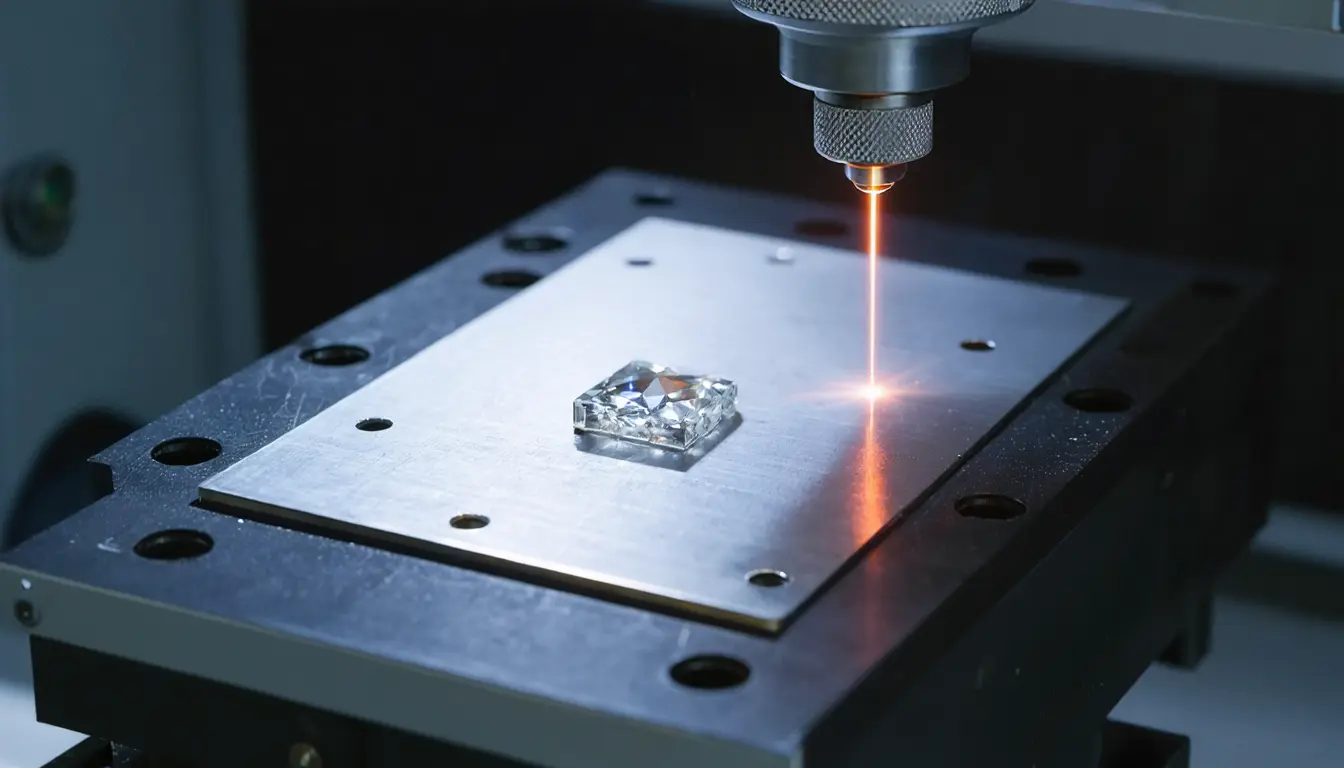
Researchers used six-nanosecond ultraviolet laser pulses to add new defects to a diamond while its nitrogen-vacancy centers stayed largely unchanged. For teams building diamond quantum sensors, that points to a way of changing one defect without disturbing the centers they depend on, though the evidence comes from one diamond.
The Product Desk
What happened
- Exposed regions showed a photoluminescence signal near 563 nanometers that had been absent before treatment, plus a second emission near 579 nanometers.
- The 563-nanometer emission stopped growing with continued exposure and could fall after peaking, suggesting the laser both creates and transforms defect configurations.
- Before irradiation the team mapped the crystal with three kinds of spectroscopy and found very little substitutional nitrogen, giving a baseline to separate laser-made defects from existing ones.
- The atomic mechanism is unresolved; the researchers propose that UV photons excite defect electronic states and that energy transfer may then rearrange nearby carbon atoms.
Why it matters
- constraint Any production recipe would need an exposure window calibrated to each material, because pushing past the 563-nanometer peak can erode the defect the step was meant to create.
- decision Teams working with diamond that holds more nitrogen than the test crystal would have to rebuild the baseline themselves before relying on the NV-sparing result.
- exposure Adopting the step on this evidence leaves NV spin performance unverified, since the reported comparison covers the centers' optical signals against untreated regions.
A team building a diamond quantum sensor already has the defect it needs. The nitrogen-vacancy center forms when a nitrogen atom replaces a carbon atom next to an empty lattice site. It can work as a qubit or as a sensitive detector of magnetic and electric fields [5]. The hard part comes later. Modifying one type of defect can disturb others nearby, and that has made diamonds difficult to tailor for a specific application [6].
The study tested a way around that on one sample. The researchers aimed 266-nanometer ultraviolet pulses, each six nanoseconds long, at localized regions of a single-crystal diamond grown by chemical vapor deposition [7]. Fluence ran from 2.2 to 8.6 joules per square centimeter [8], so the hardest-hit spots took about 3.9 times the energy per area of the lightest [16]. Earlier studies link the new emission lines to carbon self-interstitials, which are carbon atoms sitting outside their normal lattice positions [11].
The researchers described the study in broad terms. "Our study demonstrates that nanosecond laser pulses can achieve selective engineering of point defects in diamond and is promising for deterministic control of diamond color centers for quantum applications," the researchers said, according to Interesting Engineering [1]. Their statement of the demonstrated result is narrower. "We show that these nanosecond laser pulses can selectively engineer the 563-nm center, a self-interstitial-related defect, without affecting the background nitrogen-vacancy (NV) center," the authors said [2]. Neither the 563-nanometer center nor the 579-nanometer center has been established as a qubit, the publication noted [12]. The selectivity is stated only for the conditions tested [4].
For a sensor team, the usable result is a laser step that left existing NV centers optically intact in one crystal [3]. Deterministic control of color centers is a goal the authors describe the study only as "promising for" [1].
The dose response is the finding closest to a fabrication process. The 563-nanometer signal rose near-linearly with fluence. The measured power-law exponent was 1.10 plus or minus 0.16, which fits single-photon excitation, where several photons do not have to act together [14]. That band runs from 0.94 to 1.26 and contains an exponent of exactly 1 [17]. We'd expect a linear response to be easier to calibrate on a fabrication tool than one that depends on several photons arriving at once.
We would ask two questions of any defect-engineering step: does it preserve the defects your device already depends on, and does what it creates have a demonstrated job? On the reported evidence, this laser answers yes to the first and not yet to the second, so we class it as a research tool [3][12]. We think sensor teams should try it on a spare crystal they have already characterized, sweeping the reported fluence range to find where the 563-nanometer signal peaks in their own material [8]. The cost is lab time spent making a defect that has no assigned use yet. In return, the team learns whether the NV-sparing result holds in a second crystal.
What to watch
- A repeat on nitrogen-richer or differently grown diamond, with NV spin coherence measured before and after irradiation.
- Any demonstration that the 563-nanometer or 579-nanometer centers can work as qubits or sensors in their own right.
- Confirmation of the proposed excitation-and-rearrangement mechanism, so process engineers know what sets the height and timing of the 563-nanometer peak.
Clarity's read
What the record supports and how the coverage leans. The claims behind it follow.
Reality
- Evidence45
- Adoption
- Insufficient
- Hype gap+15
- Incentives
- Insufficient
- Confidence40
Claim ledger
Ranked by verification strength, evidence, and original report placement.
- [1]
"Our study demonstrates that nanosecond laser pulses can achieve selective engineering of point defects in diamond and is promising for deterministic control of diamond color centers for quantum applications," the researchers stated.
ReportedSupportedSource: Study researchers, quoted by Interesting Engineering2 sources— create a free account to open themView cited source - [2]
"We show that these nanosecond laser pulses can selectively engineer the 563-nm center, a self-interstitial-related defect, without affecting the background nitrogen-vacancy (NV) center," the study authors said.
ReportedSupportedSource: Study authors, quoted by Interesting Engineering2 sources— create a free account to open themView cited source - [3]
The diamond's existing NV centers had optical signals that remained largely unchanged after laser treatment compared with untreated regions.
ReportedSupportedSource: Interesting Engineering, describing the study2 sources— create a free account to open themView cited source - [4]
The results suggest the laser can modify one part of the defect population without substantially disturbing another under the tested conditions.
ReportedSupportedSource: Interesting Engineering2 sources— create a free account to open themView cited source - [5]
The nitrogen-vacancy center forms when a nitrogen atom replaces a carbon atom next to a vacant spot in the lattice; NV centers can function as qubits and as highly sensitive sensors of magnetic and electric fields.
- [6]
Modifying one type of defect in diamond can also affect others nearby, making it difficult to tailor diamonds for specific applications.
- [7]
Researchers irradiated localized regions of a single-crystal diamond grown by chemical vapor deposition using 266-nanometer ultraviolet laser pulses, each lasting six nanoseconds.
- [8]
The laser fluence ranged from 2.2 to 8.6 joules per square centimeter.
- [9]
Before irradiation the team characterized the diamond with confocal photoluminescence spectroscopy, ultraviolet-visible absorption spectroscopy and Fourier-transform infrared spectroscopy; the starting material contained very little substitutional nitrogen, and the baseline let researchers distinguish laser-made defects from those already present.
- [10]
After irradiation, researchers detected a previously absent photoluminescence signal near 563 nanometers in the exposed regions, and a second emission near 579 nanometers.
- [11]
Previous studies have associated the 563-nm and 579-nm emissions with defects related to carbon self-interstitials, in which carbon atoms occupy positions outside their normal lattice sites.
- [12]
The 563-nanometer and 579-nanometer centers have not been established as newly demonstrated qubits; the experiment points toward a possible way to engineer particular defects while preserving existing centers relevant to diamond quantum sensors.
- [13]
The 563-nanometer emission did not increase indefinitely with continued exposure; its signal could decline after reaching a maximum, suggesting irradiation can both generate and transform defect configurations.
- [14]
The 563-nm emission intensity showed a near-linear relationship with laser fluence, with a measured power-law exponent of 1.10 plus or minus 0.16, consistent with a single-photon excitation process rather than one requiring multiple photons to act together.
- [15]
The precise atomic-scale mechanism is unresolved; the researchers propose that ultraviolet photons may excite electronic states associated with defects, with subsequent energy transfer potentially triggering rearrangements of nearby carbon atoms.
- [16]
The highest fluence tested was about 3.9 times the lowest.
- [17]
The exponent's stated uncertainty band runs from 0.94 to 1.26, which includes an exponent of exactly 1 (a linear response).
Sources
1 independent publisher whose own reporting we read for this story.
- interestingengineering.comUltraviolet laser creates new defects in diamond without disturbing quantum centers
1 article · October 11, 2026
Topics and entities
Follow any of these and your For You feed starts watching them — no settings page required.
Topics
- Diamond color centersFollow
- Laser materials processingFollow
- Quantum SensingFollow
Entities
- Nitrogen-vacancy centerFollow
- Interesting EngineeringFollow