ScienceNot yet confirmed elsewhere1 publisher2 min readPublished
Ultraviolet laser pulses add new defects to diamond while NV centres' light stays largely unchanged
Nanosecond 266-nanometre ultraviolet pulses created new defects in a diamond while its nitrogen-vacancy centres' optical signal stayed largely unchanged. If that holds in more samples, device makers gain a way to change one defect population without disturbing the ones used as qubits.
The Scientist · Science desk
What happened
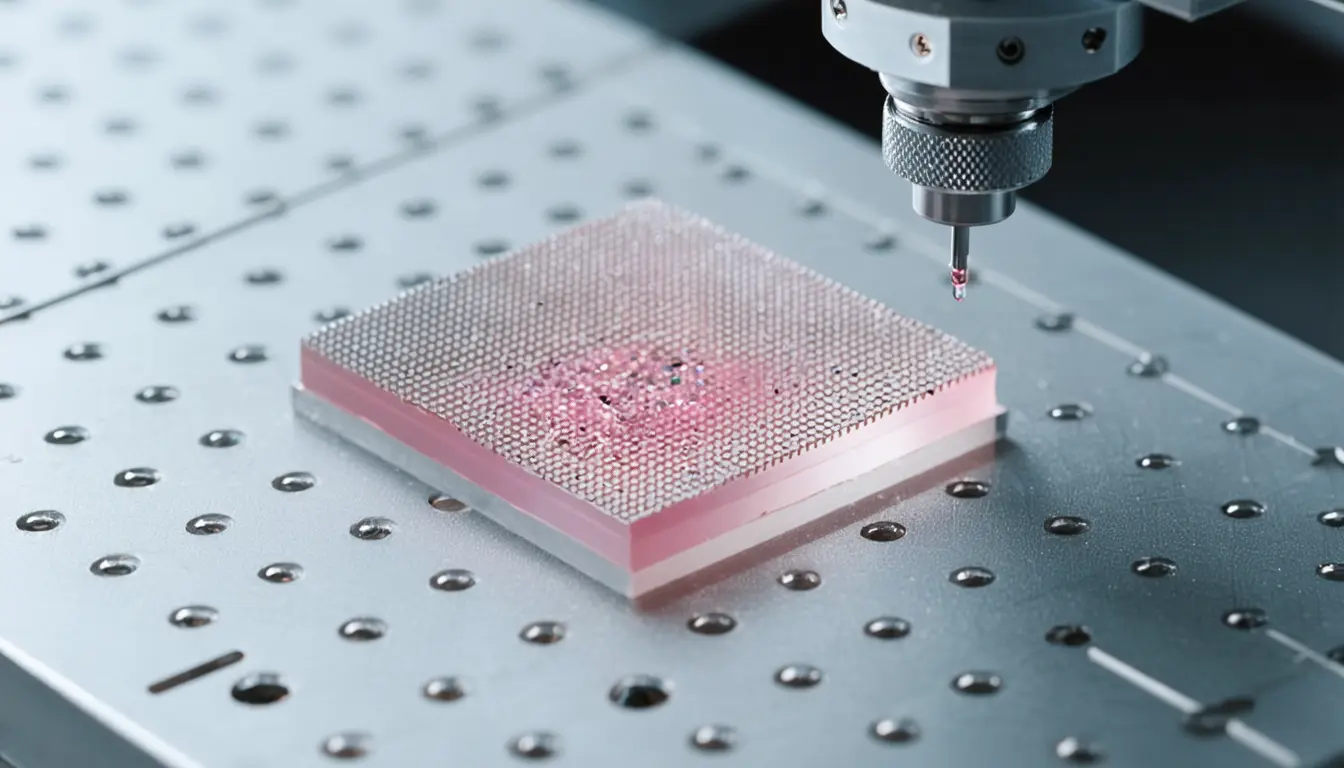
- The pulses were aimed at small, localised regions of the crystal so the excitation stayed local instead of heating the whole diamond.
- The new emissions, near 563 and 579 nanometres, have been linked in earlier studies to defects involving carbon self-interstitials, carbon atoms sitting off their normal lattice sites.
- The starting crystal was a low-nitrogen diamond grown by chemical vapour deposition, with very little substitutional nitrogen compared with nitrogen-rich diamond materials.
- The results are published in the journal Diamond and Related Materials, and the study's author described them in a first-person account for phys.org.
Why it matters
- capability A localised pulse that leaves NV centres' light alone would let a builder change one spot of a crystal after its NV centres are in place, provided the selectivity repeats beyond this sample.
- constraint A signal that peaks and then fades with exposure means any process built on this step needs a calibrated dose; past the peak, the pulses modify the configuration they just made.
- constraint Survival was judged from the NV centres' optical signal, so a device team would still have to show that NV centres in treated regions perform as qubits and field sensors before adopting the step.
Before any pulse was fired, the crystal was characterised three ways: confocal photoluminescence, ultraviolet-visible absorption and Fourier-transform infrared spectroscopy [6]. The reason, the study's author wrote, is that "it is difficult to claim that a defect was created by a laser if it was already present in the starting material" [14].
The NV check compared treated spots with untreated regions of the same crystal [8]. Using one crystal as its own control rules out differences between samples as the explanation. It also means the result rests on a single diamond [4]. The account does not put a number on how far the NV signal moved, so "largely unchanged" is the only effect size available [8].
NV centres, a nitrogen atom next to a vacant lattice site, are the defects used as qubits and as sensitive sensors of magnetic and electric fields [13]. According to the author, creating or modifying one kind of defect can also disturb others nearby [16]. The experiment tests whether one population can be changed without that side effect, and the author keeps the claim narrow. "We are not reporting that the 563-nanometer or 579-nanometer centers are newly demonstrated qubits," the author wrote [9]. In the author's words, the significance is "the ability to manipulate a particular defect population while preserving a preexisting quantum-relevant defect population" [15].
We think the evidence supports that narrow claim for this one crystal, and we would not yet call it a fabrication method for diamond quantum devices [4].
The new 563-nanometre emission [1] did not keep rising with exposure. Under continued irradiation it could fall after reaching a maximum [10]. "This behavior suggests that the laser is not merely creating defects in a one-way process," the author wrote [11]. The author's proposed explanation is that the pulses generate particular defect configurations and then modify them [17]. According to the account, those transformations remain partly unresolved, including the exact atomic-scale mechanism [12].
What to watch
- Repeat experiments on more crystals, including nitrogen-rich diamond, that show whether the selectivity seen in this one low-nitrogen sample holds.
- Follow-up work that pins down the atomic-scale process and confirms whether the 563 and 579 nanometre emissions come from carbon self-interstitial defects.
Clarity's read
What the record supports and how the coverage leans. The claims behind it follow.
Reality
- Evidence40
- Adoption
- Insufficient
- Hype gap+15
- Incentives40
- Confidence45
Claim ledger
Ranked by verification strength, evidence, and original report placement.
- [1]
After irradiation, a previously absent emission near 563 nanometres appeared in the laser-exposed regions, and a second feature near 579 nanometres appeared alongside it.
ReportedSupportedSource: Study author, phys.org2 sources— create a free account to open themView cited source - [2]
The 563 nm and 579 nm emissions have been associated in previous studies with defect configurations related to carbon self-interstitials, carbon atoms occupying positions in the diamond lattice different from their normal lattice sites.
ReportedSupportedSource: Study author, citing previous studies, phys.org2 sources— create a free account to open themView cited source - [3]
The work is published in the journal Diamond and Related Materials; the study's author described it in a first-person account published by phys.org.
- [4]
The researcher irradiated localized regions of a single-crystal chemical vapor deposition (CVD) diamond with 266-nanometre ultraviolet laser pulses only a few nanoseconds long.
- [5]
Rather than heating the entire diamond, the goal was to investigate whether localized optical excitation could modify particular defects within the lattice.
- [6]
Before laser exposure, the pristine diamond was characterised using confocal photoluminescence spectroscopy, ultraviolet-visible absorption spectroscopy and Fourier-transform infrared spectroscopy.
- [7]
The measurements indicated that the low-nitrogen CVD diamond contained a very small concentration of substitutional nitrogen compared with nitrogen-rich diamond materials.
- [8]
The diamond contained NV centres before irradiation; after laser treatment, their optical signals remained largely unchanged compared with the untreated regions.
- [9]
"We are not reporting that the 563-nanometer or 579-nanometer centers are newly demonstrated qubits."
- [10]
The newly generated 563 nm emission did not simply continue increasing with increasing laser exposure; under continued irradiation, the signal could decrease after reaching a maximum.
- [11]
"This behavior suggests that the laser is not merely creating defects in a one-way process."
- [12]
According to the account, the defect transformations remain partly unresolved, including the exact atomic-scale mechanism.
- [13]
A nitrogen-vacancy (NV) centre is a defect formed when a nitrogen atom and a neighbouring vacancy occur in the diamond lattice; NV centres can be used as qubits and as highly sensitive sensors of magnetic and electric fields.
- [14]
"it is difficult to claim that a defect was created by a laser if it was already present in the starting material"
- [15]
"the significance of the experiment is in the ability to manipulate a particular defect population while preserving a preexisting quantum-relevant defect population."
- [16]
According to the author, creating or modifying one type of defect can also affect other defects nearby.
- [17]
The author proposes that the optical excitation drives defect transformations in which particular configurations are generated and subsequently modified.
Sources
1 independent publisher whose own reporting we read for this story.
- phys.orgUltraviolet laser pulses engineer diamond defects selectively, leaving quantum qubits intact
1 article · October 10, 2026
Topics and entities
Follow any of these and your For You feed starts watching them — no settings page required.
Topics
- Diamond colour centresFollow
- Laser materials processingFollow
- Quantum SensingFollow