A seven-month stall at Hyundai Mobis shows what Korea's union law does to carve-out timetables
Seoul says restructuring is not a bargaining subject in principle, yet industrial action is lawful where working conditions are hit, so the boundary gets settled after signing. Buyers now pay for that in months.
The Investor · Invest desk
What happened
- Union demands under the revised Trade Union Act now reach withdrawal of business unit and subsidiary sales, direct hiring by prime contractors, bonuses matching prime contractors' own staff, and how executive pay is set.
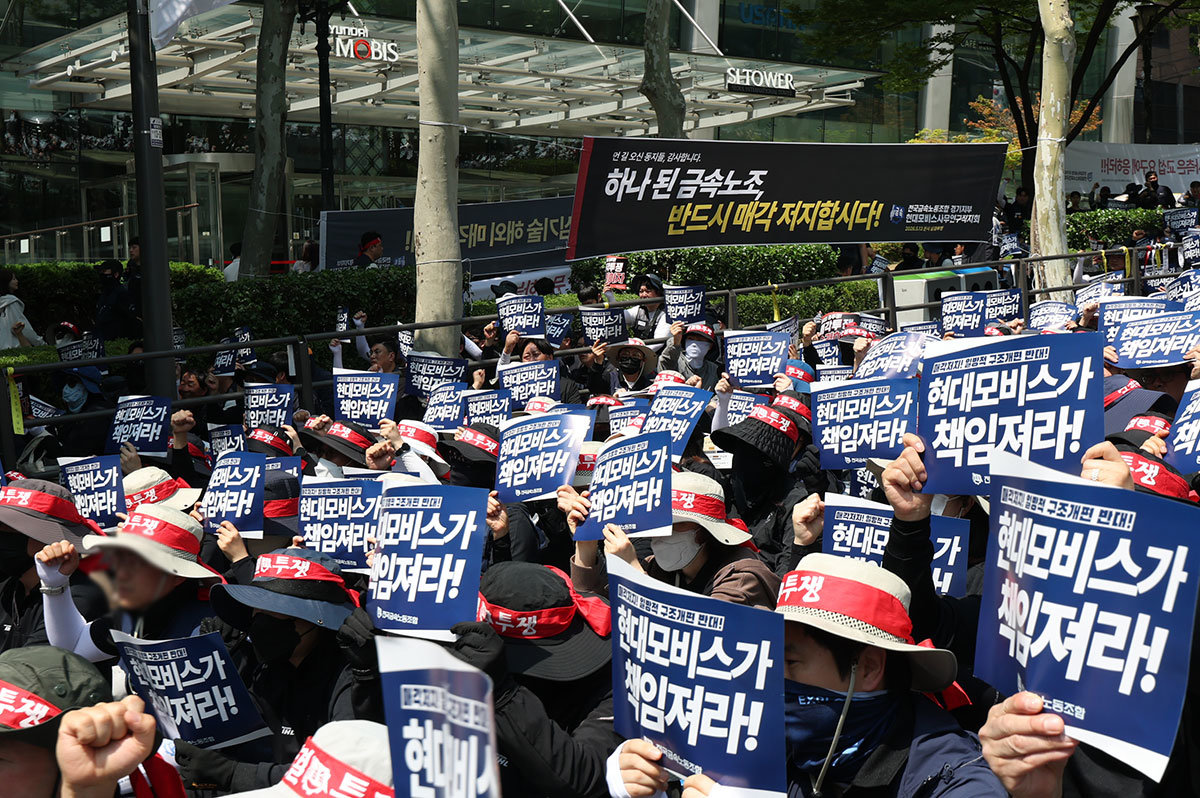
- At Hyundai Mobis, the main contract to sell the lamp business division has been stalled for seven months amid union opposition and legal action, even after a plan to maintain employment was presented.
- Seoul's stated position is that mergers, spinoffs, transfers and sales are not bargaining subjects in principle, though they can ground industrial action where they substantially affect working conditions.
- The labour ministry is filling the resulting gaps with administrative enforcement guidelines that carry no legal force, having declined to use a presidential decree or a ministerial rule.
Why it matters
- constraint With every dispute resolved by a case-specific assessment of how substantially a decision affects working conditions, an acquirer cannot bound its outside date at signing, and the exposure sits in the timetable rather than the headline price.
- decision Anyone about to sign a Korean carve-out chooses between waiting for the ministry's standards on restructuring and profit-linked bonuses, expected within weeks, and pricing the ambiguity themselves.
- exposure Prime contractors and now government ministries are being pulled in as bargaining counterparties for workers they do not directly employ, over wages and employment status they never set.
- precedent Kakao's union has put board-level material on the table, executive pay criteria and prior consultation on asset sales, which gives every other Korean union a drafted template to copy.
What a bidder actually underwrites here is the calendar. Seven months of stall on the Mobis lamp contract, counted back from the 30 August account [3][5], puts the signing block at roughly late January [18], and if you charge the unreceived proceeds a 10 per cent annual cost of capital, the wait has cost about 5.4 per cent of their present value [20] (my rate, not anyone's disclosure), which is a deliberately unimpressive number: small enough to bridge with price, awkward enough to argue over for another seven months. Nor is it one file. At Kyungdong City Gas, a customer service centre union ran a relay hunger strike in July against the prime contractor's planned sale of a subsidiary stake, on the grounds that it could lead to outsourcing [4].
Since the revised act took effect, unions have carried matters once handled as management prerogatives into bargaining and industrial action [1], and the delay is manufactured by where the boundary sits rather than by any explicit veto: each dispute turns on an assessment of how substantially and concretely a management decision touches working conditions [16], so the answer arrives after announcement, from a tribunal or an inspector. An employment covenant does not close that gap on its own, as the Mobis file demonstrates.
The counter-thesis lives in the two decisions already handed down, and I think it is at least as strong as mine. In the Welliv dispute the National Labor Relations Commission recognised Hanwha Ocean as an employer for matters such as industrial safety and working conditions, but declined to make prime-contractor-level performance bonuses a mandatory bargaining subject [7][8]; at the National Tax Service, where outsourced call centre workers asked for direct hiring and a reworked wage structure [9], the employer status the labour ministry recognised covered the work environment and protections for emotionally demanding roles, after which the demands widened to direct hiring anyway [10]. Both stopped at conditions and left pay and employment status outside [19]. Read that way, the law lengthens deals instead of stopping them, and length is something a discount rate handles.
There are three ways this resolves, and they differ by who does the resolving. The guidance publishes, both sides work from a template, and the Mobis contract lands near its agreed terms [14], which would say the ambiguity rather than the statute was binding. Or a tribunal reads substantial effect widely, prior consent to asset sales becomes bargainable in fact, and the line Park Ji-soon of Korea University Law School describes, the exclusive authority of the board and the shareholders' meeting [13], starts to move. Or the politics settles it, President Lee Jae-myung having already told officials that the scope of industrial action looked too broad and asked for clear standards [17], with the caveat that an instruction is not law either.
My view, held loosely: Korean carve-outs trade a few points wider on timing rather than at a structural discount, because only the delaying kind of objection has been adjudicated so far [19]. What would prove it wrong is a labour-heavy Korean unit repriced or withdrawn outright over union objection. Meanwhile the bill sits with the seller, which has spent the better part of a year running a division it has agreed to hand over, proceeds neither banked nor spent [5].
What to watch
- Whether the prime contractor at Kyungdong City Gas proceeds with the subsidiary stake sale its subcontracted union struck over in July.
- Any ruling by a court or the National Labor Relations Commission that the withdrawal of a sale, or a profit-linked bonus, is a mandatory bargaining subject.
- Whether the ministry escalates from non-binding guidance to a presidential decree or ministerial rule after the first case the guidance fails to settle.
Clarity's read
What the record supports and how the coverage leans. The claims behind it follow.
Reality
- Evidence38
- Adoption44
- Hype gap+19
- Incentives63
- Confidence41
Claim ledger
Ranked by verification strength, evidence, and original report placement.
- [1]
Since the revised Trade Union Act, known as the yellow envelope law, took effect, South Korean unions have moved to bring issues once treated as management prerogatives into collective bargaining and industrial action.
- [2]
Union demands now span withdrawal of business unit and subsidiary sales, direct hiring by prime contractors, performance bonuses equal to those paid to prime contractors' own employees, and intervention in how executive pay is set.
- [3]
The report is dated 30 August 2026 and cites labour and business sources on the 30th.
- [4]
The union at Kyungdong City Gas's customer service centre staged a relay hunger strike in July, demanding a halt to the prime contractor's planned sale of a subsidiary stake on grounds that it could lead to outsourcing.
- [5]
At Hyundai Mobis a labour dispute over the sale of its lamp business division continues; although a plan to maintain employment was presented, the main sale contract has been stalled for seven months amid opposition and legal action from some unions.
- [6]
The government's position is that corporate restructuring itself, including mergers, spinoffs, transfers and sales, is not a bargaining subject in principle, but such moves can become grounds for industrial action if they have a substantial effect on working conditions, and critics say the boundary remains unclear on the ground.
- [7]
The union at Welliv, which handles catering, commuter buses and facility management at Hanwha Ocean, demanded performance bonuses at the same level as those paid to Hanwha Ocean's own employees, along with improvements to the work environment.
- [8]
The National Labor Relations Commission recognised Hanwha Ocean as an employer for matters such as industrial safety and working conditions, but did not rule that performance bonuses are a mandatory bargaining subject.
- [9]
Outsourced call centre workers at the National Tax Service called for direct hiring and improvements to the wage structure after the new law took effect.
- [10]
The employer status the labour ministry recognised for the tax agency was limited to the work environment and protections for workers in emotionally demanding roles, and once that recognition was in place the demands expanded beyond it to direct hiring.
- [11]
At the Ministry of Education and the Ministry of Gender Equality and Family, contracted workers have asked to bargain directly with the government ministries over wages and employment.
- [12]
The union at Kakao called for disclosure of the criteria used to calculate executive compensation, a consistent principle for distributing performance rewards between management and employees, and prior consultation with the union on organisational restructuring, asset sales and spinoffs.
- [13]
Park Ji-soon, a professor at Korea University Law School, said the demand, which management could read as a limit on executive pay, risks encroaching on the exclusive authority of the board and the shareholders' meeting.
- [14]
The labour ministry plans to release enforcement guidelines defining the scope of labour disputes as early as early next month, expected to include standards for contentious issues such as performance bonuses set as a percentage of operating profit and business restructuring.
- [15]
The ministry chose to fill the gaps through administrative guidelines that carry no legal force rather than through a presidential decree or ministerial rule, and doubts about their effectiveness persist.
- [16]
The underlying structure does not change: each case still requires an assessment of how substantially and concretely a given management decision affects working conditions.
- [17]
President Lee Jae-myung said the scope of industrial action appeared to be expanding too broadly and instructed officials to set clear standards for matters such as performance bonuses.
- [18]
A seven-month stall reported on 30 August 2026 places the start of the Mobis lamp contract stall at roughly late January 2026.
- [19]
In both adjudicated cases the prime contractor's or agency's employer status was recognised only for safety and working-conditions matters, and neither extended to pay levels or employment status.
- [20]
At an assumed 10 per cent annual cost of capital, a seven-month delay in receiving sale proceeds costs about 5.4 per cent of their present value.
Get this ledger inside ChatGPT. Ask about any of our stories and the answer brings its figure, each claim’s verdict and the sources. Free, no account.
Sources
1 independent publisher whose own reporting we read for this story.
- en.sedaily.comUnions Push Into Boardroom Turf After Labor Law Overhaul
1 article · August 30, 2026
Topics and entities
Follow any of these and your For You feed starts watching them — no settings page required.