A 24-nanometer platinum coating held up in TU Wien stress tests where an 8-nanometer one developed defects
TU Wien researchers say a 24-nanometer platinum coating on titanium bipolar plates could cut platinum use in PEM electrolyzers by about 88%. The saving is measured against the 200-nanometer coating used in industry, and the team cautions that the best thickness depends on how the coating is made.
The Product Desk
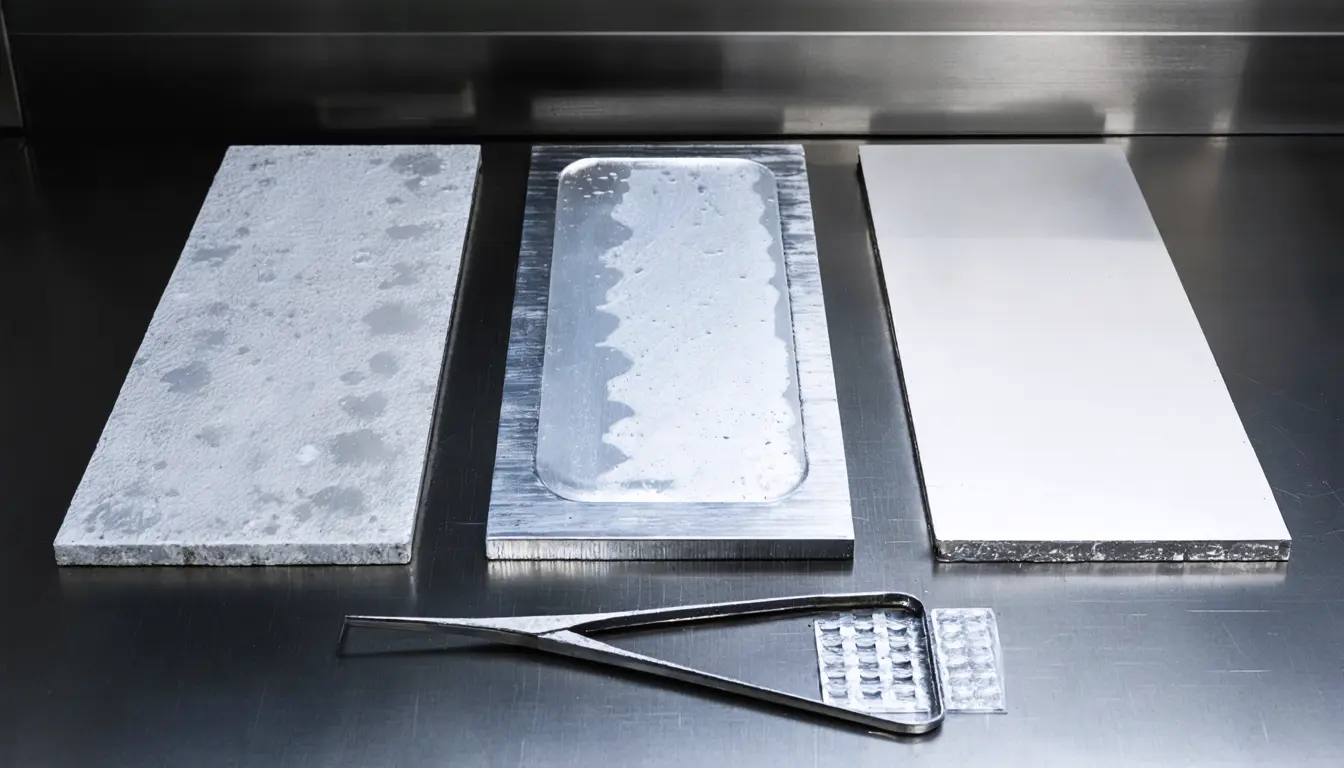
Coating thickness drops from 200 nanometers, a coating of the kind currently used in industry, to 24 nanometers, the layer that proved sufficient under the conditions tested.
| Measure | Value | As of | Claim |
|---|---|---|---|
| Coating used in industry | 200 nanometers | 8 | |
| Coating sufficient in tests | 24 nanometers | 7 |
What happened
- After electrochemical stress, the 24-nanometer layer stayed largely intact and kept good electrical conductivity, under the conditions the team studied.
- The 8-nanometer layer showed larger defects after stress, and significantly more titanium and platinum ions had entered the electrolyte.
- Titanium resists corrosion but grows an oxide layer that blocks current, so a thin platinum coating is added to conduct electricity and protect the metal underneath.
- The team analyzed the coatings before and after electrochemical stress with high-resolution methods instead of judging only initial performance.
Why it matters
- cost The 88% covers platinum in the protective coating alone, so the saving on a finished plate or stack will come out as a smaller percentage.
- constraint One flaw in a thin layer starts a cascade of oxidation, bubbles and detachment, so uniform coverage on the production line becomes the binding requirement.
- decision Buyers have to qualify their coater's own process at 24 nanometers before copying the lab figure into a spec, because the best thickness depends on how the coating is made.
Take the engineer who writes the coating spec for a titanium bipolar plate. The industry reference on that line is a 200-nanometer platinum layer [8]. TU Wien's 24-nanometer result, set against 200, is a cut of 88% [14].
In the TU Wien description, the failure starts with coverage. A defect in the platinum layer exposes the titanium below. The titanium oxidizes, small oxygen bubbles may form at the interface, and the mechanical stress damages the coating further. As larger sections detach, more titanium is exposed and the damage accelerates [13]. The team went looking for that failure path directly. "One particularly important question is whether microscopic defects develop in the coating," said Helmut Riedl-Tragenreif of TU Wien [11].
The plates are worth the attention. "Bipolar plates play a particularly important role here, accounting for up to 30% of total system costs," said Riedl-Tragenreif, who works at the university's Institute of Materials Science and Technology [5]. The 88% applies to platinum in the protective coating [8]. The source does not report a platinum price per plate or how long the stress tests ran, so the saving at plate or stack level cannot be calculated from it.
The researchers cautioned that the best thickness will vary with the manufacturing method and with how evenly the layer coats the surface, among other things [4]. In our view, a layer that is patchy on a production line gives the failure path above a place to start. We'd treat 24 nanometers as a pilot target. It saves up to 88% of coating platinum against 200 nanometers [14], and it leaves less margin for coverage flaws, given that 8 nanometers showed clear problems [7].
The first check is whether your coater can show uniform coverage at 24 nanometers on your own plates. The second is whether your stack runs under conditions close to those TU Wien studied [3]. When both hold, a pilot batch at 24 nanometers, with 200-nanometer plates as the control, is the sensible next step. When coverage is proven and your conditions differ, run your own before-and-after stress analysis first. When conditions match and coverage is unproven, qualify the coater first. When neither holds, stay at 200 nanometers for now.
What to watch
- Results for coatings made by other manufacturing methods, since the researchers say the best thickness depends on the method.
- A published test duration or a platinum cost per plate, which would let the 88% be turned into a plate-level saving.
- A plate coater or electrolyzer maker reporting a pilot batch at 24 nanometers.
Clarity's read
What the record supports and how the coverage leans. The claims behind it follow.
Reality
- Evidence58
- Adoption
- Insufficient
- Hype gap+20
- Incentives
- Insufficient
- Confidence55
Claim ledger
Ranked by verification strength, evidence, and original report placement.
- [1]
Researchers at TU Wien found that a much thinner platinum coating could protect components used in hydrogen production, potentially reducing the precious metal needed for these protective layers by around 88%.
- [2]
The experiments examined platinum-coated titanium bipolar plates used in proton exchange membrane (PEM) water electrolysis.
- [3]
Under the conditions studied, a 24-nanometer coating remained largely intact and retained good electrical conductivity after electrochemical stress.
- [4]
The researchers cautioned that the optimal coating thickness depends on factors including how the coating is manufactured and how uniformly it covers the surface.
- [5]
"Bipolar plates play a particularly important role here, accounting for up to 30% of total system costs," said Helmut Riedl-Tragenreif of the Institute of Materials Science and Technology at TU Wien.
- [6]
Titanium resists corrosion well, but an oxide layer forms on its surface and obstructs electrical current; a thin platinum coating conducts electricity while protecting the titanium underneath.
- [7]
A 24-nanometer coating proved sufficient under the conditions tested, while an eight-nanometer layer showed clear problems.
- [8]
Compared with a 200-nanometer coating of the kind currently used in industry, the successful thinner layer represents a potential reduction of around 88% in platinum consumption for the protective coating.
- [9]
After electrochemical stress, the eight-nanometer coating showed larger defects, and significantly more titanium and platinum ions had entered the electrolyte.
- [10]
The 24-nanometer coating kept metal ion release at a very low level under the studied conditions.
- [11]
"One particularly important question is whether microscopic defects develop in the coating," said Riedl-Tragenreif.
- [12]
The team analyzed the coatings before and after electrochemical stress using high-resolution methods, rather than assessing only initial performance.
- [13]
A defect in the platinum layer can expose the titanium below to attack; the titanium oxidizes, small oxygen bubbles may form at the interface and create mechanical stresses that further damage the coating, and as larger sections detach, more titanium is exposed and the damage accelerates.
- [14]
A 24-nanometer layer against a 200-nanometer layer is a thickness reduction of 88%, matching the reported figure.
Get this ledger inside ChatGPT. Ask about any of our stories and the answer brings its figure, each claim’s verdict and the sources. Free, no account.
Sources
1 independent publisher whose own reporting we read for this story.
- interestingengineering.comThinner platinum coating could cut metal use in hydrogen equipment by 88%
1 article · October 14, 2026
Topics and entities
Follow any of these and your For You feed starts watching them — no settings page required.
Topics
- Materials ScienceFollow
- Hydrogen electrolysisFollow
- PEM electrolyzersFollow
Entities
- TU WienFollow
- Helmut Riedl-TragenreifFollow
- Interesting EngineeringFollow