ScienceNot yet confirmed elsewhere1 publisher2 min readPublished
Slowed light in a microcavity lets a torsion pendulum sense the pull of a millimeter-sized mass
Shanghai Jiao Tong researchers resolved a 3.02 x 10^-16 N change in gravitational force from a millimeter-sized mass. A microcavity readout that slows light magnifies the pendulum's motion, according to the Nature Nanotechnology paper. The authors say the scheme may allow studies of gravity's quantum nature.
The Scientist · Science desk
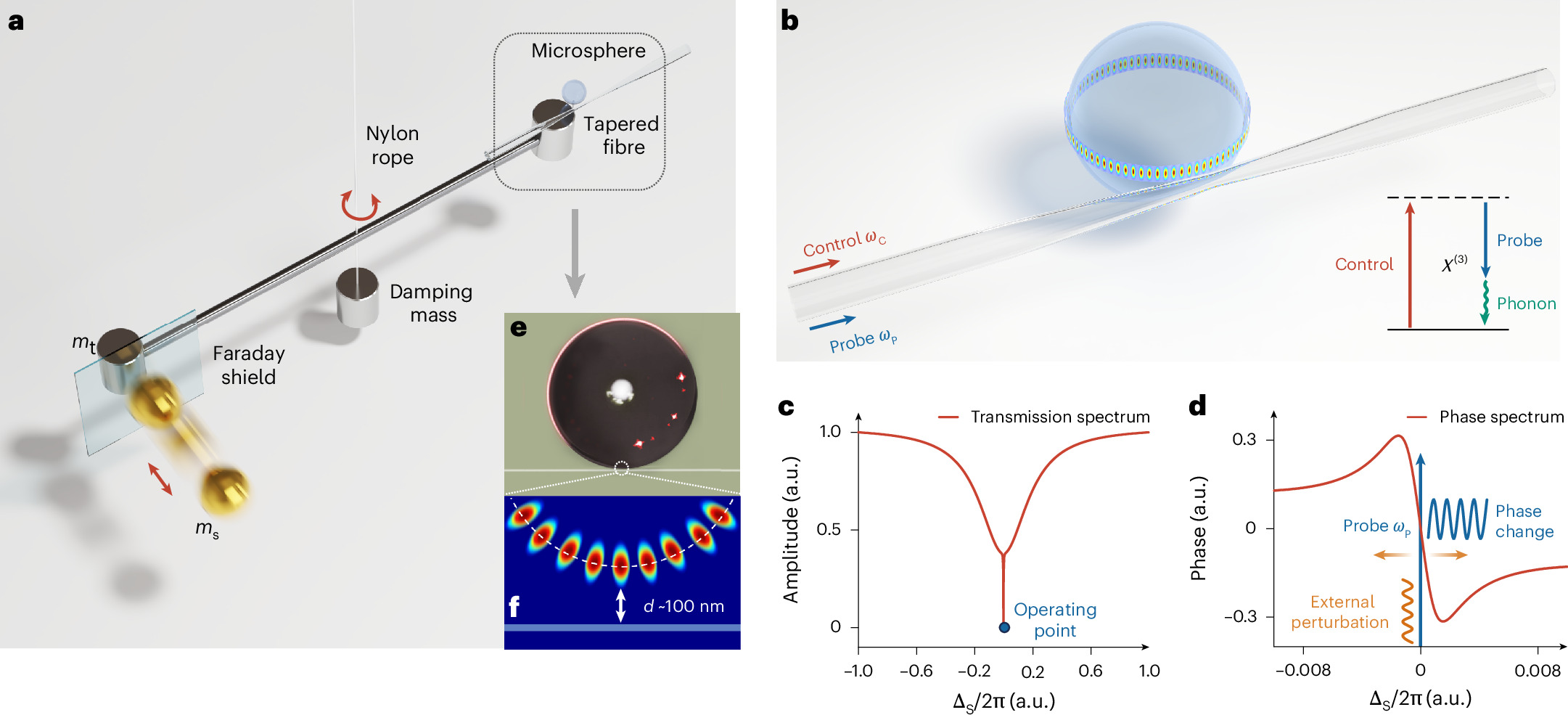
Key figures: a displacement sensitivity of 7.85 pm per root hertz; a group velocity reduced to 2,000 m/s by stopped light behavior; a coupling length of about 100 nm over which the microcavity converts nanoscale displacements into optical signals.
| Figure | Value | Note | Claim |
|---|---|---|---|
| Displacement sensitivity | 7.85 pm/sqrt(Hz) | 5 | |
| Group velocity, reduced | 2,000 m/s | 3 | |
| Coupling length, about | 100 nm | 4 |
What happened
- The sensor pairs a torsion pendulum, a suspended structure that turns by twisting its support, with an optical microcavity, a structure that confines light.
- The authors say a coupled photon-phonon resonance produces what they call stopped light behavior, with a group velocity of 2,000 m/s and steep optical dispersion.
- Displacement sensitivity is 7.85 pm per root hertz, which the authors express as an acceleration sensitivity of 3.06 x 10^-16 g.
- The team tested the device by periodically changing the position of a millimeter-sized object and watching the pendulum respond to the changing pull.
Why it matters
- capability The sensor works on millimeter-sized sources, a step toward the microscopic objects whose gravitational fields physicists want to measure reliably.
- constraint The force figure comes from modulating the mass position. It is the smallest detectable change in force at the drive, not the total pull.
- contradiction The paper's label, stopped light, sits beside a stated group velocity of 2,000 m/s, so the light is slowed and the gain comes from the steep dispersion.
Gravity is the weakest of the four fundamental forces, and the Phys.org report calls the pull of an object a few millimeters across, with very little mass, extremely challenging to detect [7]. Torsion balances are the established tool. But Yicheng Zhu, Qi Geng and their colleagues wrote that "Cavendish-type torsion balances can sensitively measure gravity from small source masses, but their integration with micro- and nanophotonic readout remains challenging" [8]. Their paper is an attempt at that integration. "We show gravitational-force sensing of a millimeter-sized mass using a torsion pendulum integrated with optical microcavity readout," they wrote [9].
The sensitivity comes from the optical side. A nearby mass nudges the pendulum, and the microcavity converts that small movement into a more pronounced change in the measured light signal [13]. The authors say the cavity's exponentially decaying evanescent field converts nanoscale displacements over a coupling length of about 100 nm into optical signals, which increases displacement sensitivity [4].
Picometers per root hertz expresses displacement noise across a bandwidth, so what the sensor can resolve in a given run depends on how long it averages [5].
The Phys.org account does not say how the sensor compares with earlier torsion balances. It does not include the mass of the source object, its distance from the pendulum, the averaging time or the operating environment.
We think the result is best understood as a readout demonstration. The reported test moved a millimeter-sized object periodically, and the pendulum registered very small changes in the force it exerted [10]. Studies of quantum states come later. The Phys.org account says the work could help investigate how the quantum state of objects affects their gravitational field [16]. The authors' own wording is hedged: "This compact, sensitive scheme supports microscopic gravitational sensing and may allow for studies of gravity's quantum nature" [14].
What to watch
- Whether source mass, distance, averaging time and operating environment are published, so the sensor can be compared with earlier torsion balances.
- Whether the readout is used in a test where the source object's quantum state is varied, the investigation the coverage says the work could support.
- Whether the same microcavity gain holds for source masses smaller than a millimeter.
Clarity's read
What the record supports and how the coverage leans. The claims behind it follow.
Reality
- Evidence58
- Adoption
- Insufficient
- Hype gap+10
- Incentives
- Insufficient
- Confidence55
Claim ledger
Ranked by verification strength, evidence, and original report placement.
- [1]
Researchers at Shanghai Jiao Tong University and other institutions developed a sensor that can detect the gravitational pull of millimeter-sized objects, introduced in a paper published in Nature Nanotechnology.
ReportedSupportedSource: Phys.org (Ingrid Fadelli) on Zhu, Geng et al., Nature Nanotechnology 2026View cited source - [2]
The sensor is based on a torsion pendulum, a suspended structure that turns by twisting its support, and an optical microcavity, a structure that confines light.
- [3]
The authors wrote that a coupled photon-phonon resonance induces stopped light behavior, reducing the group velocity to 2,000 m/s and producing steep optical dispersion.
- [4]
According to the authors, the exponentially decaying evanescent field of the microcavity converts nanoscale displacements over a ~100 nm coupling length into optical signals, increasing displacement sensitivity.
- [5]
The sensor reaches a displacement sensitivity of 7.85 pm per root hertz (pm/sqrt(Hz)), corresponding to an acceleration sensitivity of 3.06 x 10^-16 g.
- [6]
By periodically modulating the mass position, the authors resolve a minimum detectable gravitational-force change of 3.02 x 10^-16 N.
- [7]
Gravity is the weakest of the four fundamental forces, and detecting the tiny gravitational pull of objects just a few millimeters in size with very small mass is extremely challenging.
- [8]
"Cavendish-type torsion balances can sensitively measure gravity from small source masses, but their integration with micro- and nanophotonic readout remains challenging," Yicheng Zhu, Qi Geng and their colleagues wrote in their paper.
ReportedSupportedSource: Yicheng Zhu, Qi Geng and colleagues, Nature Nanotechnology (2026)View cited source - [9]
"We show gravitational-force sensing of a millimeter-sized mass using a torsion pendulum integrated with optical microcavity readout," the authors wrote.
ReportedSupportedSource: Yicheng Zhu, Qi Geng and colleagues, Nature Nanotechnology (2026)View cited source - [10]
The researchers tested the sensor by measuring the gravitational pull of a millimeter-sized object while periodically changing its position, and found it successfully detected very small changes in the gravitational force the object exerted on the pendulum.
- [11]
The paper is Yicheng Zhu et al, 'Stopped-light-enhanced gravitational force sensing', Nature Nanotechnology (2026), DOI 10.1038/s41565-026-02298-8.
- [12]
The gravitational pull of a nearby object causes a small movement in the torsion pendulum, which the team's sensor measures using an optical microcavity.
- [13]
The resulting optical response makes the tiny movements of the pendulum produce more pronounced changes in the measured light signal.
- [14]
"This compact, sensitive scheme supports microscopic gravitational sensing and may allow for studies of gravity's quantum nature," Zhu, Geng and their colleagues wrote.
ReportedInsufficientSource: Yicheng Zhu, Qi Geng and colleagues, Nature Nanotechnology (2026)View cited source - [15]
Reliably measuring the gravitational fields of microscopic objects could allow physicists to explore how gravity relates to quantum physics and to develop new instruments to study tiny objects.
- [16]
In the future, the study could also help investigate how the quantum state of objects affects their gravitational field.
Sources
1 independent publisher whose own reporting we read for this story.
- phys.orgNew sensor uses slowed light to detect gravitational pull of tiny objects
1 article · October 12, 2026
Topics and entities
Follow any of these and your For You feed starts watching them — no settings page required.