ScienceNot yet confirmed elsewhere1 publisher2 min readPublished
Researchers trace one mouse embryo's cells back to its first two using DNA Typewriter
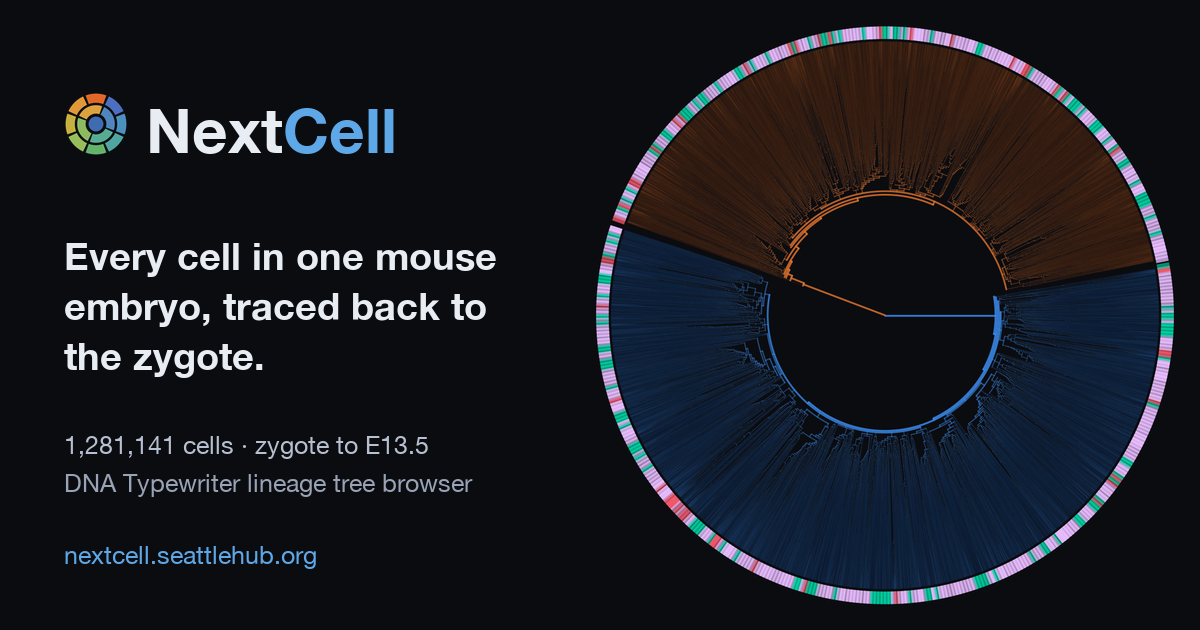
Researchers at the University of Washington and Dartmouth rebuilt a mouse embryo's cell lineage tree across 13.5 days of development using DNA Typewriter. The full analysis rests on a single embryo, which makes the tree a demonstration of the method and one observation of mouse development.
The Scientist · Science desk
Bar comparison of counts in one study: 100 fertilized mouse eggs had the recording attempted, 10 embryos were available to examine, and 1 embryo was analysed in full.
Number of eggs or embryos at each stage of this one study In count
| Item | Value | Claim |
|---|---|---|
| Fertilized eggs attempted | 100 count | 10 |
| Embryos to examine | 10 count | 10 |
| Embryo analysed in full | 1 count | 17 |
What happened
- The team inserted a redesigned tape into the fertilized egg's genome, built so the record is easier to read back out of individual cells.
- The team attempted the recording in 100 fertilized mouse eggs and ended up with 10 embryos to examine.
- A permanent mark distinguished the two very first cells, so nearly every profiled cell traced back to one of them.
- The results are due in Science on Thursday, Oct. 8, 2026.
Why it matters
- capability Complete lineages were traced in a tiny roundworm decades ago, an animal that is transparent with comparatively few cells. Recording inside the DNA extends the attempt to a mammal's more complex body.
- constraint The record ends at 13.5 days, about 64 to 71 percent of a 19-to-21-day mouse gestation, so the final stretch before birth sits outside the tree.
- cost At this run's yield, one fully analysed tree took 100 fertilized eggs, so replicate trees to test the founder-cell result would be expensive in eggs.
The recorder is easy to picture. "Think of it like an actual typewriter, except it types onto a cell's own DNA instead of paper," Haedong Kim, a co-first author at UW Medicine, said [7]. He explained the logic of the design. "Because the characters are always filled in sequence, that sequence itself spells out the cell's division history." [8] Cells that share markings had an ancestor in common [9].
According to the researchers, older methods that cut DNA can leave scars and are harsher on cells. They often erase earlier records and run out of recording capacity fast. They also place marks in no particular order, so the timeline has to be guessed afterward [20]. Kim gave the team's own assessment of the new tape. "It writes without fully severing the DNA, keeps recording relatively steadily, and writes everything in strict order, so we can record cell lineages at much higher resolution for a longer time." [21]
The scientists said embryo No. 3 was where the recorder had plainly turned on and built up the fullest record, and they focused their full analysis on it [11]. phys.org's report says one finding came from a fortuitous catch just after the egg first split [13]. Of the two founding cells, Kim said: "One of these two founding cells did go on to produce more descendants than the other, but they produced diverse cell types at almost equal ratios." [14]
phys.org's report does not say whether the other nine embryos show the same split. Until they do, we would treat the equal ratios as a one-embryo observation.
All of this is in mouse. Jay Shendure, a UW professor of genome sciences and Howard Hughes Medical Institute investigator, invented DNA Typewriter with Junhong Choi of Sloan Kettering Cancer Center [5]. He and Dartmouth's Chengxiang Qiu are co-senior authors of the paper [4]. "We are interested in tracking how cells' early ancestry in an embryo influences their later fates," Shendure said [18]. On what the work might mean for disease, he said: "Such research could eventually advance knowledge about congenital malformations, neurodevelopmental conditions, genetic disorders or cancer." [19]
What to watch
- Whether the paper shows the other nine embryos splitting cell types between the two founders at similar ratios.
- Whether later work reports fully analysed trees from more than one embryo, which would turn the founder result from an observation into a replicated one.
- Whether the recording can be extended past 13.5 days toward the 19 to 21 days of full gestation.
Clarity's read
What the record supports and how the coverage leans. The claims behind it follow.
Reality
- Evidence45
- Adoption
- Insufficient
- Hype gap+15
- Incentives55
- Confidence50
Claim ledger
Ranked by verification strength, evidence, and original report placement.
- [1]
Scientists reconstructed the family tree of cells in a developing mouse embryo, from the first split of the fertilized egg to after the body and its organs took shape, a period of 13.5 days.
- [3]
The study results will appear Thursday, Oct. 8, 2026, in Science.
- [4]
Jay Shendure is a professor of genome sciences at the University of Washington School of Medicine and a Howard Hughes Medical Institute investigator; he and Dr. Chengxiang Qiu of Dartmouth College are co-senior authors of the Science paper.
- [5]
The DNA Typewriter tracking technology was invented by Shendure and Junhong Choi, who is at Sloan Kettering Cancer Center.
- [6]
The team inserted a newly redesigned tape into the fertilized mouse egg's genome; the redesign makes the tape's record easier to read back out of individual cells.
- [7]
"Think of it like an actual typewriter, except it types onto a cell's own DNA instead of paper,"
ReportedSupportedSource: Haedong Kim, co-first author and postdoctoral scientist in genome sciences at UW MedicineView cited source - [8]
"Because the characters are always filled in sequence, that sequence itself spells out the cell's division history."
- [9]
Shared DNA Typewriter markings tell scientists which groups of cells had an ancestor cell in common.
- [10]
The research team attempted this recording in 100 fertilized mouse eggs and ended up with 10 embryos to examine.
- [11]
In Embryo No. 3, the recording system was clearly switched on and had gathered the richest history, according to the scientists, and they focused their full analysis on it.
- [12]
The recording captured a clear, permanent mark distinguishing the two very first cells, letting the team trace nearly every cell they profiled from the embryo back to one or the other.
- [13]
phys.org's report says one of the study's insights stemmed from a fortuitous catch immediately after the fertilized mouse egg split in two.
- [14]
"One of these two founding cells did go on to produce more descendants than the other, but they produced diverse cell types at almost equal ratios."
- [15]
Decades ago, other scientists traced cell lineage in a tiny roundworm, a transparent creature with a simple internal structure and comparatively few cells.
- [16]
The 13.5-day record covers about 64 to 71 percent of a mouse's 19-to-21-day gestation.
- [17]
On the yield reported, one embryo was analysed in full for every 100 fertilized eggs attempted, or 1 percent.
- [18]
"We are interested in tracking how cells' early ancestry in an embryo influences their later fates."
ReportedInsufficientSource: Dr. Jay Shendure, University of Washington School of Medicine and Howard Hughes Medical InstituteView cited source - [19]
"Such research could eventually advance knowledge about congenital malformations, neurodevelopmental conditions, genetic disorders or cancer."
- [20]
According to researchers, older methods that cut DNA can leave scars, are harsher on cells, often erase earlier records, run out of recording capacity fast, and place marks in no particular order so the timeline must be guessed afterward.
- [21]
"It writes without fully severing the DNA, keeps recording relatively steadily, and writes everything in strict order, so we can record cell lineages at much higher resolution for a longer time."
Sources
1 independent publisher whose own reporting we read for this story.
- phys.org'DNA Typewriter' records cells' history in developing mouse embryo
1 article · October 11, 2026
Topics and entities
Follow any of these and your For You feed starts watching them — no settings page required.