ScienceNot yet confirmed elsewhere1 publisher2 min readPublished
Texas A&M spectroscopy suggests thymine steers UV damage into a more reversible form
Texas A&M researchers report in PNAS that thymine, compared with uracil, tends to direct UV damage into a more reversible form. That gives a candidate reason DNA took up the more UV-prone base, and the authors word it as a possibility.
The Scientist · Science desk
What happened
- Early Earth had no protective ozone layer, so thymine's greater susceptibility to UV damage made it look like a poor replacement for uracil.
- The work comes from Peter Rentzepis, a professor of electrical and computer engineering at Texas A&M, and his research assistants Keyvan Khosh Abady and Negar Karpourazar.
- They analyzed the molecules with biophotonics, using absorption, fluorescence and Raman spectroscopy.
Why it matters
- contradiction Greater UV susceptibility and easier reversal of damage can both be true of one base, so the apparent paradox eases only if reversal outweighs the extra damage thymine takes.
- capability Khosh Abady said the spectral signatures the team measured "could support applications in faster, more sensitive pathogen detection", and named UV-disinfection monitoring in water treatment as a second use. The source frames both as possible uses.
- precedent Khosh Abady said the group hopes to "explore whether life's chemical building blocks formed and assembled entirely on Earth or whether some were delivered to our planet from elsewhere by meteorites". That would move the work to an earlier stage than the thymine-uracil choice.
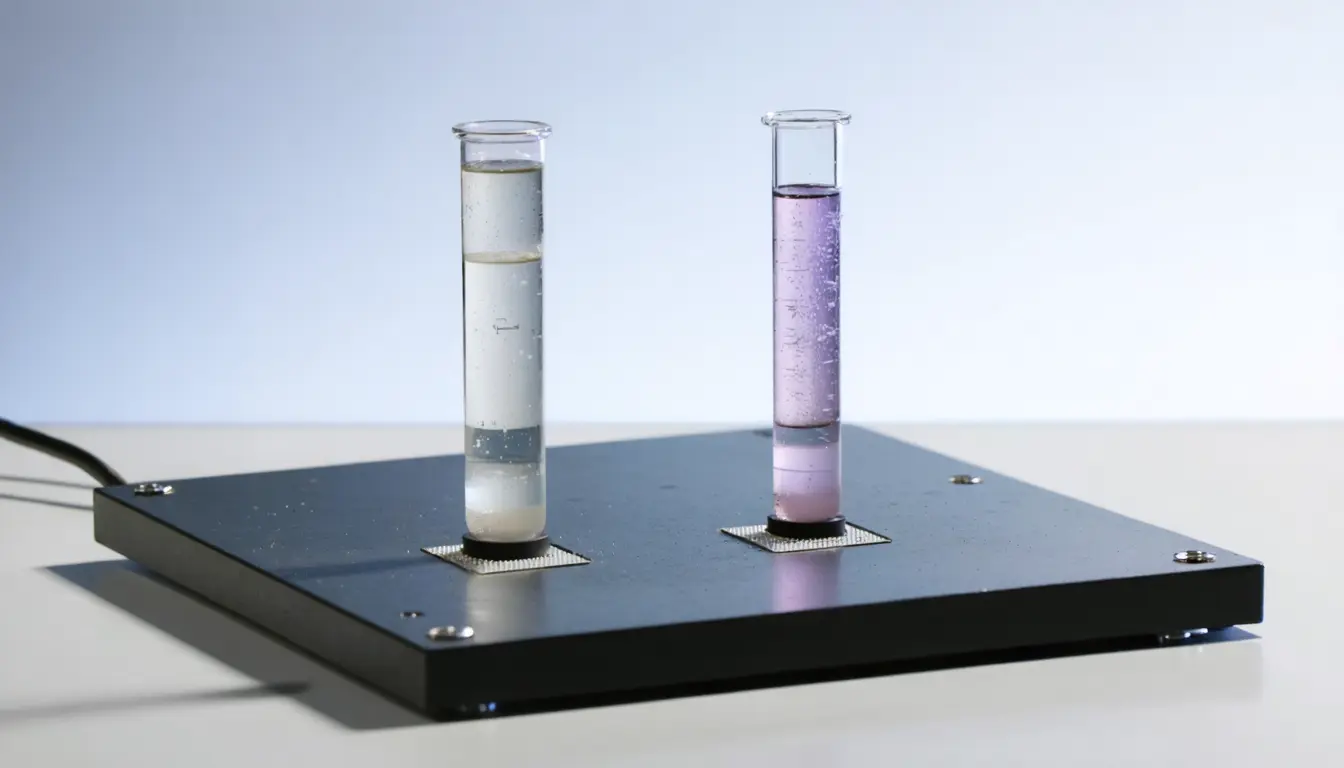
The design is a side-by-side comparison. Thymine and uracil went through the same controlled UV conditions, set up to mimic the radiation on primordial Earth [4]. That is the right control for this question, because the puzzle is a choice between exactly those two bases [2]. Any difference in how they handled the light belongs to the molecules and not to the setup.
The group read the outcome with absorption, fluorescence and Raman spectroscopy, which the source groups under biophotonics [5]. The finding concerns where the damage goes. "We found that thymine tends to direct UV damage into a more reversible form, suggesting that early genetic molecules may have survived intense sunlight not by avoiding damage but by controlling it and making it easier to self-repair," Khosh Abady said [6]. He added that thymine "may have acted as a molecular sunscreen, absorbing harmful UV energy and keeping the damage confined to the genetic bases" [7].
Two claims sit inside those sentences: the damage is more reversible, and it stays on the bases. The phys.org account does not give the UV doses, the sample conditions or an effect size for how much more reversible thymine's damage is, and it describes no tests on microorganisms or water. Without those, the size of the effect is unknown.
We think the proposal is a reasonable hypothesis about chemistry. As an explanation of evolution it rests on a lab comparison of two bases [4]. The thing this doesn't tell you is whether that difference was what favored thymine when DNA diverged from RNA [2]. The authors' own wording, "may have" in both quoted passages, is about right [6][7].
The paper, "UV photodamage pathways and the evolutionary selection of thymine over uracil in early genetic systems", appeared in Proceedings of the National Academy of Sciences in 2026 (DOI 10.1073/pnas.2615278123) [10].
What to watch
- Whether the full PNAS paper reports UV doses, sample conditions and an effect size for thymine's more reversible damage.
- Whether other labs reproduce the thymine-versus-uracil difference under their own simulated early-Earth UV.
- Any test of the spectral signatures on microorganisms in water, which the source describes only as a possible future use.
Clarity's read
What the record supports and how the coverage leans. The claims behind it follow.
Reality
- Evidence50
- Adoption
- Insufficient
- Hype gap+10
- Incentives
- Insufficient
- Confidence45
Claim ledger
Ranked by verification strength, evidence, and original report placement.
- [1]
The work comes from Dr. Peter Rentzepis, a professor in the Department of Electrical and Computer Engineering at Texas A&M University, and his research assistants Keyvan Khosh Abady and Negar Karpourazar; findings were published in Proceedings of the National Academy of Sciences.
- [2]
When DNA diverged from single-stranded RNA to become the primary biological code, thymine replaced uracil as one of the molecule's main building blocks.
- [3]
Thymine is more prone to ultraviolet damage than uracil, which seemingly made it a poor replacement on early Earth, where the lack of a protective ozone layer exposed life forms to extreme UV radiation from the sun.
- [4]
The team compared thymine and uracil under controlled UV conditions designed to mimic the intense radiation environment of primordial Earth.
- [5]
The team analyzed the molecules using biophotonics, an interdisciplinary field using light-based spectroscopic methods including absorption, fluorescence and Raman spectroscopy.
- [6]
"We found that thymine tends to direct UV damage into a more reversible form, suggesting that early genetic molecules may have survived intense sunlight not by avoiding damage but by controlling it and making it easier to self-repair," said Khosh Abady.
- [7]
"In that sense, thymine may have acted as a molecular sunscreen, absorbing harmful UV energy and keeping the damage confined to the genetic bases rather than allowing it to harm more vulnerable parts of the molecule," said Khosh Abady.
- [8]
Rentzepis and his team plan to extend the work to an earlier stage in the origin-of-life process by investigating the forces that made thymine, uracil and other components of early genetic systems come together in the first place.
- [9]
"We hope to explore whether life's chemical building blocks formed and assembled entirely on Earth or whether some were delivered to our planet from elsewhere by meteorites and later incorporated into early genetic systems," said Khosh Abady.
- [10]
The paper is Keyvan Khosh Abady et al., "UV photodamage pathways and the evolutionary selection of thymine over uracil in early genetic systems", Proceedings of the National Academy of Sciences (2026), DOI 10.1073/pnas.2615278123.
- [11]
"The distinct spectral signatures we measured could support applications in faster, more sensitive pathogen detection and in monitoring whether UV disinfection has effectively inactivated microorganisms, particularly in water treatment systems," said Khosh Abady.
Sources
1 independent publisher whose own reporting we read for this story.
- phys.org'Molecular sunscreen' may explain why DNA uses thymine despite its vulnerability to UV damage
1 article · October 12, 2026
Topics and entities
Follow any of these and your For You feed starts watching them — no settings page required.
Topics
- Origin of LifeFollow
- Biophotonics and spectroscopyFollow
- Nucleic acid backbone chemistryFollow