ScienceNot yet confirmed elsewhere1 publisher2 min readPublished
Rutgers and IBM reset up to 100 qubits mid-run to bring a chaotic quantum system under control
Rutgers and IBM researchers repeatedly measured and reset up to 100 qubits on a 156-qubit chip to bring a chaotic system under control. The Nature Physics study is among the largest real-time feedback-control demonstrations to date, a capability future fault-tolerant machines will need.
The Scientist · Science desk
What happened
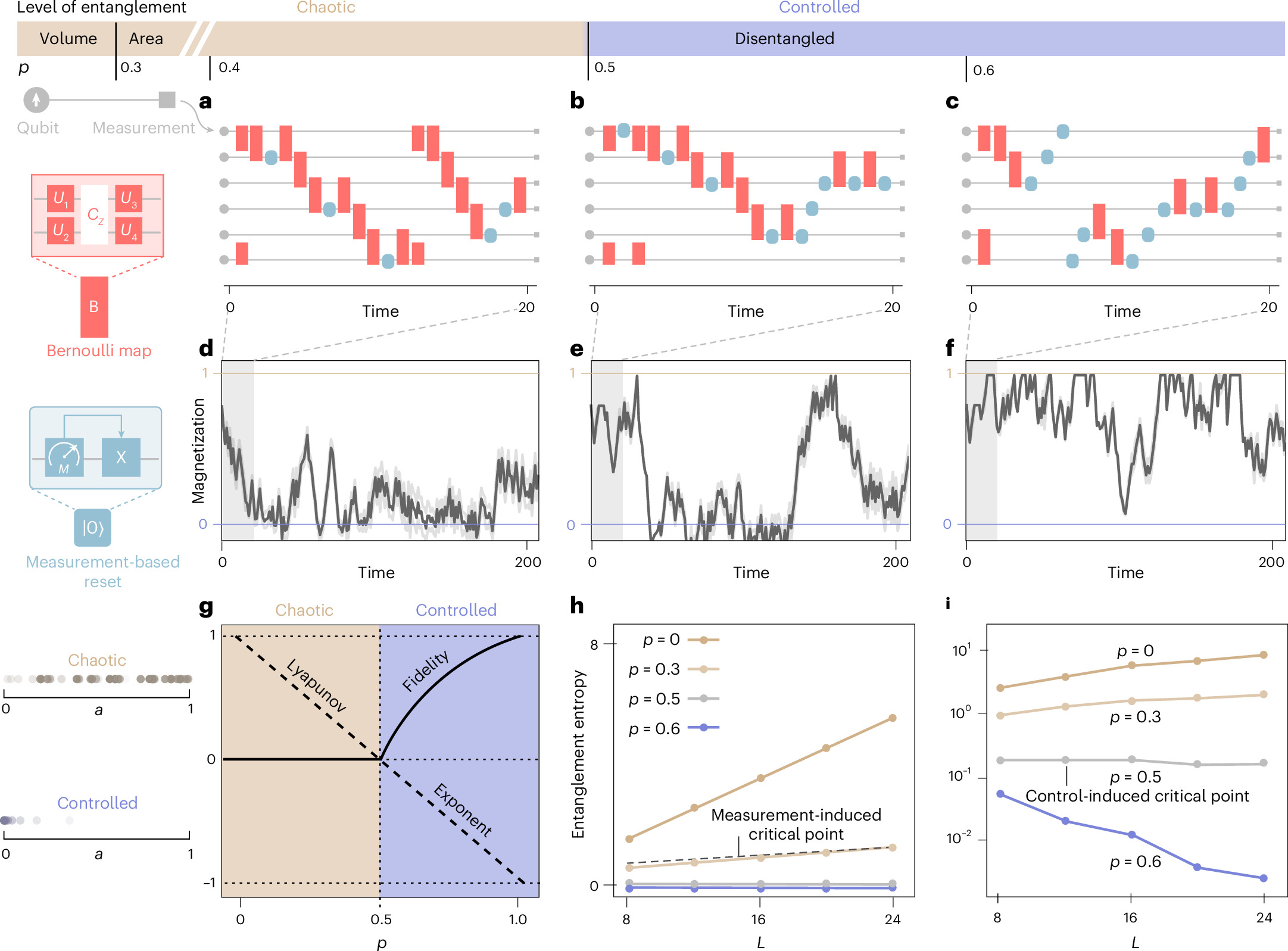
- The team alternated two tasks: a scrambler that mixed information among neighboring qubits, like shuffling a deck of cards, and a control step to rein that chaos in.
- As the researchers raised how often the machine checked and reset its qubits, the system shifted abruptly from chaos to a controllable state, confirming a prediction about quantum behavior.
- Measurement is the hard part: there is no simple way to copy quantum information, and a measurement can alter or destroy the very state the computation relies on.
Why it matters
- capability IBM's Takita says present-day hardware can already coordinate operations, measurements and resets thousands of times across a large system, a vendor-authored data point that awaits independent confirmation.
- constraint The run tested control of a scrambling process. A full calculation kept correct by repeated corrections has not been shown, and no fault-tolerant machine exists.
- decision In our view, designers of feedback circuits should treat check frequency as a quantity with a threshold, since the system moved abruptly from chaos to control as it rose.
The design is a sweep over one knob. The team alternated a scrambler that mixed information among neighboring qubits, much as repeated shuffling destroys the order of a deck [7], with a control step, and then raised how often the computer checked and reset its qubits [5]. The system shifted abruptly from chaos to a state the researchers could control. The shift confirmed a prediction about quantum behavior [5].
A threshold seen while one parameter is swept is a cleaner result than a single successful run. It is harder to get by luck, and it was predicted in advance.
The chain was as many as 100 qubits, chosen from a 156-qubit IBM Quantum Heron processor [6]. That is about 64% of the chip [11]. The run used a connected line of qubits, so it does not yet test feedback across the whole device.
Jedediah Pixley, a Rutgers physics professor and senior author, put the stakes this way: "To build a fault-tolerant quantum computer, we have to make these checks and corrections not just once or twice, but a huge number of times during a calculation" [4]. He called the experiment "a landmark on that road" [12].
Maika Takita, a senior author and principal research scientist at IBM, described the engineering difficulty. "The challenge was not simply to measure a qubit, but to do it repeatedly while the rest of the processor continued to operate," she said [13]. Measurement is costly in a quantum machine because the act of measuring can alter or destroy the very state the computation relies on [8].
The account does not include per-measurement error rates, cycle counts beyond Takita's "thousands", or comment from researchers outside the study. Both senior authors quoted work on the project, and one of them works for the company that sells the hardware.
The phys.org headline says computers that "can correct their own mistakes" [10]. The experiment as described is feedback control of a scrambling process. A fault-tolerant machine is one that keeps computing correctly while its qubits constantly make small mistakes [9], and no one has built one [3]. We think the result is a credible test of the control layer such a machine would need. We would not read it as error correction of a calculation, and no one in the account claims it is.
What to watch
- Whether the same group reports the feedback loop protecting a logical qubit or a full calculation, which would move this from control of chaos to error correction.
- Whether the abrupt chaos-to-control shift holds on chains longer than 100 qubits or across the full 156-qubit chip.
- Whether researchers outside Rutgers and IBM reproduce the result on other hardware, and publish per-measurement error rates.
Clarity's read
What the record supports and how the coverage leans. The claims behind it follow.
Reality
- Evidence58
- Adoption
- Insufficient
- Hype gap+20
- Incentives45
- Confidence55
Claim ledger
Ranked by verification strength, evidence, and original report placement.
- [1]
Researchers from Rutgers, IBM and collaborating institutions showed in a Nature Physics study that a quantum computer can repeatedly check and reset parts of itself while running, bringing chaotic behavior under control.
- [2]
The experiment is among the largest demonstrations to date of real-time quantum feedback control, a capability considered essential for future fault-tolerant quantum computers.
- [4]
"To build a fault-tolerant quantum computer, we have to make these checks and corrections not just once or twice, but a huge number of times during a calculation," said Jedediah Pixley, a Rutgers professor of physics and astronomy and a senior author of the study.
- [5]
As the researchers increased how often the computer checked and reset its qubits, the system abruptly shifted from chaos to a state they could control; the work confirmed a prediction about quantum behavior.
- [6]
The researchers ran the experiment on a 156-qubit IBM Quantum Heron processor, selecting a connected chain of as many as 100 qubits.
- [7]
The researchers programmed the system to alternate between two competing tasks: the first acted as a scrambler that mixed information among neighboring qubits and spread chaos, similar to repeatedly shuffling a deck of cards, and the second served as a form of control.
- [8]
Quantum information cannot simply be copied, and measuring it can change or destroy the state being used.
- [9]
A fault-tolerant quantum computer can keep computing correctly even though its individual quantum bits are constantly making small mistakes.
- [10]
The phys.org headline reads "One step closer to quantum computers that can correct their own mistakes".
- [11]
The 100-qubit chain is about 64% of the 156-qubit Heron processor.
- [12]
"This experiment is a landmark on that road," said Pixley.
- [13]
"The challenge was not simply to measure a qubit, but to do it repeatedly while the rest of the processor continued to operate," said Maika Takita, principal research scientist at IBM and a senior author of the study.
- [14]
Takita said the experiment shows that present-day hardware can coordinate quantum operations, measurements and resets thousands of times across a large system.
Sources
1 independent publisher whose own reporting we read for this story.
- phys.orgOne step closer to quantum computers that can correct their own mistakes
1 article · October 12, 2026
Topics and entities
Follow any of these and your For You feed starts watching them — no settings page required.
Entities
- IBMFollow
- Rutgers UniversityFollow
- IBM Quantum HeronFollow
- Jedediah PixleyFollow
- Maika TakitaFollow
- Nature PhysicsFollow