ProductIndependently confirmed2 publishers3 min readPublished Updated
Mova's $1,300 V70 Ultra bets that reach, not suction, is the robot vacuum's remaining gap
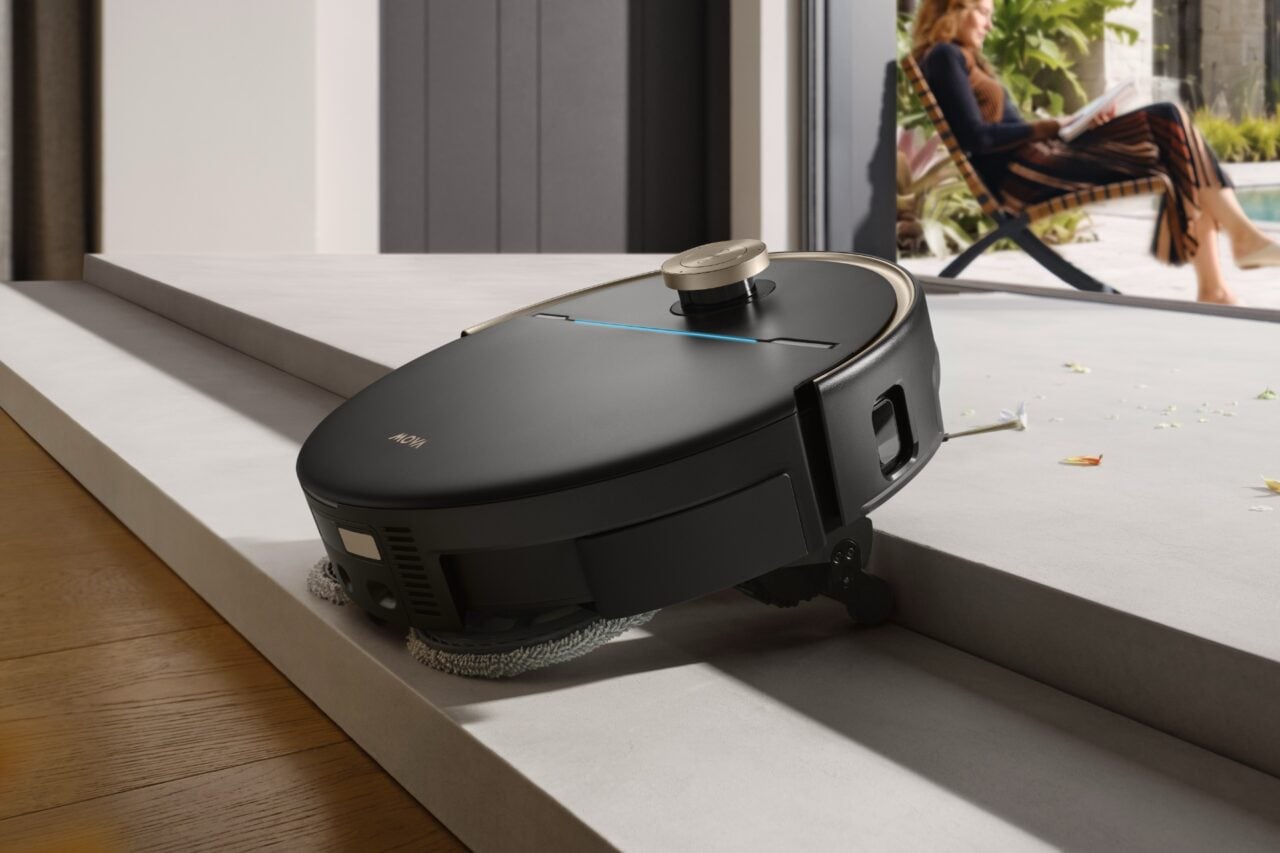
The V70 Ultra Complete extends a mop pad 6.7 inches and a side brush 5 inches to clean around chair legs. Its 42,000Pa suction number is the least interesting thing about it.
The Product Desk
What happened
- Mova, a Dreame sub-brand, has released the V70 Ultra Complete, a self-cleaning, self-emptying robot vacuum, available now from Mova's website, Amazon and other retailers for $1,300.
- The Mova V70 Ultra Complete is priced at $1,299.99 and launched the day of The Verge's hands-on piece.
- The V70's mop pad stretches 6.7 inches, almost totally clearing its body based on images on Mova's website, and its spinning side brush extends close to 5 inches.
- The V70 Ultra Complete features a mop on an articulating arm that can reach almost 7 inches out from the robot, along with a side brush that extends 5 inches.
- The Verge describes chairs and stools as an area where robot vacuums fail: a row of stools at a kitchen table or chairs tucked under a dining table leaves dust, and because these are eating areas, crumbs and food debris accumulate.
Why it matters
Mova, a sub-brand of Dreame, has put the V70 Ultra Complete on sale for $1,300 through its own site, Amazon and other retailers [1][2]. The selling point is not the suction figure on the box but geometry: a mop pad that extends 6.7 inches from the body and a spinning side brush that extends close to 5 inches [3][4].
That targets the failure everyone with a robot vacuum already knows. The Verge's Jennifer Pattison Tuohy frames it as the kitchen stool problem: rows of stools and chairs tucked under tables that the robot cannot get into or around, in exactly the part of the house where crumbs collect [5]. After a day of testing, she reported the V70 reached the edges of each stool leg with its mop arm and swept debris out from under the stools, clearing dust bunnies in about five minutes on max suction with its dual roller brushes [6][7].
The reach numbers are what separate this from the last round of edge-cleaning attempts. Gizmodo notes that the Ecovacs Deebot X12 OmniCyclone and Narwal Freo Z10 Turbo both slide a mop out from beneath the body, but barely peek out, and that the side brush on Dreame's X60 Max Ultra Complete gets into corners while still leaving dust between chair legs [8][9]. Dreame pioneered the mop-split idea in the first place [10], and showed its own X60 Pro arm earlier this year with what appeared to be a larger mop and a more maneuverable arm, according to The Verge, which has not launched in the US [11]. The sub-brand is shipping the feature in the US before the parent brand does.
Which makes the 42,000Pa headline the least informative spec here. For comparison, Gizmodo puts the Eufy Omni E28 at 20,000Pa, the X12 OmniCyclone at 22,000Pa and the Dreame Aqua10 Ultra Roller at 30,000Pa [12]; the V70's figure is roughly 1.4 to 2.1 times those [20]. The same reviewer found the Matic, at 3,200Pa, picks up more debris with an oversized roller brush, and raised the risk of high suction pulling fibers out of rugs [19][21]. The V70 claims about 13 times the pascals of a machine that outperformed pricier rivals in that reviewer's testing [22].
The rest is the current premium checklist: a dock that empties the bin and washes the mops with 212-degree Fahrenheit water, a bagless cyclonic canister you dump into the trash rather than a bag you re-buy, a lidar disc that retracts so the robot fits under low furniture, cameras for obstacle detection, mop removal on carpet, and legs that lift it over thresholds of about 3.5 inches in two shorter step-ups rather than one [13][14][15][16][17][18].
On price, Gizmodo says the X60 Max Ultra Complete and Aqua10 Ultra Roller launched at $1,700 and $1,600, putting the V70 about $400, or 24 percent, below the flagship [24][28]. The Verge describes that same X60 Max as Dreame's $1,500 flagship and says the V70's build quality is not as premium [25][23]; the two accounts differ by $200 on the flagship's price [29]. Gizmodo's reviewer, having been disappointed by both Dreame robots tested, is openly skeptical that a machine sharing this much DNA will deliver [26].
Watch whether the X60 Pro reaches the US with its bigger arm [11], and watch longer reviews for the ordinary failure modes Gizmodo lists: clogging, loud self-emptying docks, and obstacle avoidance around cables [27]. One day of hands-on time is not a verdict on a $1,300 appliance [6].
Clarity's read
What the record supports and how the coverage leans. The claims behind it follow.
Reality
- Evidence45
- Adoption
- Insufficient
- Hype gap+20
- Incentives
- Insufficient
- Confidence55
Claim ledger
Ranked by verification strength, evidence, and original report placement.
- [1]
Mova, a Dreame sub-brand, has released the V70 Ultra Complete, a self-cleaning, self-emptying robot vacuum, available now from Mova's website, Amazon and other retailers for $1,300.
- [2]
The Mova V70 Ultra Complete is priced at $1,299.99 and launched the day of The Verge's hands-on piece.
- [3]
The V70's mop pad stretches 6.7 inches, almost totally clearing its body based on images on Mova's website, and its spinning side brush extends close to 5 inches.
- [4]
The V70 Ultra Complete features a mop on an articulating arm that can reach almost 7 inches out from the robot, along with a side brush that extends 5 inches.
- [5]
The Verge describes chairs and stools as an area where robot vacuums fail: a row of stools at a kitchen table or chairs tucked under a dining table leaves dust, and because these are eating areas, crumbs and food debris accumulate.
- [6]
The Verge's Jennifer Pattison Tuohy spent about a day testing the Mova V70 and reported its appendages let it clean under and around the stool legs at her kitchen counter, extending its mop to the edges of each leg and using its brush to sweep up debris under the stools.
- [7]
After about five minutes on max suction, the Mova cleared the dust bunnies under the reviewer's counter, which she attributed to its 42,000Pa suction and dual roller brushes.
- [8]
The V70's reaching mop pad is a similar idea to the roller mop or pad that slides out from beneath the Ecovacs Deebot X12 OmniCyclone or the Narwal Freo Z10 Turbo, but those only barely peek out.
- [9]
The side brush of the Dreame X60 Max Ultra Complete sticks out far enough to get into corners but would still leave dust between chair legs; the V70's mop pad and side brush figures are close to those Dreame gives for the X60 Pro Ultra Complete.
- [10]
Mova is a sub-brand of Dreame, which pioneered mop splits, where the mop pads extend outwards from underneath the robot to clean along baseboards and edges.
- [11]
Dreame showed its version of the mop-arm technology on the X60 Pro earlier this year, with what appears to be a much larger mop and a more maneuverable arm, and it has not launched in the US.
- [12]
Mova says the V70 Ultra Complete generates 42,000Pa of suction; by comparison the Eufy Omni E28 reaches up to 20,000Pa, the Ecovacs X12 OmniCyclone reaches 22,000Pa, and the Dreame Aqua10 Ultra Roller can hit 30,000Pa.
- [13]
The V70 Ultra Complete has a self-cleaning dock that empties the robot's dustbin and cleans its mops with 212-degree Fahrenheit water.
- [14]
The V70's base has a bagless, cyclonic dustbin, which Gizmodo calls a much rarer feature that avoids buying replacement dust bags.
- [15]
The V70's multifunction base station cleans and dries its mop and empties its bin without disposable bags, using a canister the owner empties over the trash when full.
- [16]
The V70's LiDAR sensor disc retracts into its body to help it get under low furniture, as on Dreame's robots.
- [17]
The V70 uses lidar for navigation along with cameras for obstacle detection, and it can remove its mops when vacuuming carpet.
- [18]
Using legs tucked in by its wheels, the V70 Ultra Complete can climb up to 3.5 inches, but is rated to do so as two shorter step-ups in a row rather than in a single bound, matching Dreame's X60 Max Ultra Complete and UltraRoller.
- [19]
Gizmodo's reviewer found that the Matic robot vacuum, which creates 3,200Pa, picks up more debris with its oversized roller brush.
- [20]
The V70's 42,000Pa rating is about 2.1 times the Eufy Omni E28's 20,000Pa, about 1.9 times the X12 OmniCyclone's 22,000Pa, and about 1.4 times the Aqua10 Ultra Roller's 30,000Pa.
- [21]
Gizmodo's reviewer says suction is not everything for robot vacuums and worries about too much suction damaging rugs by yanking out their fibers.
- [22]
The V70's claimed 42,000Pa is about 13 times the Matic's 3,200Pa.
- [23]
The Verge says the V70's build quality is not as premium as the Dreame X60 Max Ultra Complete's, but that its compact size and mopping skills make it worth checking out for grungy floors under tables and counters.
- [24]
Gizmodo says the V70 is priced well, noting the Dreame X60 Max Ultra Complete and Aqua10 Ultra Roller launched at $1,700 and $1,600 respectively.
- [25]
The Verge describes the Dreame X60 Max Ultra Complete as Dreame's $1,500 flagship.
- [26]
Gizmodo's reviewer found both Dreame robot vacuums tested especially disappointing and is leery that the V70, which shares much of their DNA, will perform.
- [27]
Gizmodo says the priciest robot vacuum models still struggle in real homes: some clog easily, others have very noisy self-emptying docks, and object avoidance can be unreliable, especially around cables.
- [28]
At $1,300 the V70 is $400 below the X60 Max Ultra Complete's $1,700 launch price, about 24 percent less.
- [29]
Gizmodo's $1,700 launch price for the X60 Max Ultra Complete and The Verge's description of it as a $1,500 flagship differ by $200.
Sources
2 independent publishers whose own reporting we read for this story.
- gizmodo.comThis Robot Vacuum Has a Brush and Mop Pad That Can Reach Places Others Can’t
1 article · August 20, 2026
- theverge.comThis robot vacuum solves my kitchen stool problem
1 article · August 19, 2026
Topics and entities
Follow any of these and your For You feed starts watching them — no settings page required.