Iraq moved 2.1 million tons of fuel overland through Syria in four months
With Hormuz shut, the truck run to Baniyas is carrying real volume, which makes a Syrian state one year past Assad an input into routing decisions rather than background risk. The rail meant to replace the trucks is years out.
The Board Room · Leadership desk
What happened
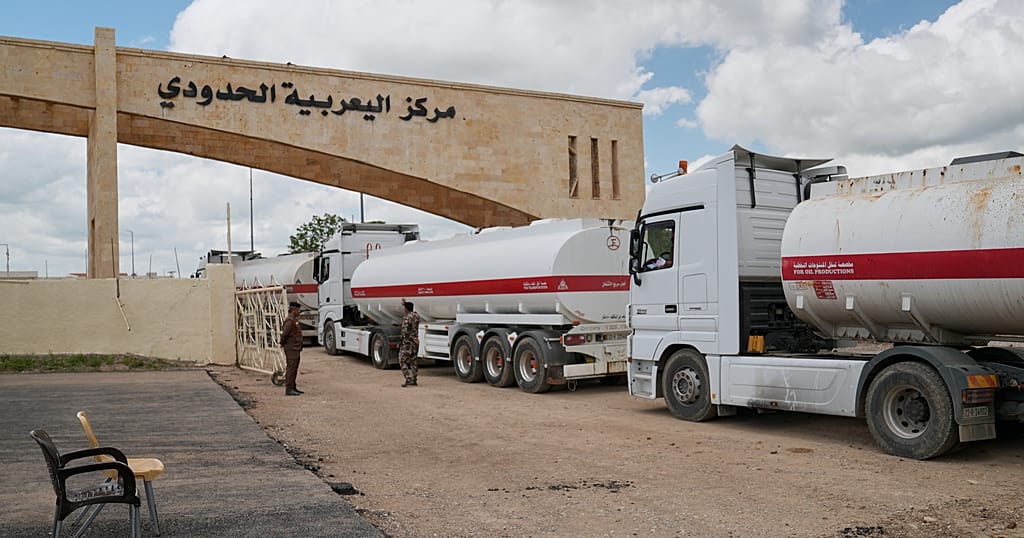
- A convoy of 299 Iraqi fuel tankers crossed into Syria in early April headed for the Mediterranean port of Baniyas, one of the few remaining routes to market with the Strait of Hormuz closed.
- It was the first legal transit of Iraqi oil through Syria since 2003, when the US invasion of Iraq shut the cross-border flow.
- Between April and late July, more than 2.1 million metric tons of Iraqi fuel reached the Syrian coast.
- Syria's customs agency estimates that as many as 327,000 trucks carrying over seven million tons of cargo entered the country by August 2025.
- Jordan, Saudi Arabia, Syria and Turkey agreed in April and June to redevelop the Ottoman-era Hejaz Railway within three to four years.
Why it matters
- decision Traders and refiners weighing the Baniyas run are choosing which risk they would rather hold, since Foreign Affairs reads the turn toward Syrian routes as a hedge against Iranian retaliation rather than a cost saving.
- constraint Gate throughput at Rabia and berth turnaround at Baniyas, not Iraqi supply, cap what this corridor can absorb, and signing a rail agreement does nothing to lift either in the near term.
- precedent A route that has cleared customs once is far easier to reopen than to create, so Gulf and Turkish cargo owners can price a Levant option into contracts that previously assumed Hormuz or nothing.
- capability Baghdad now has a westbound outlet that avoids a chokepoint, which strengthens its hand with buyers even at modest tonnage.
Rate matters more than total for anyone sizing this corridor. The tonnage Foreign Affairs reports for early April through late July works out to roughly 17,500 tons a day across about 120 days [14] [1]. Syria's own customs counts imply an average load near 21 tons per vehicle [16] [6]. Apply that average to the fuel and the route is absorbing on the order of 100,000 tanker loads, several hundred crossings a day [17]. Iraqi fuel alone accounts for something close to 30 percent of the tonnage customs counted entering the country, though the two reporting windows do not line up exactly [23].
The volume is small against seaborne trade, and the road could close the week Hormuz reopens. Even so, the corridor matters, because the durable asset here is procedural: a legal channel that took two decades to restore [19] and the Rabia crossing, reopened in late April after more than ten years shut during the civil war [5]. Restoring customs status took twenty years. Running trucks over it again took weeks.
What buyers are actually trading is one kind of exposure for another. Foreign Affairs argues that countries are turning to Syrian land and sea routes precisely because alignment with the United States and Israel, and reliance on the Strait of Hormuz, now carry greater risk of Iranian retaliation [20]. That substitutes a chokepoint nobody can influence for a sovereign counterparty whose government took power at the end of 2024 [7].
The fiscal mechanism is what should hold a planner's attention. The World Bank put Syrian reconstruction at $216 billion in 2025, nearly ten times projected 2024 GDP [9], which implies an economy of roughly $22 billion [18]. Transit is one of the few revenue lines Damascus can charge for now, and the essay reads the new authorities as deliberately recasting the country as a connectivity power to capture it [10]. So the incentive to keep the road open is strong. The same essay cautions that the pace of investment could outrun the institutions meant to manage it, and that money neither scrutinised nor fairly distributed could destabilise the recovery [21]. That tension between incentive and oversight is still playing out, and the essay does not resolve it either way.
Then there is sequencing. The Hejaz Railway plan carries estimates, drawn from Atlantic Council work on comparable regional corridors, of about 1.5 million containers a year initially and up to three million with track and port expansion [22]. On the essay's own dating, the earliest that capability exists is 2028 or 2029 [15]. Truck fleets and insurance terms committed this quarter will have been renewed at least once before the first container moves by rail, which means the choice in front of shippers now is a choice about roads, gates and berths.
What to watch
- Whether flows held at the April-to-July rate after late July, which is where the reported window closes.
- Whether transit fee terms are published, showing how much of Syrian state revenue now depends on the corridor.
- Whether any of the normalising partners commit capital to Baniyas port capacity rather than trade agreements alone.
Clarity's read
What the record supports and how the coverage leans. The claims behind it follow.
Reality
- Evidence52
- Adoption61
- Hype gap+14
- Incentives57
- Confidence47
Claim ledger
Ranked by verification strength, evidence, and original report placement.
- [1]
Between April and late July, more than 2.1 million metric tons of Iraqi fuel moved to the Syrian coast.
- [2]
In April and June of this year, the Jordanian, Saudi, Syrian, and Turkish governments agreed to redevelop the Hejaz Railway, built by the Ottoman Empire, within three to four years.
- [3]
In early April, a convoy of 299 Iraqi fuel tankers crossed into Syria on its way to the Mediterranean port of Baniyas, one of the few remaining paths to international markets amid the closure of the Strait of Hormuz.
- [4]
It was the first time Iraqi oil had crossed through Syria legally since 2003, when the U.S. invasion of Iraq effectively shuttered the cross-border flow of oil from Iraq to Syria.
- [5]
In late April, Iraq expanded the route by reopening its northern Rabia crossing with Syria, a crossing that had been closed for more than a decade during Syria's civil war.
- [6]
By August 2025, as many as 327,000 trucks carrying over seven million tons of cargo crossed into Syria, according to estimates by Syria's customs agency.
- [7]
Hayat Tahrir al-Sham, the militant group once led by Syria's new president, Ahmed al-Shara, toppled the Assad regime at the end of 2024, after which regional trade began to trickle back in.
- [8]
Jordan, Qatar, Saudi Arabia, and Turkey began to normalize relations and do business in Syria, and Damascus's new authorities moved quickly to restore ties with regional and international partners to end the country's economic isolation.
- [9]
In 2025, the World Bank estimated that Syria's reconstruction would cost $216 billion, nearly ten times Syria's projected GDP for 2024.
- [10]
Syrian authorities are using the potential rush of capital and trade to create a new source of revenue and to recast the country's image as a transit power that plays a dominant role in regional connectivity.
- [11]
Between 2010 and 2021, Syrian exports fell by roughly 90 percent, and major transit routes through the country closed entirely as the state fragmented into competing zones of control.
- [12]
The Iran war broke out in late February, and since then opportunities for new foreign investment in Syria have proliferated.
- [13]
Before Syria's civil war began in 2011, the country served as a commercial crossroads between Iraq, Jordan, Lebanon, Turkey, and the Mediterranean, connecting Gulf states to European markets.
- [14]
The reported fuel movement implies an average of roughly 17,500 metric tons a day reaching the Syrian coast.
- [15]
On the essay's own dating, the Hejaz Railway timeline puts the earliest operating capability in 2028 or 2029.
- [16]
Syrian customs figures imply an average load of about 21 metric tons per truck entering the country.
- [17]
At that average load, the Iraqi fuel volume equates to roughly 100,000 tanker loads over the period, or several hundred crossings a day.
- [18]
The World Bank reconstruction figure implies a projected 2024 Syrian GDP of roughly $22 billion.
- [19]
About 22 years separate the 2003 closure of legal Iraqi oil transit through Syria from its reopening in April.
- [20]
Because alignment with the United States and Israel and reliance on the Strait of Hormuz carry ever-greater risks of retaliation from Iran, many countries are turning to Syria, which has a variety of well-placed land and sea routes.
- [21]
The speed and scale of investment could overwhelm the institutions needed to manage it, and if not properly scrutinized or fairly distributed, the rush of new investment may destabilize Syria's fragile recovery.
- [22]
Analyses of comparable regional rail corridors, such as that by the Atlantic Council, estimate the Hejaz Railway could initially carry around 1.5 million containers annually, potentially rising to three million with track and port capacity expansion.
- [23]
Iraqi fuel bound for the coast represents roughly 30 percent of the total cargo tonnage Syrian customs counted entering the country, on windows that overlap but are not identical.
Get this ledger inside ChatGPT. Ask about any of our stories and the answer brings its figure, each claim’s verdict and the sources. Free, no account.
Sources
1 independent publisher whose own reporting we read for this story.
- foreignaffairs.comThe Road Through Damascus
1 article · August 30, 2026
Topics and entities
Follow any of these and your For You feed starts watching them — no settings page required.
Topics
Entities
- Hejaz RailwayFollow
- Kirkuk-Baniyas pipelineFollow
- India-Middle East-Europe Economic CorridorFollow
- Four Seas and Nine Corridors initiativeFollow
- Hayat Tahrir al-ShamFollow
- Ahmed al-SharaFollow
- Bashar al-AssadFollow
- Syria's customs agencyFollow
- World BankFollow
- Atlantic CouncilFollow
- Strait of HormuzFollow
- BaniyasFollow
- Rabia crossingFollow