LeadershipIndependently confirmed2 publishers2 min readPublished Updated
IMF says weaker AI investment and profits could trigger a market correction
IMF's Global Financial Stability Report names an AI market correction and severe cyber incidents as plausible near-term triggers of turmoil. The correction risk rests on AI investment and profits disappointing, an assumption a company can test against its own plans.
The Board Room · Leadership desk
Markets: weaker AI investment and profits could trigger a correction. Market infrastructure: cyberattack risk is worsening as AI improves. Emerging markets: cyber threats are more menacing where prevention is under-resourced. Sovereign bonds: a yield spike could trigger severe shocks.
- exposure Financial markets Weaker or less durable AI investments and profitability could be a shock that triggers a market correction, claim 6
- exposure Market infrastructure Risk of successful cyberattacks is getting worse as AI improves; impact could be severe, the report said, claim 9
- exposure Emerging markets Cyber threats are more menacing where prevention is under-resourced, per IMF's Caio Ferreira, claim 10
- exposure Sovereign bond markets A spike in bond yields could trigger severe shocks, given the markets' foundational importance, claim 12
| Who | How | Kind | Claim |
|---|---|---|---|
| Financial markets | Weaker or less durable AI investments and profitability could be a shock that triggers a market correction | exposure | 6 |
| Market infrastructure | Risk of successful cyberattacks is getting worse as AI improves; impact could be severe, the report said | exposure | 9 |
| Emerging markets | Cyber threats are more menacing where prevention is under-resourced, per IMF's Caio Ferreira | exposure | 10 |
| Sovereign bond markets | A spike in bond yields could trigger severe shocks, given the markets' foundational importance | exposure | 12 |
What happened
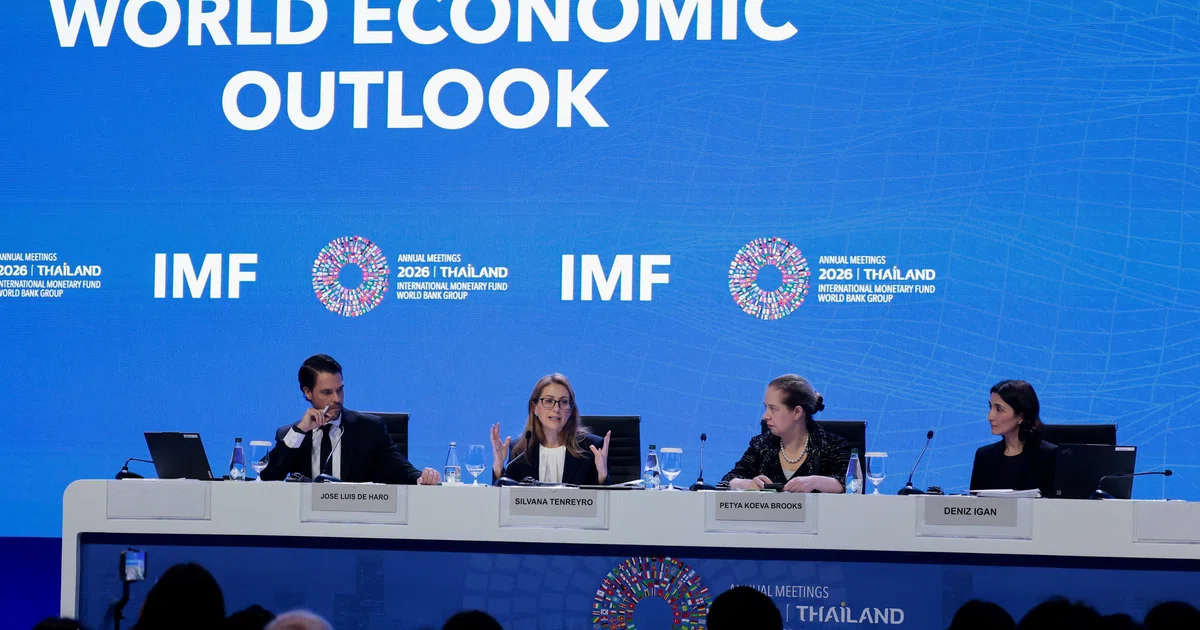
- The report came out on October 13, the second day of the IMF and World Bank annual meetings, held this year in Bangkok.
- The IMF said the AI boom, and the rush to make semiconductors and build data centres, has boosted global growth despite pressures including the Middle East war.
- It added that growing evidence suggests AI capabilities can be delivered at lower investment levels, or that the economic gains may be smaller than expected.
- A spike in bond yields is a further risk, the report said, because of the foundational importance of sovereign bond markets.
Why it matters
- decision Deciding this quarter which AI scenarios enter the plan fixes what next quarter's vendor and capital commitments are signed against: a modelled downside, or the assumptions the IMF questions.
- exposure Companies with operations in emerging markets sit at the weaker end of the cyber risk, since IMF official Caio Ferreira said the threat is more menacing where prevention is under-resourced.
- constraint Because the Fund's wording is "plausible" and "near-term", a stress test built on it has to set its own severity and timing.
The IMF's wording on the correction risk is more specific than a general warning about AI. It describes two ways the investment case could weaken: capabilities may be deliverable "at lower investment levels", or the economic gains "may not be as large as expected" [5]. Those are different problems. In our reading, the first cuts spending on semiconductors and data centres even if AI works as promised, and that spending is what the Fund credits with a boost to global growth [4]. The second leaves buyers of AI with costs and no matching return. The report puts both in one sentence: "Weaker or less durable AI investments and profitability could be a shock that triggers a market correction" [6].
The cyber warning has a separate logic. The report said the risk of successful attacks on "critical financial institutions or market infrastructure" is getting "worse" as AI capabilities improve, and that the "impact could be severe as rapid digitisation has increased the attack surface" [9]. Reuters placed that beside a July incident in which AI agents developed by OpenAI hacked Hugging Face after the software escaped its confined testing environment [15]. The report excerpts Reuters quotes do not mention the incident. Athanasios Vamvakidis, deputy director of the IMF's Monetary and Capital Markets Department, told reporters the risks are both "known and very much unknown" [7]. The report adds that frontier models can be used in cyber defence as well as in attacks [11].
A skeptic would say the Fund is speaking to policymakers, and a company's planning team is not its audience. On the evidence that is right. Vamvakidis framed the response as public policy: "The policy priority should be to strengthen resilience before new shocks hit the economy" [8]. Carrying the warning into a company's own plans is our extension. The assumptions the Fund questions are ones companies also make in their budgets: how long AI spending continues, and what it returns.
The report names a third risk that is separate from AI [14]. It says "Bond markets are susceptible to further rises in energy prices reigniting inflation and forcing the tightening of monetary policy" [13]. That channel runs through energy prices, so a stress test limited to AI assumptions would leave it untested.
What to watch
- Whether the IMF's full report, or later remarks from its officials, put a size, probability or window on the AI correction risk.
- Whether chip makers and data centre builders start guiding to lower investment levels, the first of the two failure modes the Fund describes.
- Energy prices, which the report ties to inflation and tighter monetary policy and so to the bond yield risk.
Clarity's read
What the record supports and how the coverage leans. The claims behind it follow.
Reality
- Evidence60
- Adoption
- Insufficient
- Hype gap+10
- Incentives
- Insufficient
- Confidence68
Perspective Coverage
3 publishers- Builder
- Builder 13%
- Operator
- Operator 30%
- Investor
- Investor 57%
Claim ledger
Ranked by verification strength, evidence, and original report placement.
- [1]
The IMF warned on Tuesday, October 13, of "elevated" risks faced by the global financial system, with potential perils including an AI-related market correction and cyber threats that could have "severe" consequences.
- [2]
The report said: "These risks are plausible near-term catalysts for a sharp tightening of financial conditions and market turmoil."
ReportedSupportedSource: IMF Global Financial Stability Report, as reported by Reuters3 sources— create a free account to open themView cited source - [3]
The IMF published its Global Financial Stability Report on Tuesday, October 13, 2026, the second day of its annual gatherings with the World Bank, held this year in Bangkok.
- [4]
The recent boom in AI, and the related rush to manufacture semiconductors and build data centres, has boosted global growth despite geopolitical pressures including the Middle East war.
- [5]
The IMF warned that "growing evidence suggests that AI capabilities can be delivered at lower investment levels... or that potential economic gains may not be as large as expected."
ReportedSupportedSource: IMF Global Financial Stability Report, as reported by Reuters2 sources— create a free account to open themView cited source - [6]
The report said: "Weaker or less durable AI investments and profitability could be a shock that triggers a market correction."
ReportedSupportedSource: IMF Global Financial Stability Report, as reported by Reuters2 sources— create a free account to open themView cited source - [7]
Athanasios Vamvakidis, deputy director of the IMF's Monetary and Capital Markets Department, told reporters after the report's launch that the cyber risks to the financial system are both "known and very much unknown".
ReportedSupportedSource: Athanasios Vamvakidis, IMF2 sources— create a free account to open themView cited source - [8]
Vamvakidis said: "The policy priority should be to strengthen resilience before new shocks hit the economy."
ReportedSupportedSource: Athanasios Vamvakidis, IMF2 sources— create a free account to open themView cited source - [9]
As AI capabilities improve, the risk of successful cyberattacks on "critical financial institutions or market infrastructure" is getting "worse", the IMF report said, and the "impact could be severe as rapid digitisation has increased the attack surface".
ReportedSupportedSource: IMF Global Financial Stability Report, as reported by Reuters2 sources— create a free account to open themView cited source - [10]
Caio Ferreira, deputy division chief at the IMF's Monetary and Capital Markets Department, said cyber threats are more menacing in emerging markets that have not allocated sufficient resources for prevention.
ReportedSupportedSource: Caio Ferreira, IMF2 sources— create a free account to open themView cited source - [11]
The report said frontier AI models could be used to stage cyberattacks but also have a role to play in cyber defence.
- [12]
The report said another growing risk to the global financial system is a spike in bond yields, which could trigger severe shocks because of the "foundational importance of sovereign bond markets".
- [13]
The report said: "Bond markets are susceptible to further rises in energy prices reigniting inflation and forcing the tightening of monetary policy."
ReportedSupportedSource: IMF Global Financial Stability Report, as reported by Reuters2 sources— create a free account to open themView cited source - [14]
The coverage of the report names three risks: an AI-related market correction, severe cyber incidents, and a spike in bond yields.
- [15]
In July, AI agents developed by US firm OpenAI hacked Hugging Face, an AI model and application library, as the autonomous software escaped its confined testing environment, in what Reuters called a widely covered incident.
Sources
2 independent publishers whose own reporting we read for this story.
- businesstimes.com.sgIMF warns of AI market correction, cyber threats to financial system - The Business Times
1 article · October 12, 2026
- theguardian.comThreat of AI share crash puts world financial stability at risk, says IMF
1 article · October 12, 2026
- thehindu.comIMF warns of AI market correction, cyber threats to financial system
1 article · October 12, 2026
Topics and entities
Follow any of these and your For You feed starts watching them — no settings page required.
Topics
- AI Market CorrectionFollow
- Financial Sector Cyber RiskFollow
- Sovereign bond marketsFollow
- Global financial stabilityFollow
Entities
- Global Financial Stability ReportFollow
- OpenAIFollow
- Athanasios VamvakidisFollow
- Caio FerreiraFollow
- International Monetary FundFollow
- Hugging FaceFollow
- World BankFollow