Product1 publisherNot yet confirmed elsewhere3 min readPublished
Techouse's compact offshore steam generator clears full-scale tests; the CO2 math is still an estimate
A once-through steam generator developed with TotalEnergies, Equinor and SINTEF passed vibration and fatigue testing at Stord. Commercial launch is targeted for end-2026, and the data analysis is unfinished.
The Product Desk · Product desk
Drafted by a language model from the sources cited here and checked against its claim ledger before publication. How we use AISend a correction
What happened
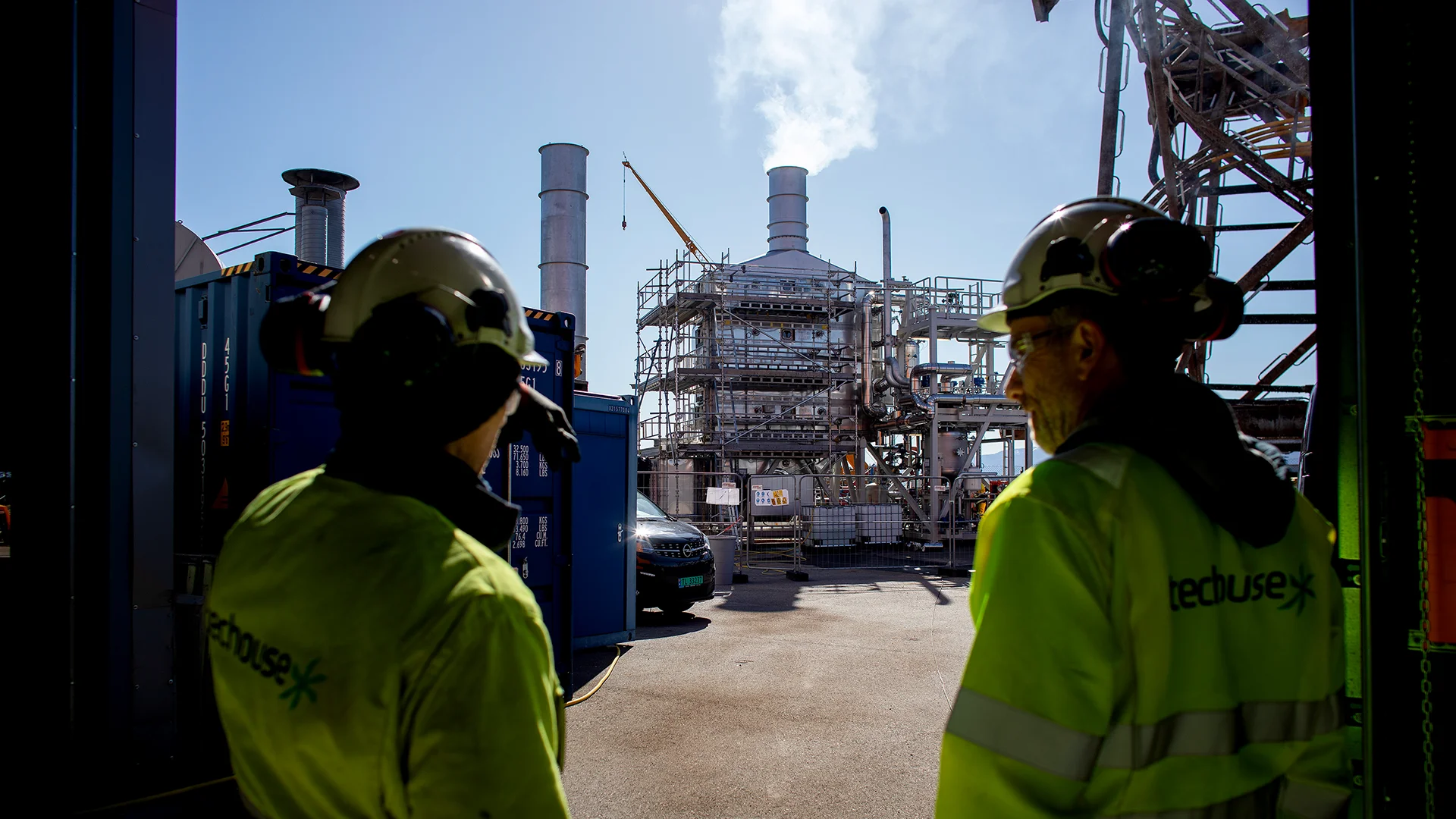
- Norwegian technology company Techouse has completed full-scale testing of a compact once-through steam generator (COTSG) designed to make combined-cycle power generation more practical on offshore oil and gas installations.
- The COTSG was developed through a joint industry project involving TotalEnergies, Equinor and SINTEF Energy Research, with funding from the Norwegian Research Council.
- Sustainable Energy conducted the testing at its test center in Stord, western Norway.
- A combined-cycle system captures gas-turbine exhaust heat to produce steam, which can drive a separate turbine connected to a generator, producing additional electricity without an equivalent increase in fuel consumption; the approach is already established on land.
- Offshore installations present a space and weight constraint: conventional once-through steam generators and other heat-recovery equipment can be large and heavy, offshore platforms have limited deck space and structural capacity, and floating facilities such as FPSOs face additional constraints when new equipment is added.
Compiled by The Product DeskSomething wrong?How this is made
Why it matters
Norwegian technology company Techouse has completed full-scale testing of a compact once-through steam generator (COTSG) designed to make combined-cycle power generation practical on offshore oil and gas installations [6]. The barrier it addresses has never been thermodynamic: recovering gas-turbine exhaust heat to raise steam and drive a second turbine is standard practice on land, but conventional once-through steam generators and associated heat-recovery equipment are large and heavy, and platforms have finite deck space and structural capacity, with floating production units facing additional constraints when new equipment is added [9][10].
That reframes the product question. The engineering claim is not better efficiency but a smaller and lighter box, which is what turns a known cycle into something a topsides engineer can actually specify. According to Offshore Magazine, Techouse built the COTSG specifically to solve that weight and space problem [11]. Techouse CTO Pal Kloster said the company had already met its objectives of making the generator smaller and lighter, and that the latest campaign was about verifying robustness and commercial potential [14].
The test content matters more than the headline. The full-scale unit went through performance testing plus vibration, fatigue and thermal-fatigue testing, including cyclic loading intended to assess whether it can meet a targeted 30-year operating life [13]. Thermal cycling is the failure mode that kills waste-heat equipment on installations that ramp with production, so testing it before launch rather than after first delivery is the right sequence. The unit was developed through a joint industry project involving TotalEnergies, Equinor and SINTEF Energy Research, with funding from the Norwegian Research Council, and Sustainable Energy ran the testing at its center in Stord, western Norway [7][8].
Now the numbers, and their provenance. Techouse says the technology could cut fuel consumption and CO2 emissions by up to 25% against conventional gas-turbine power generation [1]. Its earlier research put the range at 22 to 25% for both floating and fixed installations, translating to annual reductions of 50,000 to 150,000 metric tons of CO2 depending on the installation [2][12]. Those are company estimates, not outputs of this test campaign [3]. Taken at the 25% figure, the tonnage range implies host installations currently emitting roughly 200,000 to 600,000 tons a year, which is a wide spread and a reminder that the payback case is site-specific rather than a product spec [17].
The company said the tests produced positive results against its key parameters and that it is analyzing the collected data [4]. Testing is finished; the final analysis is not, which makes this a development milestone rather than evidence of readiness for widespread commercial deployment [5]. Techouse is targeting commercial launch by the end of 2026, with fixed production platforms, FPSOs and other gas-turbine-dependent installations as candidate applications [15][18]. It also plans to explore integrating the technology with offshore carbon-capture systems [16].
What to watch: whether the completed data analysis is published in enough detail to check the 30-year life claim against the cyclic loading actually applied [13][5]; whether any operator, including the two that funded the project, converts the test result into a named retrofit or newbuild order ahead of the end-2026 launch target [7][15]; and whether the 22 to 25% band survives contact with a specific installation's turbine configuration and load profile rather than remaining a range [2].