Invest1 publisher2 min readPublished
TotalEnergies signs with PDVSA five years after writing off $1.4bn in Venezuela
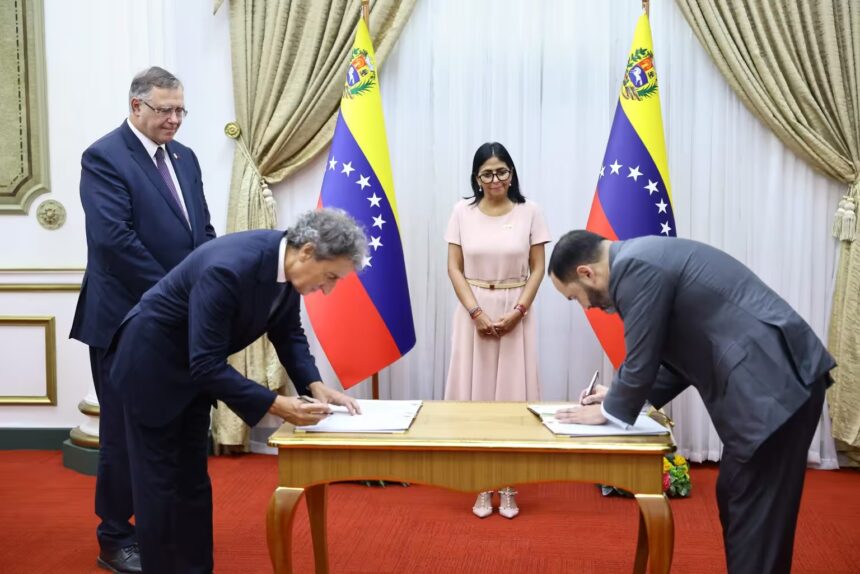
The memorandum signed at Miraflores Palace on September 19 follows deals BP, Eni, Repsol and Chevron struck with the new government this year. Venezuela still pumps under a million barrels a day against about three million in the late 1990s.
The Investor · Invest desk
What happened
- The French company left Venezuela's upstream in 2021 and took a $1.4 billion writedown doing it, five years before this memorandum.
- BP, Eni, Repsol and Chevron have each struck comparable agreements with Venezuela's post-Maduro government this year, under a revised Organic Hydrocarbons Law.
- The document is not a production-sharing agreement, and its operational, financial and contractual terms were not disclosed.
Compiled by The InvestorSomething wrong?How this is made
Why it matters
- constraint The memorandum leaves TotalEnergies free of any spending obligation, so Venezuela competes for capital only once fiscal terms, production targets and revenue splits are negotiated.
- precedent Five majors inside the same reformed framework sets a template the next signatory can price off, and weakens any one company's leverage over terms.
- exposure OPEC+ carries the downside of success: every few hundred thousand barrels a day Venezuela recovers has to be absorbed inside a quota schedule built without it.
- decision Closing the gap to the late-1990s level means volumes equal to about 83 percent of everything TotalEnergies pumps worldwide. That is a consortium-scale spending decision.
A memorandum is cheap. The signing at Miraflores Palace put TotalEnergies' senior vice president for the Americas, Francisco Javier Rielo, opposite PDVSA president Hector Obregon on a document covering "strategic cooperation in hydrocarbons", with acting President Delcy Rodriguez overseeing [1][2]. The two sides did not disclose operational, financial or contractual terms, and the document is not a production-sharing agreement [10]. TotalEnergies wrote down $1.4 billion when it left the upstream in 2021 [3].
By the time the French company signed, the terms of the reformed regime had already been tested by four others. BP, Eni, Repsol and Chevron all struck comparable agreements with Venezuela's post-Maduro government this year [7], which makes TotalEnergies the fifth major to sign since Maduro's ouster in January 2026 [4][3]. The revised Organic Hydrocarbons Law is what changed underneath all five: it gives international companies expanded operational roles in place of the state-control model of the Maduro years [5].
Venezuela holds roughly 303 billion barrels of proven reserves, more than any other country, and currently produces under 1 million barrels a day [8][9]. At that rate the reserves run about 830 years [1]. The binding constraints are fiscal terms and capital, and the document sets out neither.
Scale the recovery the same way. Returning to the roughly 3 million barrels a day Venezuela pumped in the late 1990s means adding more than 2 million, about 83 percent of the 2.4 million barrels of oil equivalent a day TotalEnergies produced across its entire global portfolio in recent years [9][11][2]. It would take a consortium to underwrite that, and an OPEC member restoring even a few hundred thousand barrels a day complicates OPEC+ quota work [12].
From here, the memorandum converts into signed fiscal terms and a dated work programme; or it sits roughly where the trading discussions of April 2026 sat, useful for position and nothing more [6]; or barrels actually arrive and the quota table becomes the fight. I would expect the second through the next few quarters, because a signature with no disclosed commitment costs nothing and commits nothing. What would move me off that: a royalty rate, a cost-recovery mechanism, a first-oil date, or a capital number attached to a named block.
Read in sequence, the signature lands late. Chevron, BP, Eni and Repsol were already inside the reformed framework before September 19 [7][1], and TotalEnergies itself was talking to Venezuelan counterparts about trading arrangements in April [6].
What to watch
- Whether the memorandum converts into fiscal terms under the revised Organic Hydrocarbons Law, with a royalty rate and a named block.
- Whether Venezuelan output moves above 1 million barrels a day, and how OPEC+ treats the increment in quota talks.
- Any partial reversal of the $1.4 billion 2021 writedown appearing in TotalEnergies' reporting.