ScienceNot yet confirmed elsewhere1 publisher2 min readPublished
Host-star mass and metal content split 300 multiplanet systems into two families
INAF-led researchers sorted 300 well-characterized multiplanet systems into two families that track host-star mass and metal content. In Nature Astronomy, the authors say the split holds up against detection bias.
The Scientist · Science desk
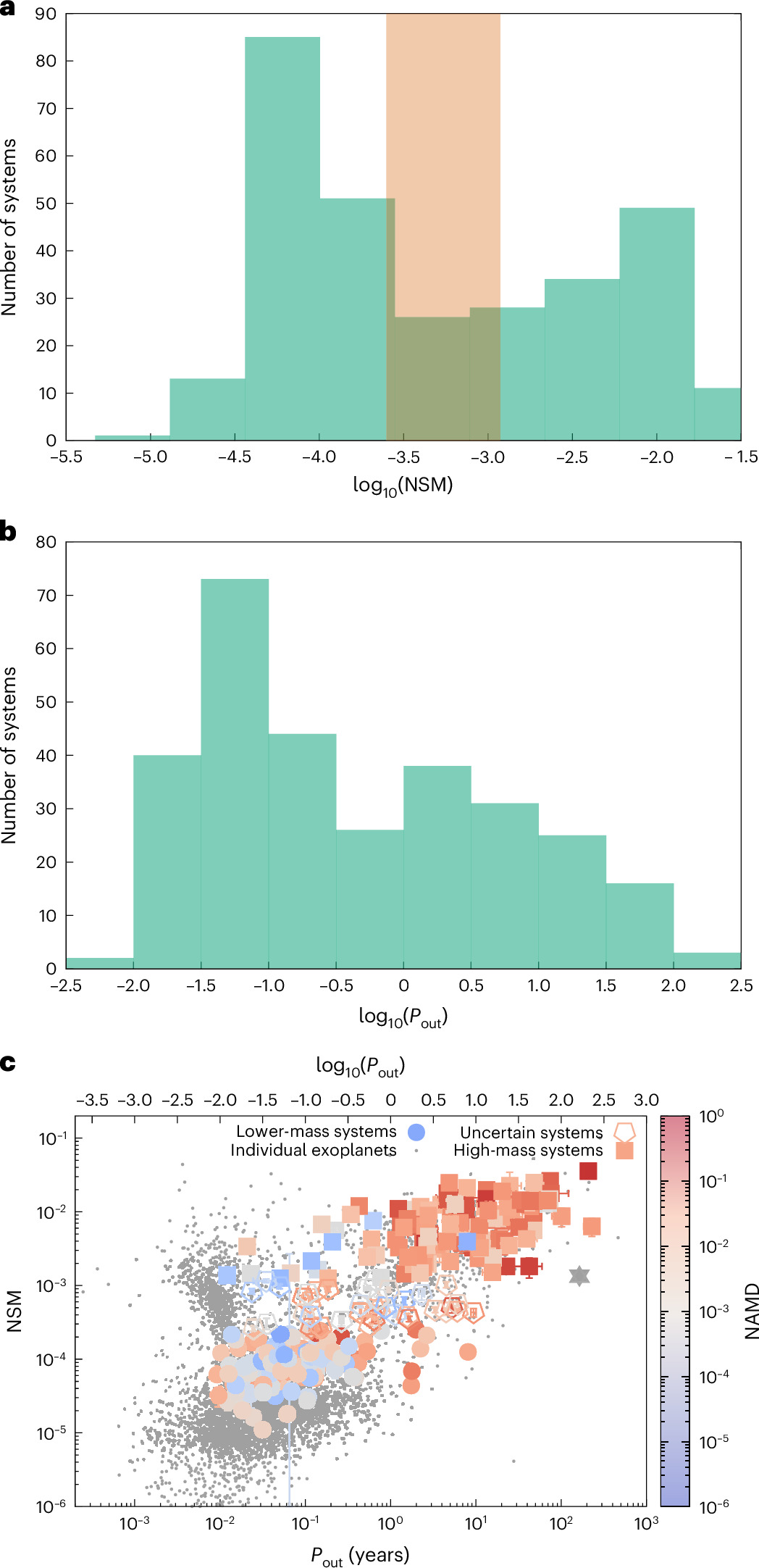
Systems in the wide, massive family often have total masses between twice and 10 times that of the solar system. The team analyzed a sample of 300 planetary systems, out of more than 1,000 known in the Milky Way.
| Figure | Value | Note | Claim |
|---|---|---|---|
| Wide family's total mass, often up to | 10 × solar system | often from twice the solar system's | 3 |
| Systems in the sample | 300 systems | 13 | |
| Systems known, over | 1,000 systems | 1 |
What happened
- More than 1,000 planetary systems are known in the Milky Way, and the team analyzed the 300 best characterized of them.
- Wide, massive systems, often twice to 10 times the solar system's total mass, orbit stars heavier and richer in metals than the sun.
- Compact peas-in-a-pod systems hold planets of similar mass and size around stars at or below the sun's mass and metallicity, mostly much closer in than Mercury orbits.
- A high dynamical temperature marks the first family, a measure of departure from circular, coplanar orbits that the team attributes to a history of violent instability.
- The second family shows traces of less violent dynamical histories, closer to the solar system's, according to the researchers.
Why it matters
- constraint The host-star link is an observed association, while the explanation for the wide family comes from simulations, so it is the best-matching scenario in a set of models.
- decision The release says the link should guide the search for solar-like architectures. We would expect host-star mass and metallicity to become a first filter when building target lists.
- exposure More than 700 known systems sit outside the 300-system sample, and they are less well characterized by construction, so the two-family split is untested where the data are thinnest.
The hard part was showing the two families exist at all. Co-first author Camilla Danielski said "The main difficulty during the data analysis was determining whether the two families of planetary systems were real or just an illusion created by the technological limits of current observational techniques" [7]. Her conclusion followed. "In the end, it became clear that selection effects acted as the tip of the iceberg, revealing the existence of much deeper structural differences between these systems," she said [8].
Simulations supplied the explanation. The team explored the evolution of planetary systems from different initial conditions [12]. Danae Polychroni, who supervised that part of the study, said "The scenarios that best reproduce the dynamical properties of the family of wide and massive systems are those in which the systems are unstable from birth" [9]. She added: "The greater abundance of material from which planets form around their host stars causes them to be born too large, preventing the system from remaining stable" [10]. The wording "best reproduce" implies a comparison among several scenarios. That is the stronger design.
Co-first author Diego Turrini framed the underlying question as birth versus later sculpting. "The truth, in the end, turned out to lie somewhere in the middle," he said [11].
The 300 systems are under 30 percent of those known [13]. The release does not say how many of them fall in each family, or how sharp the boundary between the families is.
In our view the association between host-star properties and architecture is the sturdier result, because it comes with a test against selection effects. The causal chain is simulation evidence. A scenario that reproduces the dynamical properties of the wide family is a candidate mechanism, and it holds as long as the best-characterized systems are not skewed in ways that test missed. The release says the study demonstrates for the first time a true "genetic link" between host star and planets [15]. We would put it more narrowly: a strong association, with a simulated route from stellar properties to unstable birth.
The habitability framing is the release's own. It says understanding the link is essential to guiding the search for solar-system-like architectures and for potentially habitable planets like Earth [16]. The quantities the study describes are planet masses and sizes, orbital configuration, and host-star mass and metallicity [3][4][5].
What to watch
- Whether the Nature Astronomy paper's data show how many of the 300 systems fall in each family and how sharp the boundary between them is.
- Whether the classification holds when applied to the 700-plus known systems that were not in the sample, and to new discoveries.
- Whether other groups run simulations that test alternatives to the unstable-from-birth scenario for the wide, massive family.
Clarity's read
What the record supports and how the coverage leans. The claims behind it follow.
Reality
- Evidence58
- Adoption
- Insufficient
- Hype gap+25
- Incentives40
- Confidence55
Claim ledger
Ranked by verification strength, evidence, and original report placement.
- [1]
An international research team led by the Italian National Institute for Astrophysics (INAF) analyzed a sample of 300 of the best-characterized planetary systems among the more than 1,000 known in the Milky Way.
- [2]
The study, published in Nature Astronomy, finds that the multiplanet systems identified so far belong to two distinct families.
- [3]
The first family consists of wide, massive systems, often with total masses between twice and 10 times that of the solar system, orbiting stars more massive and richer in metals than the sun.
- [4]
The second family consists of compact, lower-mass systems of planets with comparable masses and sizes (peas-in-a-pod), orbiting stars with mass and metallicity equal to or lower than the sun's, in most cases at distances much smaller than Mercury's distance from the sun.
- [5]
Systems in the first family have a high dynamical temperature, a parameter quantifying deviation from an unperturbed configuration with all circular orbits in the same plane, which traces a past marked by violent gravitational instabilities, giant collisions and planetary ejections.
- [6]
Members of the second family show traces of less violent dynamical histories, closer to that of our solar system.
- [7]
"The main difficulty during the data analysis was determining whether the two families of planetary systems were real or just an illusion created by the technological limits of current observational techniques."
ReportedSupportedSource: Camilla Danielski, University of Valencia researcher, former INAF postdoctoral fellow and co-first authorView cited source - [8]
"In the end, it became clear that selection effects acted as the tip of the iceberg, revealing the existence of much deeper structural differences between these systems."
- [9]
"The scenarios that best reproduce the dynamical properties of the family of wide and massive systems are those in which the systems are unstable from birth."
ReportedSupportedSource: Danae Polychroni, INAF researcher who supervised the simulation part of the studyView cited source - [10]
"The greater abundance of material from which planets form around their host stars causes them to be born too large, preventing the system from remaining stable."
- [11]
"The truth, in the end, turned out to lie somewhere in the middle," in answer to whether planetary system characteristics are established at birth or sculpted by evolution over time.
- [12]
A series of numerical simulations exploring the evolution of planetary systems with different initial conditions was essential to proving the hypothesis that the wide, massive systems are unstable from birth.
- [13]
The 300-system sample is under 30 percent of the known planetary systems.
- [14]
More than 700 known planetary systems are outside the 300-system sample.
- [15]
The study, according to the release, demonstrates for the first time a true "genetic link" between the host star and its planets that shapes the birth, dynamical evolution and future stability of the entire planetary system.
- [16]
The release says understanding the link between stars and planetary systems is essential to guiding the search for planetary architectures similar to the solar system and for potentially habitable planets like Earth.
Sources
1 independent publisher whose own reporting we read for this story.
- phys.orgPlanetary systems reveal two distinct families tied to their host stars
1 article · October 13, 2026
Topics and entities
Follow any of these and your For You feed starts watching them — no settings page required.
Topics
- Planet formationFollow
- Exoplanet systemsFollow