ScienceNot yet confirmed elsewhere1 publisher2 min readPublished
Pooled crop trials show no yield penalty for fertilizers made from human excreta
A meta-analysis of 134 data sets found no systematic yield disadvantage for recycled human-excreta fertilizers against mineral ones. Data on pharmaceutical residues and PFAS remain too incomplete to clear every product group of organic contaminants.
The Scientist · Science desk
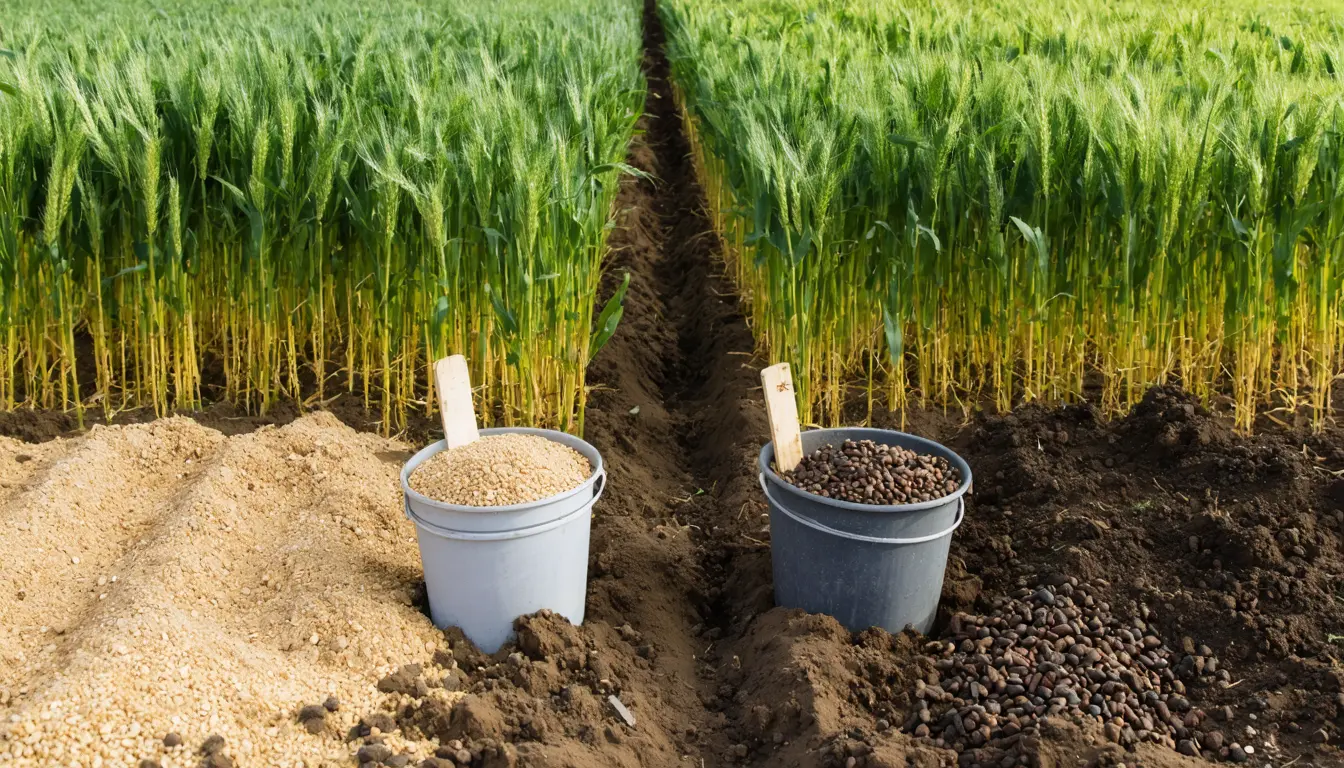
Share bar: 134 data sets went into the yield meta-analysis, out of more than 450 data sets in the full compilation. That is under 30 percent.
- Yield meta-analysis, of over 450, claim 14 134 of 450 data sets 30% computed
Yield meta-analysis, of over 450 The rest of the 450
| Share | Part | Whole | Percent | Claim |
|---|---|---|---|---|
| Yield meta-analysis, of over 450 | 134 data sets | 450 data sets | 30% (computed) | 14 |
What happened
- The compilation draws on more than 450 data sets from over 200 sources in 32 countries, analysed at the level of individual products.
- Yields were generally significantly higher than in unfertilized control treatments.
- Heavy metal concentrations in the products examined were predominantly low and comparable to those in established fertilizers.
Why it matters
- constraint The pooled result is an average over many soils and crops, so it cannot predict a given field, where the authors say nutrient form, soil, crop and management all shape the effect.
- decision A buyer has to evaluate each product by its raw material and processing method, because nutrient form and concentration follow from them.
- exposure Anyone certifying a product for hygiene safety has to document feedstock and treatment conditions, the two factors the authors single out.
The yield finding rests on a smaller body of evidence than the headline compilation. Set against the more than 450 data sets in the full compilation [1], the 134 behind the yield test [7] are under 30 percent of the total [14].
Pooling has a benefit and a cost. Mixing field, pot and hydroponic trials across 31 crop species [7] lets the authors ask whether any pattern survives very different conditions. It also averages those conditions away. The result is no systematic yield disadvantage against mineral fertilizers [8], and that is a weaker statement than equivalence: the pooled data show no consistent shortfall, not that every product matches. The summary does not include effect sizes or confidence intervals for the mineral comparison, so we cannot say how large a shortfall the pooled data could still hide in one product.
The comparison with unfertilized controls is the easier test. A source of nitrogen, phosphorus or potassium would be expected to beat none, so the finding that yields were generally significantly higher [8] is the less informative of the two.
The authors are the ones making the broad case. Ariane Krause of the Network for Sustainable Sanitation, a co-author, said: "Until now, however, there has been no comprehensive overview of the wide variety of products, processes and application conditions." [11] Her co-author Martina Winker of the Institute for Social-Ecological Research said the findings show that recycled fertilizers from separately collected material streams "are not second-class fertilizers". [12]
In our view, the supportable claim is narrower than the phys.org headline, which reads "Recycled fertilizers from sanitation systems are as effective as conventional fertilizers, study finds". [13] The study text says many of the products, not all, fall into known mineral, organic or organic-mineral categories [3]. It also says nutrient form and concentration depend largely on raw material and processing method [10]. That points to a product-by-product reading. For the 13 types with enough data [2], no systematic yield penalty appears in the pooled trials.
The thing this doesn't tell you is how any single product performs on your soil with your crop.
What to watch
- Per-product yield results with effect sizes and confidence intervals for each of the 13 fertilizer types.
- Field-only yield comparisons, to see whether the pooled result holds outside pot and hydroponic trials.
- New measurements of pharmaceutical residues and PFAS across the product groups where data are now incomplete.
Clarity's read
What the record supports and how the coverage leans. The claims behind it follow.
Reality
- Evidence62
- Adoption
- Insufficient
- Hype gap+25
- Incentives
- Insufficient
- Confidence55
Claim ledger
Ranked by verification strength, evidence, and original report placement.
- [1]
The study compiled more than 450 data sets from over 200 sources across 32 countries and analyzed them at the product level.
- [2]
For 13 types of recycled fertilizers, sufficient data were available to characterize their properties in detail.
- [3]
Many of the recycled fertilizers can be classified into known categories of mineral, organic or organic-mineral fertilizers in terms of nutrient composition and function.
- [4]
Overall, the heavy metal concentrations examined were predominantly low and comparable to those in established fertilizers.
- [5]
The feedstock and treatment conditions are particularly critical for hygiene safety.
- [6]
Data on organic contaminants such as pharmaceutical residues or PFAS are still incomplete and do not yet allow a comparably comprehensive assessment across all product groups.
- [7]
The fertilizing effect was determined using a quantitative meta-analysis of 134 data sets from 68 sources, including 31 crop species as well as field, pot and hydroponic trials.
- [8]
Across the recycled fertilizers examined, no systematic yield disadvantage was observed compared to mineral fertilizers; yields were generally significantly higher than in unfertilized control treatments.
- [9]
The specific effect on yield depends, among other factors, on nutrient form, soil, crop and management practices.
- [10]
The nutrients contained in a ROS-based fertilizer, as well as their form and concentration, depend largely on the raw material and the specific processing method.
- [11]
"Until now, however, there has been no comprehensive overview of the wide variety of products, processes and application conditions."
ReportedSupportedSource: Ariane Krause, Network for Sustainable Sanitation (NetSan), co-authorView cited source - [12]
Martina Winker of the Institute for Social-Ecological Research (ISOE), a co-author, said the findings show that recycled fertilizers derived from separately collected material streams "are not second-class fertilizers".
- [13]
The phys.org headline reads: "Recycled fertilizers from sanitation systems are as effective as conventional fertilizers, study finds".
- [14]
The 134 data sets behind the yield meta-analysis are under 30 percent of the more than 450 data sets in the full compilation.
Sources
1 independent publisher whose own reporting we read for this story.
- phys.orgRecycled fertilizers from sanitation systems are as effective as conventional fertilizers, study finds
1 article · October 13, 2026
Topics and entities
Follow any of these and your For You feed starts watching them — no settings page required.