SpaceX's $100B Louisiana pad farm bets on a turnaround Starship has never shown
The stated ceiling exceeds SpaceX's entire IPO haul, and the refurbishment cycle that would justify ten launch pads has not been demonstrated once.
The Engineer · Build desk
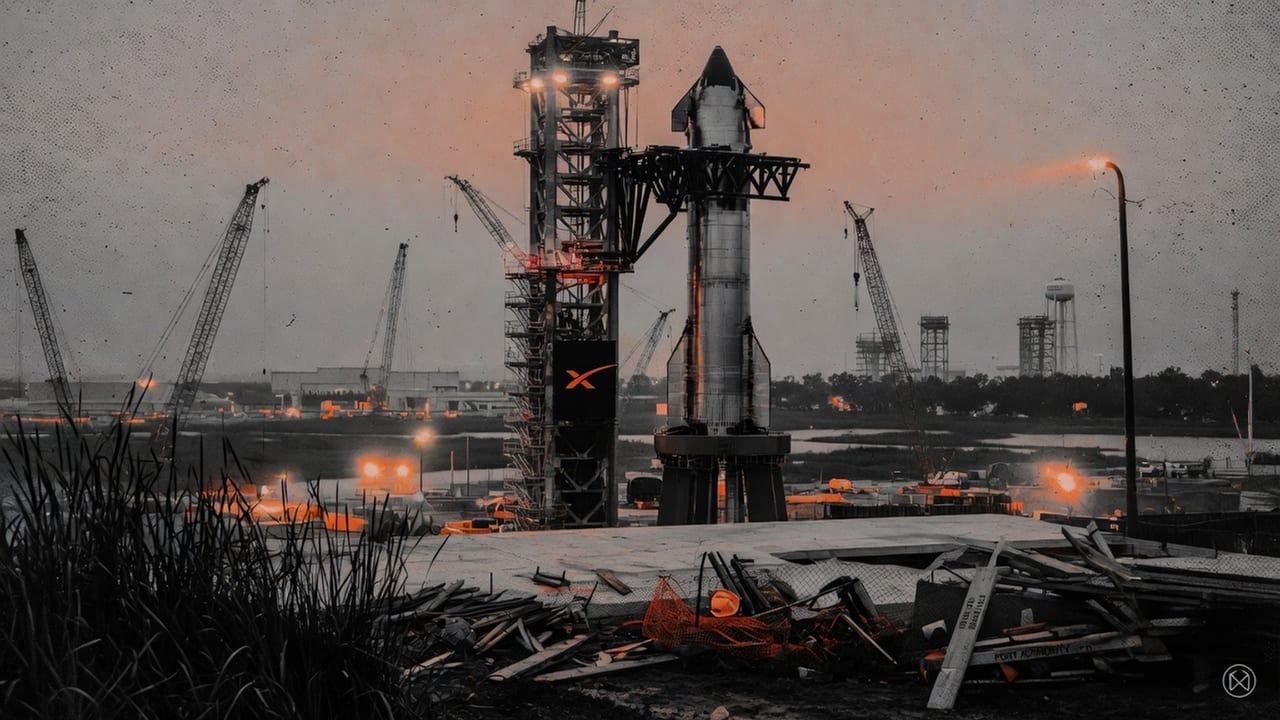
What happened
- SpaceX plans to put up to $100 billion into a Louisiana spaceport sized for thousands of launches a year, CNBC reported Tuesday.
- The site is a former Exxon property near Pecan Island in Vermilion Parish, on the Gulf Coast.
- Construction is slated to start in 2027, with SpaceX targeting a first launch as soon as 2029 and the state citing initial operations in 2030.
- Full buildout calls for five launch complexes, each with two pads and its own propellant farm, on a campus with fuel, power, a deep-water port, an airport and worker housing.
Why it matters
- constraint Pad count is not what caps launch rate here; refurbishment time is, and ten pads only earn their keep if a vehicle comes back ready every couple of days.
- exposure Public shareholders now share this call with Starlink cash generation and AI compute spending, on a project whose capital ceiling has no published year-by-year schedule.
- decision Because Musk has tied Falcon 9 and Falcon Heavy retirement to Starship flying several times a week, the same unproven turnaround governs when SpaceX gives up its revenue-earning fleet.
- contradiction Runtimewire treats $100 billion as a ceiling on planned investment, mezha.net reports it as an intended figure of about $100 billion, and that gap decides whether this is a commitment or an option.
At full buildout the campus carries ten pads [25], and that is the number that makes the cadence claim checkable. Take the conservative reading of "thousands of launches annually" that CNBC's reporting invites, 2,000 a year [5], and each pad has to put a vehicle up every 1.8 days [22]. Concrete, cryogenic plumbing and a propellant farm are the tractable part of that. The intractable part is the inspection and refurbishment loop, which Starship has not demonstrated at any rate: 13 test flights since 2023, with orbital insertion of the upper stage possibly arriving on flight 14, and return of both stages plus quick re-flight still unproven, according to TechCrunch's account [6][7]. A 2,000-flight year would be roughly 154 times the entire flight history to date [23].
What SpaceX is buying with a phased schedule is optionality. The $100 billion is a maximum, not verified committed spending, and neither the company nor the state has published an annual capital schedule or a split between pads, factories, utilities, transport and housing [12]. Ground breaks in 2027 [3], so most of that money is years of board decisions away, each one informed by a better estimate of turnaround time. The exposure sits in the first complex, because the self-supporting half of the site does not scale down gracefully. Fuel production, power generation and a deep-water route for oversized hardware [4] are largely built out to support the first flight, not the two thousandth.
Against the balance sheet, the number is large but not absurd. The June 2026 IPO grossed about $85.7 billion, earmarked in an SEC filing for launch infrastructure and vehicles, satellite capacity, AI computing and general corporate needs [13]. The Louisiana ceiling runs about $14.3 billion above that entire haul, some 17 percent [26]. Set against the more than $8 billion SpaceX says in filings it has already spent developing Starship [19], the spaceport ceiling is no more than about 12.5 times cumulative program development cost [28]. That is a heavy ratio of fixed plant to a vehicle still in test.
Vermilion Parish gets paid either way, at least in part. The payment-in-lieu-of-taxes deal is $20 million upfront and $25 million a year for 25 years with an escalator, which Louisiana expects to exceed $820 million [16]. Flat, that schedule totals $645 million, so the state is counting on the escalator for at least $175 million of the headline [27]. The employment side is thinner than the capital side: about 3,000 direct jobs over ten years at an average $92,600, with construction peaking above 30,000 [8], which works out to roughly $33 million of planned capital per permanent job [24].
The staffing peak is where the Texas record becomes relevant. Starbase in south Texas has drawn scrutiny for a high injury rate, and a contractor employee died there in May after a fall [20]. Ramping a coastal construction workforce past 30,000 is a different safety problem than running a single pad complex, and SpaceX is already in consultation with Louisiana wildlife and coastal restoration agencies over the site's effect on fisheries and wetlands [21].
What to watch
- Flight 14: whether the upper stage reaches orbit and whether both stages come back in a condition that supports quick re-flight.
- Whether the state rebate and the parish payment agreement carry clawback terms if buildout halts after the first launch complex.
- Whether a Falcon 9 retirement timeline appears in SpaceX shareholder disclosure before Louisiana concrete is poured.
Clarity's read
What the record supports and how the coverage leans. The claims behind it follow.
Reality
- Evidence60
- Adoption12
- Hype gap+55
- Incentives75
- Confidence68
Claim ledger
Ranked by verification strength, evidence, and original report placement.
- [1]
SpaceX plans to invest up to $100 billion in a Louisiana spaceport capable of handling thousands of launches a year, according to CNBC's report Tuesday.
- [2]
The proposed Starbase, Louisiana campus would occupy a former Exxon property near Pecan Island in Vermilion Parish.
- [3]
SpaceX expects construction to begin in 2027 and is targeting a first launch as soon as 2029, while Louisiana officials put initial operations in 2030, according to TechCrunch.
- [4]
SpaceX's project site describes a self-sustaining campus with fuel production, power generation, deep-water shipping, vehicle processing and an airport; Louisiana's announcement also includes residential housing for workers and their families.
- [5]
Even 2,000 launches a year would average about 5.5 per day, and would require reusable vehicles, rapid inspection and refurbishment, continuous propellant production and a regulatory system able to process launches at a pace the US space industry has never approached.
- [6]
SpaceX has flown 13 Starship test flights since 2023, and the system still has to prove it can reliably reach low Earth orbit, return both stages and prepare them quickly for reuse, according to TechCrunch.
- [7]
The 14th Starship test flight may for the first time include placing the upper stage in orbit.
- [8]
Louisiana Economic Development estimates about 3,000 direct jobs in the site's first ten years at an average annual salary of $92,600, with employment during peak construction possibly exceeding 30,000.
- [9]
The Louisiana site is about 10 hours by road from the existing Starbase in south Texas.
- [10]
Mezha.net, citing TechCrunch, describes SpaceX as intending to invest about $100 billion in the project.
- [11]
At full buildout, Starbase, Louisiana would have five launch complexes, each containing two pads and a propellant farm.
- [12]
The $100 billion figure is a maximum planned investment rather than verified spending already committed to construction, and SpaceX and Louisiana have not published an annual capital schedule or a breakdown across launch pads, factories, utilities, transport or housing.
- [13]
SpaceX's June 2026 IPO raised approximately $85.7 billion in gross proceeds, which an SEC filing said would support launch infrastructure and vehicles, satellite capacity, AI computing and general corporate needs.
- [14]
RuntimeWire reported before SpaceX's first earnings release that Starlink cash generation would be tested against Starship and AI spending, and the Louisiana proposal adds another large demand on the same pool of capital.
- [15]
Louisiana is offering SpaceX its Aerospace Facilities and Activities Rebate, the High Impact Jobs program and customized recruitment support, conditioned on capital investment, hiring and a $25 million donation to the Community Foundation of Acadiana.
- [16]
Under a payment-in-lieu-of-taxes agreement, SpaceX will make a $20 million upfront payment and pay Vermilion Parish $25 million annually for 25 years with an agreed escalator; Louisiana expects those payments to exceed $820 million.
- [17]
In Louisiana's economic development announcement, Musk said SpaceX wants to make trips to space "as routine as flying on an airplane."
- [18]
Musk has said SpaceX plans to retire Falcon 9 and Falcon Heavy once Starship can launch several times a week.
- [19]
According to documents filed with the SEC, SpaceX has already spent more than $8 billion developing Starship.
- [20]
The Texas Starbase site has recorded a high injury rate, and in May a contractor's employee died after a fall.
- [21]
SpaceX is consulting the Louisiana Department of Wildlife and Fisheries, the Coastal Protection and Restoration Authority and other state agencies on the spaceport's possible effect on wildlife, fishing and coastal ecosystems.
- [22]
At 2,000 launches a year across ten pads, each pad would average 200 launches a year, or one about every 1.8 days.
- [23]
A 2,000-launch year would be about 154 times the 13 Starship test flights conducted since 2023.
- [24]
Spread over about 3,000 direct jobs, the $100 billion ceiling is roughly $33 million of planned capital per permanent job.
- [25]
Five launch complexes with two pads each gives ten launch pads at full buildout.
- [26]
The $100 billion ceiling exceeds the $85.7 billion IPO gross by about $14.3 billion, roughly 17 percent.
- [27]
The flat payment schedule totals $645 million, so Louisiana's expectation of more than $820 million implies the escalator supplies at least about $175 million.
- [28]
The $100 billion site ceiling is no more than about 12.5 times the more than $8 billion spent on Starship development so far.
Sources
2 independent publishers whose own reporting we read for this story.
- mezha.netSpaceX створить у Луїзіані другий Starbase для запусків Starship
1 article · August 25, 2026
- runtimewire.comSpaceX plans a $100B Louisiana spaceport before Starship is routine
1 article · August 25, 2026
Topics and entities
Follow any of these and your For You feed starts watching them — no settings page required.