ScienceNot yet confirmed elsewhere1 publisher2 min readPublished
NYU Abu Dhabi researchers build a seed-sized nerve stimulator injected through a needle
NYU Abu Dhabi researchers report a seed-sized, battery-free nerve stimulator injected through a standard needle and powered from outside the body. In preclinical tests it activated nerves in a living organism, though its effect on pain or movement disorders in patients has not been established.
The Scientist · Science desk
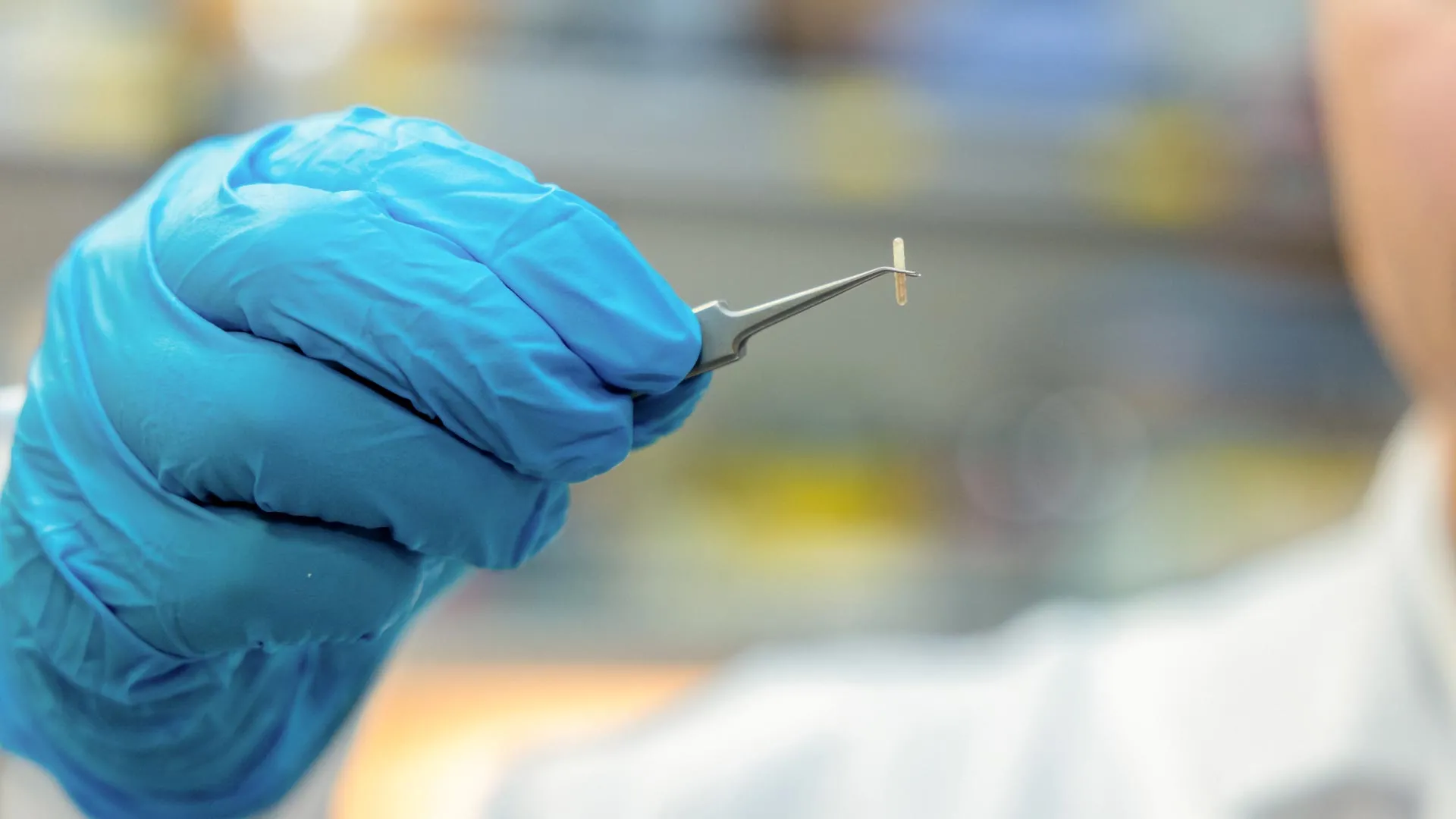
What happened
- The work, a collaboration between NYU Abu Dhabi and Cleveland Clinic Abu Dhabi, is published in Science Advances.
- Once injected, the device sits close to a specific nerve and sends controlled electrical signals that alter that nerve's activity.
- Doctors or patients can adjust the stimulation in real time, because power is supplied wirelessly from outside the body.
- Ultrasound and CT scans can locate the device, guiding placement near the nerve and checking its position afterward.
- Laboratory and preclinical tests showed precise stimulation with consistent performance under conditions designed to resemble real-world use.
Why it matters
- capability If the preclinical results carry over to people, placing a nerve stimulator would take an injection instead of a surgical operation, with no battery or wires left in the body.
- constraint With no onboard battery, stimulation runs only while power is sent from outside, so the external transmitter becomes part of the therapy a patient would have to live with.
- decision Clinicians weighing drugs against surgically implanted stimulators for chronic pain or movement disorders have no patient results from this device to factor in yet.
Making a nerve fire inside a living organism is the result the release calls an important early step toward medical use [2]. It is a physiological readout, showing that the injected device can drive the nerve it sits beside. Relieving pain or improving movement is a clinical outcome, and a separate test [11].
The release does not name the organism, the number of subjects, how long the devices were followed, or how power crosses the tissue to reach the implant [7]. For a battery-free device aimed at chronic conditions, follow-up time and the power link are the first figures we would want from the paper [12].
The headline and the body of the release disagree. ScienceDaily ran it as "Scientists created a tiny device that can control your nerves to treat chronic pain" [3]. Further down, the same text says the device's ability to relieve chronic pain or improve movement disorders in human patients "has not yet been established" [11].
The authors place the device beside existing treatments. The release says it could be another option alongside medications and surgically implanted devices, tailored to individual needs [13]. Mohamed Elsherif, a research associate at NYU Abu Dhabi and the study's first author, said: "This technology has the potential to bridge the gap between non-invasive therapies and traditional implants" [15].
Khalil Ramadi, the senior author, said: "By creating a device that can be injected rather than surgically implanted, we are making these therapies simpler, safer, and more accessible, while still maintaining precise control over nerve activity" [14]. Simpler follows directly from skipping the operation [5]. Safer is a claim about patients, and we think it has to wait for human results [11].
We think the device deserves attention as engineering on what is reported: a programmable stimulator small enough for a standard needle that fired a nerve in a living organism [4][10][2]. How it compares with implanted stimulators for chronic pain will be decided in patients [11].
What to watch
- The Science Advances paper's methods: which animal was used, how many subjects, how long implants were followed, and what physical method carries the wireless power.
- Any first-in-human study from NYU Abu Dhabi and Cleveland Clinic Abu Dhabi that measures pain or movement outcomes, not just nerve activation.
- Long-term data on whether the injected device stays beside its target nerve and keeps stimulating consistently over months.
Clarity's read
What the record supports and how the coverage leans. The claims behind it follow.
Reality
- Evidence35
- Adoption3
- Hype gap+45
- Incentives60
- Confidence45
Claim ledger
Ranked by verification strength, evidence, and original report placement.
- [1]
The researchers evaluated the device through laboratory experiments and preclinical testing; it delivered precise nerve stimulation while maintaining consistent performance under conditions designed to resemble real-world use.
ReportedSupportedSource: New York University release via ScienceDaily2 sources— create a free account to open themView cited source - [2]
The team demonstrated that the device could activate nerves in vivo, within a living organism; the release calls this an important early step toward determining whether it could be used in medical care.
ReportedSupportedSource: New York University release via ScienceDaily2 sources— create a free account to open themView cited source - [3]
ScienceDaily published the release under the headline "Scientists created a tiny device that can control your nerves to treat chronic pain".
ReportedSupportedSource: ScienceDaily headline2 sources— create a free account to open themView cited source - [4]
Scientists at NYU Abu Dhabi, in partnership with Cleveland Clinic Abu Dhabi, developed a miniature medical device roughly the size of a small seed and small enough to be delivered through a standard needle.
- [5]
The device can regulate nerve activity without surgical implantation, batteries, or connecting wires.
- [6]
The device is injected into the body and positioned close to a specific nerve, where it sends carefully controlled electrical signals that alter the nerve's activity.
- [7]
Power is supplied wirelessly from outside the body, allowing doctors or patients to adjust the stimulation in real time.
- [8]
The findings from NYU Abu Dhabi and Cleveland Clinic Abu Dhabi are published in Science Advances.
- [9]
Doctors can locate and monitor the device using ultrasound and CT scans, which help guide placement near the intended nerve and allow its position to be checked afterward.
- [10]
The implant provides programmable electrical stimulation that can be adjusted to suit a patient's needs.
- [11]
Although the device has shown promising results in early testing, its ability to relieve chronic pain or improve movement disorders in human patients has not yet been established.
- [12]
Because the device carries no battery and receives its power wirelessly from outside the body, stimulation depends on an external power source being present.
- [13]
Rather than replacing existing treatments, which can include medications and surgically implanted devices, the technology could provide another option tailored to individual medical needs.
ReportedInsufficientSource: New York University release via ScienceDaily2 sources— create a free account to open themView cited source - [14]
"By creating a device that can be injected rather than surgically implanted, we are making these therapies simpler, safer, and more accessible, while still maintaining precise control over nerve activity."
ReportedInsufficientSource: Prof. Khalil Ramadi, Assistant Professor of Bioengineering at NYU Abu Dhabi and NYU Tandon, senior author2 sources— create a free account to open themView cited source - [15]
"This technology has the potential to bridge the gap between non-invasive therapies and traditional implants."
ReportedInsufficientSource: Dr. Mohamed Elsherif, Research Associate at NYU Abu Dhabi, first author2 sources— create a free account to open themView cited source
Sources
1 independent publisher whose own reporting we read for this story.
- sciencedaily.comScientists created a tiny device that can control your nerves to treat chronic pain
1 article · October 10, 2026
Topics and entities
Follow any of these and your For You feed starts watching them — no settings page required.
Topics
- Bioelectronic medicineFollow
- Chronic pain treatmentFollow
- Medical devicesFollow
- NeuromodulationFollow
Entities
- NYU Abu DhabiFollow
- Cleveland Clinic Abu DhabiFollow
- Science AdvancesFollow
- ScienceDailyFollow
- Khalil RamadiFollow
- Mohamed ElsherifFollow
- Sawsan Abdel-RazigFollow