Product1 publisherNot yet confirmed elsewhere3 min readPublished
One good site in four: Vienna's thorium crystal aims a clock out of the vacuum chamber
After more than 15 years of crystal work, Thorsten Schumm's group found the one lattice position that answers on a single wavelength. The two precision figures in the account sit a factor of 100 apart.
The Product Desk
What happened
- Getting the crystal recipe right took the group, led by physicist Thorsten Schumm, more than 15 years.
- The survey method was 60 seconds of ultraviolet illumination, then five minutes of watching the nuclei emit light on the way back down, repeated at different frequencies.
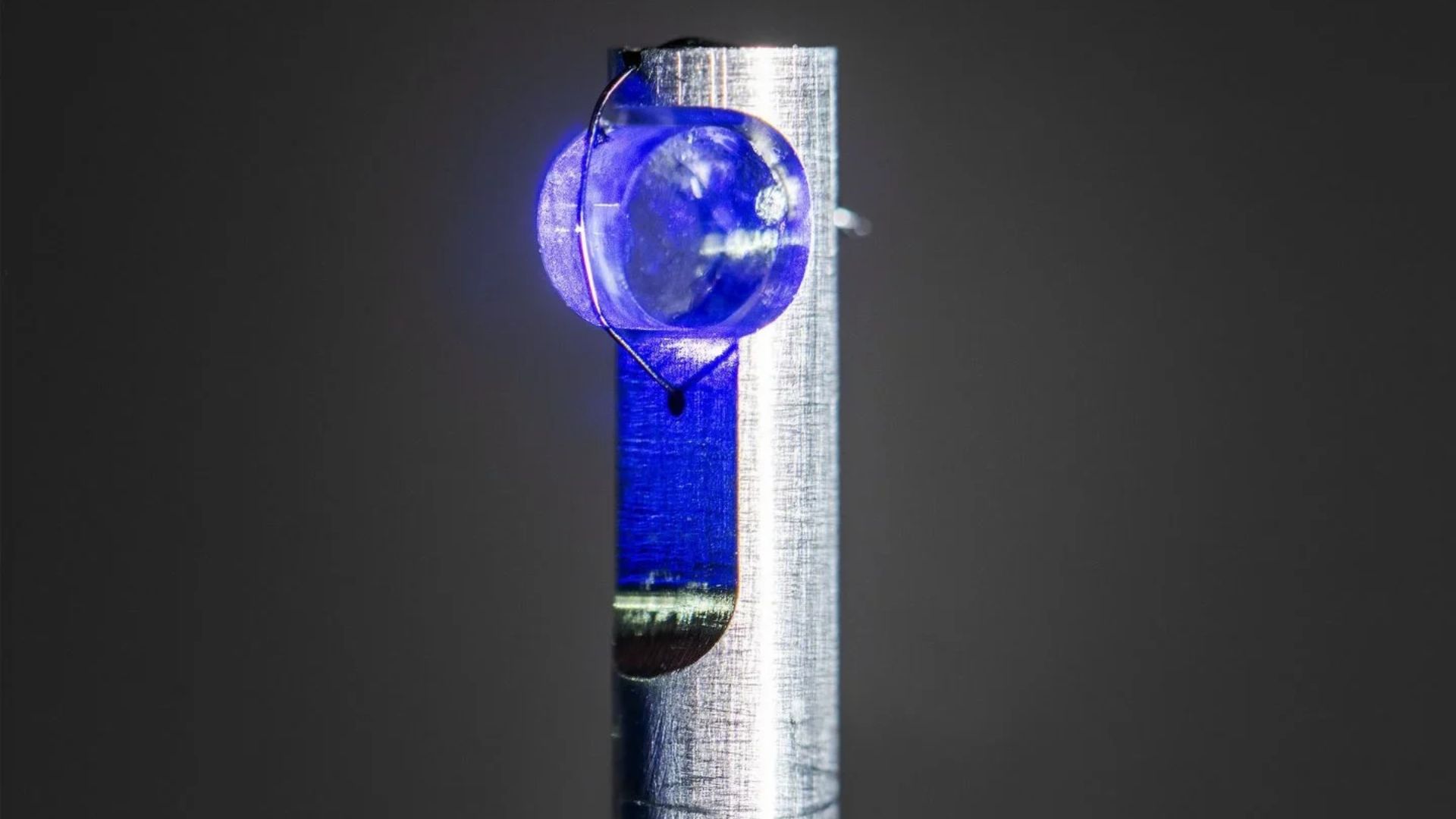
- A first prototype clock has been built on the good site, and the researchers say it could eventually fit into a small chip.
Compiled by The Product DeskSomething wrong?How this is made
Why it matters
- capability Screening that comes from the atom's own electron cloud, plus room-temperature operation in a solid, takes the vacuum chamber off the bill of materials, which is the precondition for a clock that...
- decision With three quarters of the candidate sites unusable, anyone funding this is buying crystal-growth competence rather than laser competence, and that is a different supplier list.
- contradiction A tenfold gain and a thousandfold gain cannot both describe the same comparison, so there is still nothing here that lets an operator benchmark the device against the timing sources it would displace.
- constraint Because no gamma-ray laser exists, the approach is locked to the one isotope that ultraviolet light can reach, and the account offers no alternative if that path proves awkward at scale.
Put thorium-229 into a calcium fluoride lattice at a position where the surrounding electric field is lopsided, and the nuclear transition stops being one frequency. Three of the four positions the Vienna Institute of Technology team probed sent light back at several wavelengths, which is the signature of that uneven field [2], and an uneven field is what pulls the clock's timing off [6]. The remaining site answered on a single wavelength [3], meaning its local environment is symmetric enough to leave the line unsplit. One usable site in four is a 25 percent hit rate [14], and it puts the gate on this device in the furnace rather than the laser bench.
The diagnostic also explains why the calendar reads the way it does. Each frequency point costs six minutes of instrument time, so an hour buys about ten points [13]. Schumm's own comparison of the work to cooking, or to alchemy, with repeated small changes until something comes out right [12], is an honest description of a search run at that rate over more than a decade.
The precision numbers deserve less deference than the crystal does. The account opens with a clock up to ten times better than existing ones [1], then reports that the group expects at least three orders of magnitude of improvement by year end [15]. Those two statements are a factor of 100 apart [16], and neither is tied to a named baseline instrument. What the team says it is actually chasing is not precision but size: getting the clock small enough to be deployed outside the lab as early as possible [15].
That ordering of priorities is the part worth taking seriously. Conventional atomic clocks read electron jumps between energy states and sit underneath satellite navigation and the tracking of financial transactions worldwide [7], but they buy their accuracy with vacuum chambers and shields that occupy substantial lab space [8]. A nuclear transition is already wrapped in the atom's own electron cloud, which screens stray electric and magnetic fields without external hardware, and a doped crystal runs at room temperature [9]. A prototype that could eventually fit on a small chip [17] is therefore not a better lab instrument. It is a clock that can be carried.
The dependency underneath all of it is the isotope. Flipping a neutron generally calls for a gamma-ray laser, and none has been built, which is why the work uses ultraviolet light on thorium-229 instead [10]. The precision case rests on that higher frequency, since larger energy jumps can be interrogated more often and so divide time more finely [11]. The report names no second isotope and no fallback excitation route, so every claim above is a claim about one nuclide in one host crystal.
What to watch
- Whether the single-wavelength site is reproduced in crystals grown by other groups, and at what thorium-229 doping density.
- Whether the year-end precision figure arrives with a named baseline instrument and a published comparison rather than an order-of-magnitude claim.
- How large the prototype actually is now, and what stability it holds once packaged and taken off the optical bench.