Product1 publisher3 min readPublished
Manchester's platinum pressure paint shrinks the heat correction wind tunnel engineers still make
University of Manchester researchers made a pressure-sensitive paint that reacts to heat 25% less than the industry benchmark. Wind tunnel teams testing above Mach 5 still have to correct for temperature, only by a smaller amount.
The Product Desk · Product desk
What happened
- A platinum-based light-emitting compound is anchored in a Teflon-like plastic so its molecules cluster less, the behaviour that raises temperature response in conventional paints.
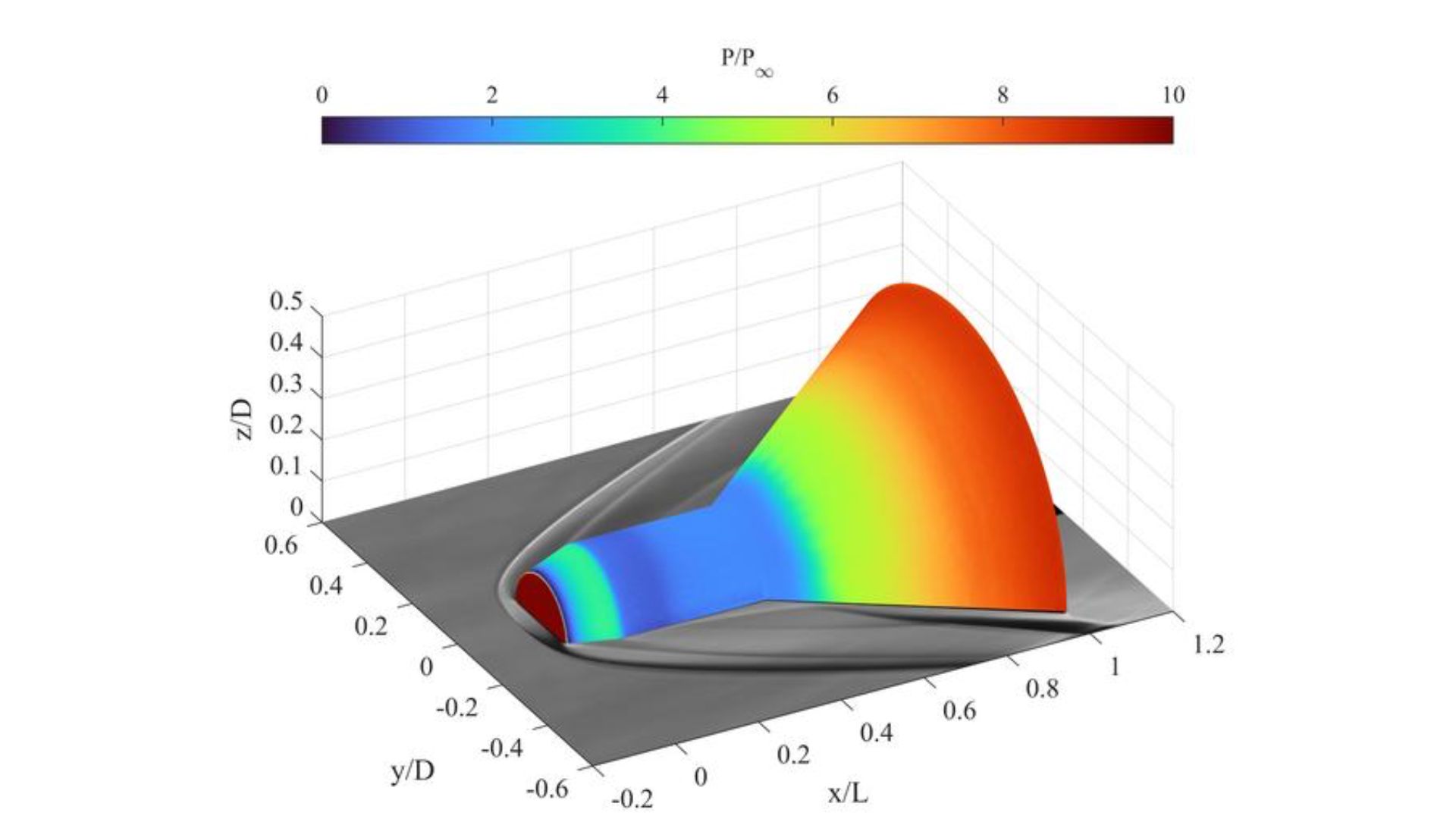
- On a cone model in a supersonic tunnel where air can exceed Mach 5, the paint's pressure readings closely matched computer simulations despite sharp surface temperature changes.
- The coating also picked up Gortler vortices, corkscrew-shaped flows along concave surfaces that show how the thin layer of air next to the model behaves.
Compiled by The Product DeskSomething wrong?How this is made
Why it matters
- constraint A model that warms 10 degrees still moves the new paint's glow by about 3 percent, so temperature correction stays in the processing of any run with a real heat swing.
- contradiction The coverage headline credits a 25% error cut to tests above Mach 5, but the researchers' 25% is a coefficient comparison, and the tunnel result reported is a close match to simulation.
- decision Labs with large surface temperature swings and poor temperature maps have the most to gain from switching, since heat error they cannot correct falls by a quarter.
Partway through a high-speed run, a scale model heats up. The paint on its surface starts glowing differently for reasons unrelated to air pressure [3]. That glow is the measurement: the coating's brightness under light tracks the pressure around it, and engineers turn it into a pressure map of the model [2]. What test teams actually do today is take the heat back out before anyone reads the map [3].
The Manchester coating makes that step smaller. In the paper, published in ACS Applied Engineering Materials [10], the researchers put the paint's temperature sensitivity at about 0.3 percent per degree Celsius [4] and say that is 25 percent below the current industry benchmark [5]. Working backwards, the benchmark is about 0.4 percent per degree [1]. On a 10-degree rise, the new paint's light output drifts by roughly 3 percent and the benchmark's by roughly 4 [2]. A team still corrects for the 3.
Dr. Elliott Nunn of the university's Department of Chemistry, the paper's first author, said: "When you're testing a vehicle at high speed, it can heat and cool dramatically based on its aerodynamic design. By creating a pressure-sensitive paint which doesn't respond as strongly to this heat, we've got something that's much closer to measuring exactly what we want to measure." [11]
"Much closer" is a more modest claim than the coverage makes. Interesting Engineering's headline says the paint "cuts heat-related errors by 25% in tests above Mach 5 speeds" [13]. The article under it reports two separate results. The 25 percent compares temperature coefficients against a benchmark [5]. In the tunnel, the paint went on a cone model in a supersonic tunnel where air can exceed Mach 5, and its pressure readings closely matched computer simulations while surface temperatures changed sharply [7]. The account does not give the size of that temperature swing or of the gap from simulation. So the headline's 25 percent error cut is a calculation from the coefficient, true when both paints see the same temperature swing [2].
The gain comes from where the glowing molecules sit. In conventional paints those molecules can cluster, and clustering raises their response to temperature [6]. The Manchester team anchored a platinum-based compound directly into a durable, Teflon-like plastic, so it clusters less easily and keeps responding to pressure [6]. Dr. Louise Natrajan, a reader in the university's Inorganic Chemistry Group, said of the aerospace engineers: "they knew what the paint needed to do in a wind tunnel, and we knew how to create something that could do it." [12]
A lab deciding whether to switch coatings can settle it with two measurements from its own runs: how far surface temperature moves across a model, and how well the lab already maps that temperature. Large swings with a weak temperature map gain the most, because the heat error the lab cannot correct shrinks by a quarter [2]. Large swings with a good map still mean correcting, but any error in the temperature map now reaches the pressure reading at three-quarters of its old size [3]. Small swings leave little to gain in either case. The published evidence so far comes from a cone model, and the team says it plans tests across a wider range of temperatures and flow conditions [9].
What to watch
- A side-by-side run of the new paint and a benchmark coating on the same model in the same tunnel, which would show the error reduction as a measurement.
- Whether other wind tunnel groups reproduce the 0.3 percent per degree figure on their own models and after repeated high-speed runs.