Science1 publisher3 min readPublished
Thorium-229's clock transition shows up in absorption under a sub-nanowatt continuous laser
Physicists reporting in Nature drove the 8.4-electronvolt nuclear transition in a thorium-doped calcium fluoride crystal and read the resonance as a dip in the transmitted beam, a detection route that works without waiting for the excited nucleus to decay.
The Scientist · Science desk
What happened
- A continuous-wave, narrow-bandwidth solid-state laser excited the thorium-229 nuclear transition using less than a nanowatt of vacuum-ultraviolet power.
- Earlier excitations used pulsed sources: with a high-harmonic frequency comb, around 100,000 modes reached the crystal and only one was resonant with the nucleus.
- Two thorium sites in the calcium fluoride crystal were characterised, one of them with a static electric field gradient below 0.1 volts per square angstrom against about 100 in earlier work.
Compiled by The ScientistSomething wrong?How this is made
Why it matters
- capability A clock can be interrogated as fast as the transmitted power can be measured, so the averaging time no longer depends on how quickly the excited nucleus gives its energy back.
- constraint Photon count was not the constraint on the earlier attempts. The harder limit stays where it was: only a handful of nonlinear materials are transparent and phase-matched at 148 nanometres.
- decision Groups building a 148-nanometre continuous-wave source now weigh the cadmium-vapour route, with roughly 100 times the power, against a solid-state chain that needs one stabilised laser.
- precedent Crystal growth becomes part of clock design: the authors expect high-symmetry thorium sites to give resonance lines that barely move with lattice spacing.
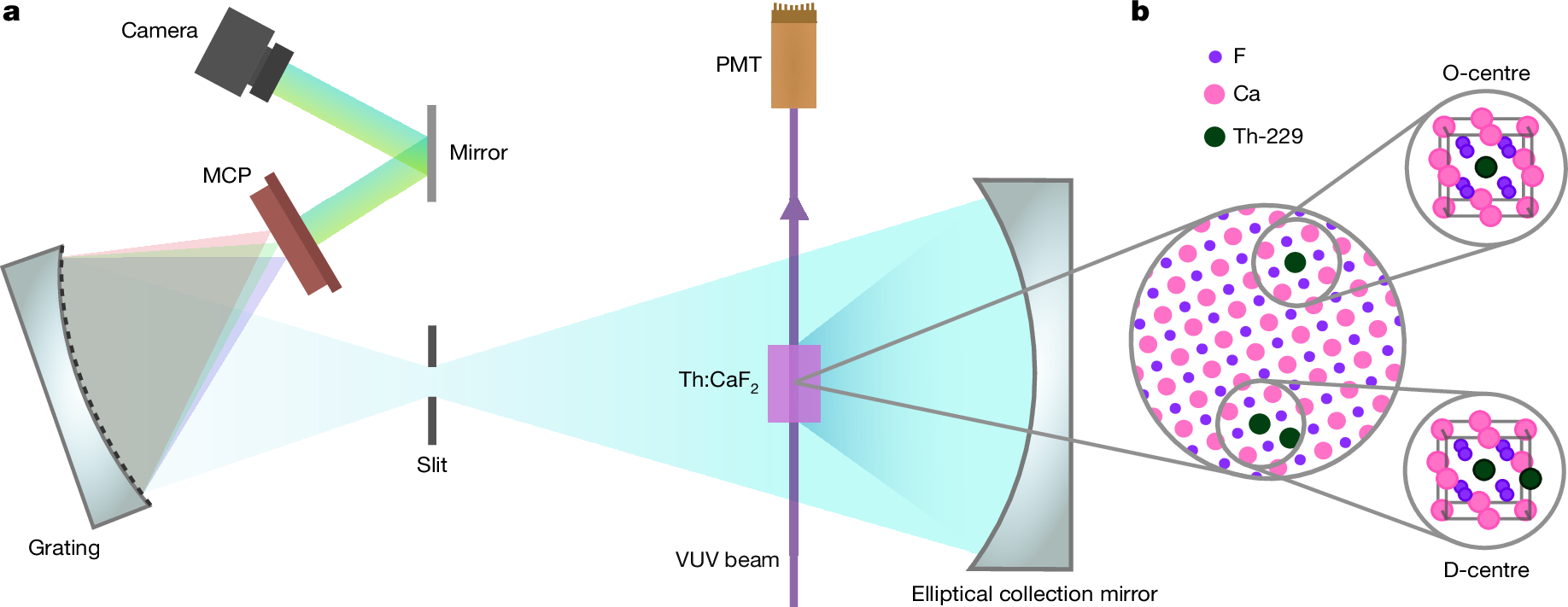
Absorption only works if nearly all the light can be absorbed. In the high-harmonic experiments, a femtosecond frequency comb put on the order of 100,000 modes onto the crystal and a single mode was resonant with the nucleus [7]. About one part in 100,000 of the incident light could interact [2]. The four-wave-mixing sources failed the same test in a different way, with spectral widths several orders of magnitude wider than the nuclear linewidth in the host crystals [8]. So detection went the long way round: block the beam, then count the photons the isomer emits as it decays, with a time constant of about 600 seconds [6].
Six hundred seconds is ten minutes [3], and a measurement that reads that decay has to sit through it. The new readout is the attenuation of the transmitted laser power [18]. "This eliminates the slow nuclear fluorescence decay from the detection process, allowing for clock operation with fast signal acquisition," the authors write in Nature [5][20]. Earlier in the paper they set out the requirement plainly: a solid-state nuclear clock needs a laser whose linewidth is comparable with the crystal-field-broadened nuclear linewidth, plus a fast, sensitive and robust detection method [19].
The light starts as an infrared diode laser at 1,187 nanometres and passes through three consecutive second-harmonic steps [10]. Each step halves the wavelength, so 1,187 becomes 593.5, then 296.9, then 148.4 nanometres [1], which is the thorium resonance [2]. The final doubling stage uses a strontium tetraborate crystal [11], one of the few materials that are transparent in the vacuum ultraviolet and also phase-match there [13]. Power delivered to the nucleus is below a nanowatt [4]. A competing continuous-wave source, four-wave mixing in cadmium vapour, produces about 100 times more vacuum-ultraviolet power [12].
Inside the calcium fluoride host, the group resolved two distinct thorium centres and measured the isomeric shift between them [14]. One centre has a static electric crystal field gradient below 0.1 volts per square angstrom, against gradients around 100 volts per square angstrom in earlier work, more than a thousandfold smaller [15][4]. The authors read that as a high-symmetry arrangement of the ions around the nucleus, and expect nuclear resonance lines nearly independent of the lattice spacing [16]. In a solid, thorium-229 doubles as a test case for laser Mössbauer spectroscopy, sensitive to how the nucleus couples to its surroundings [17].
The paper does not report a measured instability, so it leaves open how well a clock built this way would keep time. It does show both laser-side requirements met in one apparatus: a source narrow enough to put its whole power inside the line [9], and a readout that works without waiting on the isomer [5]. For anyone building the source, the solid-state chain needs frequency stabilisation of only the single laser at 1,187 nanometres, a wavelength that can be linked to other optical clocks [12].
What to watch
- A measured fractional instability from a clock actually run on the absorption signal, which this paper does not report.
- Whether the low-gradient thorium centre in calcium fluoride can be grown reliably, and at what doping density.
- Whether the cadmium-vapour continuous-wave source, with about 100 times more vacuum-ultraviolet power, is turned to absorption spectroscopy too.