Science1 publisher2 min readPublished
TU Wien slides high-harmonic X-rays continuously between the comb's fixed teeth
High-harmonic X-ray sources normally emit only at integer multiples of their driving laser. A TU Wien and UC San Diego method detunes the driver instead, filling in the frequencies between two neighbouring harmonics.
The Scientist · Science desk
What happened
- A team from TU Wien and the University of California San Diego reports in Communications Physics a way to tune high-harmonic X-ray output continuously across the full gap between two neighbouring harmonics.
- A fixed comb of integer harmonics is of little use when the wavelength an experiment needs falls between two teeth, as it does when exciting an atomic resonance that demands one specific frequency.
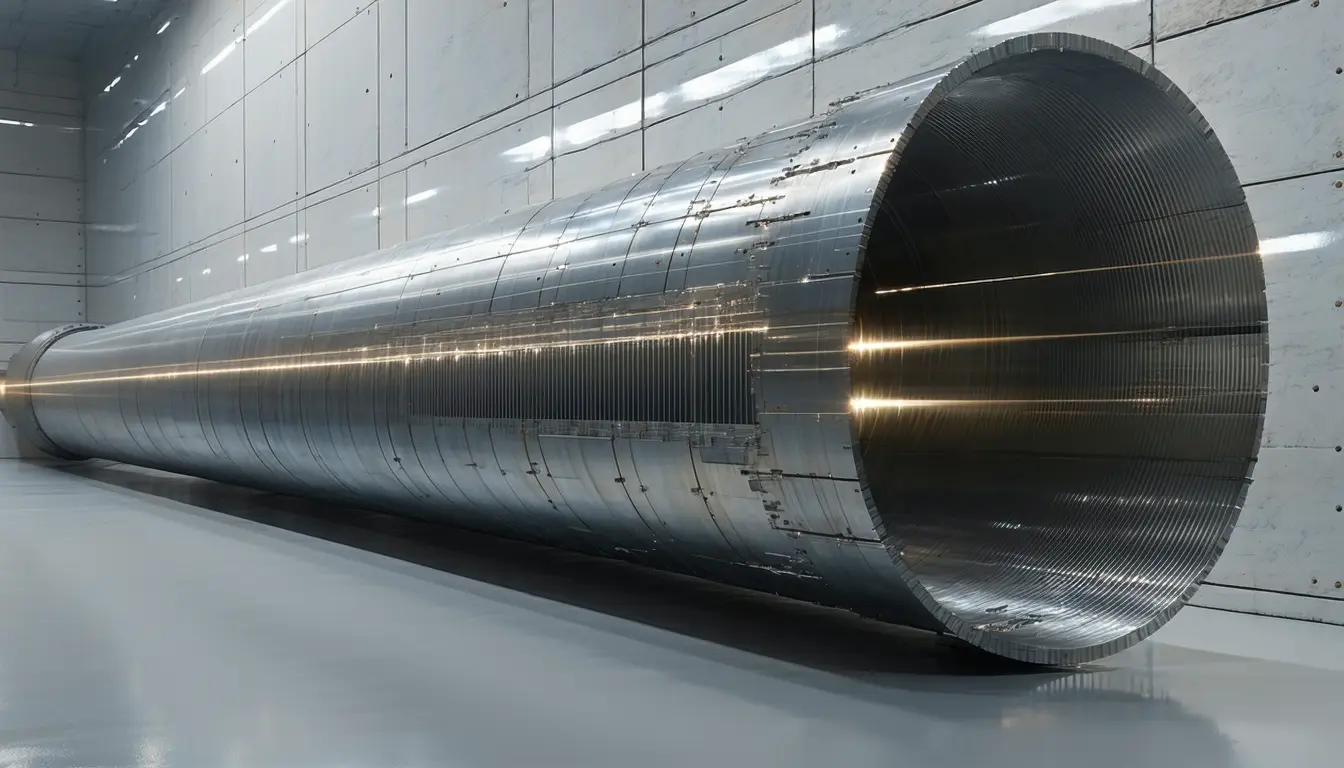
- The adjustment is made in the driving light, whose frequencies are detuned inside a six-metre gas-filled hollow waveguide until exactly the required X-ray frequency comes out.
- A crystal converts the broadened infrared into visible light with a colour range from blue to yellow-green, and that visible beam is what is directed at the helium atoms.
Compiled by The ScientistSomething wrong?How this is made
Why it matters
- capability An experiment that needs one exact photon energy can be designed from the resonance outward. The source can be moved onto it, instead of the measurement being fitted to whichever harmonic lands nearest.
- decision Groups specifying a high-harmonic beamline now have a reason to pay for a conversion stage and drive in the visible: the same choice delivers phase matching and more intense emission per atom.
- constraint The frequency freedom has a hardware requirement. A lab copying this needs room for the waveguide and a driver stable enough that broadening the spectrum does not cost control of the pulse.
The leverage is in the multiplication. High harmonics come out as integer multiples of the laser that drives them [3]. Taking those integer multiples at face value, the gap between neighbouring teeth is one driving frequency. An output sitting at the Nth multiple moves N times as far as its driver does, so crossing a whole gap needs a change of 1/N in the drive frequency: 5 percent at the twentieth multiple [16]. The team went at the laser rather than the X-rays, and a comparatively small shift in laser wavelength is enough to bridge the entire gap to the next harmonic [10].
"For decades, high-harmonic light has behaved a little like a guitar with fixed frets," said Tenio Popmintchev, a professor at the Institute of Photonics at TU Wien [7]. "What we have now built is more like a slide guitar in the X-ray range: We can move continuously between the harmonics, in either direction, and select exactly the energy we need," he said [8].
Producing that shift in a high-power infrared pulse is the difficult part. The ytterbium laser's light acquires its new spectrum from a strong nonlinear interaction with the gas inside the hollow guide [11].
"Spectral broadening, such as the kind we produce in our gas-filled waveguide, would normally mean losing control of the pulse," said Dimitar Popmintchev, the study's first author [15]. He is at the Institute of Photonics at TU Wien.
The conversion step restores that control. Visible light can be controlled accurately enough to oscillate at a pace that fits the emerging X-rays. Only when that phase matching holds do the illuminated atoms jointly produce a brighter beam with a narrower linewidth instead of uncoordinated waves that partly cancel each other [13]. Tuning to an exact energy helps only if the emitted line is narrow enough to sit on the resonance. There is a second gain: under visible driving, each atom's electrons are accelerated and recombine within a shorter interval than with infrared pulses. That is fast enough that quantum diffusion of the electron wave packet has less time to reduce efficiency [14].
The paper does not report photon energies, a tuning range in energy units or a beam flux. The only application it names is exciting an atomic resonance that requires one very specific frequency [17]. For that class of experiment the frequency problem is the one being solved, since the shift now covers the entire gap between two neighbouring teeth [6]. Choosing between a tabletop driver and a storage-ring beamline still turns on photons per second at the energy you picked.
What to watch
- Published photon energies and photons per second at a chosen energy, which would settle whether resonance experiments can run on this instead of a beamline.
- A second group reproducing the gas-guide broadening stage and keeping pulse control through it.
- A published measurement of an atomic resonance excited at a frequency that sits between two harmonics.